
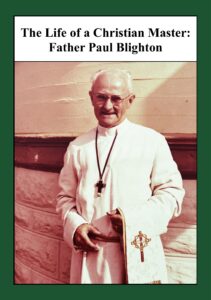
 The Life of a Christian Master: Father Paul Blighton is available at no cost (shipping and handling $15). Use the email address of bookfpmr@gmail.com and donation button to order.
About the author Helen (Mother Ruth) Blighton
This book about Earl W. Blighton (Father Paul) was written by a Christian mystic, who was a spiritual mother to many. A spiritual seeker from a young age, Helen joined in with the work of husband Earl Blighton in the Science of Man, a group Earl began in 1961, dedicated to the “uniting of all faiths” and teaching the harmony of science and religion in reality.
The Science of Man evolved into an initiatory, mystical Christian order, the Holy Order of Mans, in 1968 in San Francisco. This became a vital service and teaching order with centers in many cities across the country and in Europe and Japan. Its international headquarters was on Steiner Street, and the vowed brothers, sisters and priests quickly became known to many for their charity and dynamic brand of Christianity, which transformed many lives. Father Paul and Mother Ruth, as they came to be called by their students, revived the elements lost over time to the Christian religion: the spiritual initiation of Illumination by the Light of Christ and finding of the God-Self, which transforms individuals and awakens them to responsibilities for the advancement of all mankind. The Order recognized all faiths as springing from one Creator, and studied and respected all that taught the Universal Path to enlightenment through prayer, meditation and selfless service. We offered classes on the Bible and Tree of Life free to the public.
Among the many services the Order offered in each city (there was at least one center in every state): street ministry to offer assistance and counseling (no proselytizing), soup kitchens and shelters for men and women (Our women’s shelters, all named “Raphael House”, operated in Portland, San Francisco and St. Louis and both the Portland shelter and the San Francisco shelter continue today), youth hostels in 6 cities, and volunteering by our members in hospitals and other service organizations.
Helen was called in the Order, “Mother Ruth,” for she became a second mother to many of us. Mother Ruth continued to lead the Order after her husband’s passing in 1974, but gradually allowed the leadership to pass to other, younger Teachers.
In the late 1970s Mother quietly reactivated the original organization, the Science of Man, as a way to preserve the vitality and spirit of the original group. She moved to Oregon in the mid-1980s to live among some of her spiritual children, where she continued to function as a spiritual guide to many who came to see her or wrote for help. Her peaceful but powerful presence touched thousands of lives, although unknown to the wider world. Helen wrote this biography of Father Paul while living in Oregon and she gave copies to those who knew and appreciated the power and Light that our Teacher transmitted, all to the glory of God.
Mother Ruth peacefully transitioned from this planet in 2005. We publish this book knowing it will be a blessing to all who read it.
The Life of a Christian Master, Father Paul Blighton
CHAPTER 1
He was born Earl Wilbur Blighton on April 18, 1904, at Brockport, New York. His parents were fine and upright people, but at some time in his childhood years they were divorced. His father (Rant Wilbur Blighton?) then moved to one of the North Central states, probably Benton Harbor, Michigan, and remarried, bringing up several other children. Earl did not see his father again until as a young man he visited them and became acquainted with the family. It appears that two of his half-brothers were named Floyd and Gordon Blighton, one of whom moved to Florida.
In the meantime he was brought up by his mother (maiden name Bessie Strickland) and his English grandmother, to whom he said he would always be grateful because she taught him to wash dishes and press his own clothing, as well as the niceties of how a gentleman behaves. He was a gentleman always. He said they were descended from the house of York in England. Beyond that, little has been told of his childhood years, but we may recall a few incidents gleaned from his occasional reminiscences.
Sometime in his middle teens, his masculine nature felt the need of something more than life at home with two women. As he was working mornings and afternoons, before and after school, he was able to pay a modest sum for room and board – certainly not over $5.00 per week, as that was a good price then for adults. So he announced that he was moving out and took up residence with a nice German couple and their son, who was near his own age. Since Earl was quite mature and dependable for his age, this would not have caused his mother any alarm, and he was still in touch, not far away.
He remembered this family with affection. Sometimes they played checkers or cards of an evening, and occasionally the father would bring up from the cellar a German drink called Kimmel (which he may have brewed himself). In the mornings Earl arose very early to start the fire in a doctor’s office, and to shovel the snow from his walk; after school he clerked in a grocery store.
At some time during that period his mother was remarried to a widower with children, but it is not certain whether this was before or after he moved from the home. Apparently no children were born of this marriage. His mother was a Freemethodist, a sincere Christian, and he always spoke highly of her. He remembered one time in church when she was so moved by the Spirit that she stood with her arm straight up in the air for an hour.
There were certain things generally taught in religion that he could not accept. In particular, he could not believe that God was vindictive in punishing people, or that their misfortunes came from Him. He could not believe in a cruel God, and had very independent ideas which did not fit what he called “churchianity”. He felt indeed that the churches had concealed or repressed much of the Truth Jesus taught.
Earl was serious about the spiritual things of life, but he also enjoyed good times and good friends. He was sprightly even in old age, and something of a romantic. He liked dancing, and began by escorting a stepsister, Stella Bowen. At some point he took fencing lessons, and in later years always enjoyed those motion pictures which depicted swashbuckling heroes, such as Ronald Coleman, in dashing sword play. He liked Westerns too, especially those with John Wayne because, as he said, the stories were simple and uncomplicated, administering justice in a straightforward way, and people were what they were, not pretending to be something else.
He went on to study electrical engineering in Rochester, and at one time did some teaching there. But some time either before or after these studies, he did some secret service work for the government, spending a year in Panama, seeking the son of a prominent person who had seemingly disappeared into the jungle. He said one would never find a record of his work, but that the Navy helped him to escape overboard a ship so that no one could guess he was on a mission. He went alone into the jungle, carrying a machete.
Before going into the jungle, he met a beautiful young Spanish woman (probably while staying with her family). They were quite attracted to each other, but he had to continue on his mission, although they continued to correspond for a time. His spiritual powers must have been functioning even then, because there was a telepathy between them which caused her to write asking him to please stop looking over her shoulder.
Eventually, back in Rochester, he married a young lady whose heart had been given elsewhere, but she accepted Earl under strong pressure from her parents, who felt he had better prospects for supporting her. She was a person of German descent, admirable in character and talents, and though there was not much love between them, she wanted a family, so they eventually had three sons spaced some years apart. The youngest of these went on to become a parish priest, a fact of which Earl was quite proud, although he never saw the boy grow up.
The second son left home during his teens to join the merchant marines, and returned in later years to spend some time with his father. He was in the Order for a year or two. Earl’s eldest son, upon returning from the armed services, married, settled down and had a family. He went into some kind of business. Only the second son became reconciled with their father’s work in later years, and he was heartily supportive. He was also the only son to leave New York State and eventually settle in California.
Earl knew from quite a young age that he had a mission to perform, though it never unraveled all at once. To quote his own words: “I’ve talked about letting go and letting God all my life, since I’ve been about fifteen years old.” The Master plan was there and he knew some of it, but was shown only as much as he needed to know at any one time.
During his young married years, his old teacher Ananias had returned to teach him – not in the flesh, but from above. He spent seven rigorous years under this teacher, a harder discipline, he said, than anything he ever required of his own students in later years. He related two incidents. One was told by him during a taped class talk, and concerns a time when his teacher appeared to find him with a severe cold. Ananias sternly admonished him, saying that he was going away for a period of seven minutes, and if Earl had not cured himself of the cold before he returned, he would never see his teacher again. In this desperate situation, Earl got rid of the cold in a hurry, and it was gone when his teacher came back.
The other story concerns a summer weekend. He had promised to take his family to the park for a Saturday afternoon picnic. But before the time came, his teacher appeared from the other side to tell him that he must take a train on that Saturday to another city where he would meet a certain stranger in the railroad station. He was to tell no one of this plan. So he had to permit his family to think badly of him for breaking his date with them, while he went off in obedience to his teacher to keep the appointment in Cleveland (or was it Buffalo?) not knowing whom he should meet. Once there, he sat on a bench and a man came up and sat beside him, and proceeded to tell him what his mission was to be, while explaining certain things relating to his spiritual work.
He was alone in this work, although he knew and worked with many people. Such things cannot be told. It is not surprising that there was a growing estrangement in the marriage, with a husband so difficult to understand, so totally dedicated in directions other than family life, although he worked responsibly at being a good father too. He admired his wife, especially her way with the children and her ideas of firm discipline. She was a Roman Catholic, and the children were raised in that faith. Earl never became a Catholic, but studied privately with a Roman priest for two years.
During his early married years, he worked for the Kodak company, and became much interested in light therapy, as had certain others around that time. He began to work with a doctor using colored light on patients who were not being helped by regular medical treatment. He developed an ingenious machine for this, using his electrical engineering talents. There was a good ratio of success, with arthritic patients in particular. But the AMA became jealous and sent in a spy, posing as a patient, who willingly perjured herself to get him arrested. He then gathered dozens of affidavits, signed by those who had been helped by his treatment; but the judge was obviously biased, appearing from the court transcript to have been wholly unfriendly, and the case went against him. Since he could not raise the necessary bail and since, like Jesus in his hour of trial, he was practically deserted by friends, he had to spend a short time in jail. Understandably, he did not retain a good impression of the AMA. But he had fought a battle for the healing work, for a method which was wholesome and harmless, and helped many people.
Let us quote his son Jerry concerning this period, condensing some of the statements: “He had a machine he called the ultra theory ray machine that he used to heal people. The theory of the machine was based on light coming from the sun and the colors of the total spectrum. He was using that when I was real young. A lot of it centered around ultra violet rays. He had these lenses – he would take a round piece of glass and an equally large one – looked like cellophane or something which had a color which sat against it, and then he’d put another piece of glass against that so that the round colored paper was in the center and black tape was used to put around the outside to hold it; and it had a high stand.
“There was a cylindrical piece of metal which moved up and down which was built so that it held this glass, and it was hooked up, and he would put various shades of colors on various parts of the body for certain lengths of times. But then he would use another color and another, and it was important in what sequence he used the colors and the length of time he used each one, according to the parts of the body or what the problem was.
“I remember a young boy whose body was shaped like somebody sitting in a chair, so that his knees were up – his arms didn’t lay by his side but looked like he was resting them on the arms of a chair, and he was always carried in and out of the house by the mother and father. And no one had been able to help the boy. He couldn’t move his body at all. But I remember just towards the end, before I left home, that he was standing up and walking.
“Later on, my father opened up an office. He had been arrested for practicing medicine without a license. Finally they conceded that if he could give them a name which they could accept, they would give him a license and allow him to practice. He called it the ‘ultra theory ray machine’, and they said this wasn’t acceptable. He came up with four or five other names and they wouldn’t allow him to put it on the patent. They said, ‘No dice – there’s no such thing.’
“My father wasn’t one to make any concession – he never tried to say in court or out that he had something which was better than something else, he never once advertised it or put up a sign telling people to come; he more or less just did what he knew he could do quietly. And again here’s an instance of a man who knew that he could heal and he used the machine because many people would not relate to the placing of hands and dealing with Christ directly, so he used some thing which Christ obviously moves through, which was light, without using the words or phrases and so on, but something that they could deal with. They could see the light, they could feel it on their body and when it began to feel better they believed that it was the light solely, as opposed to the Christ force moving through that light. Which is fine – whatever works is what you should do, as Father used to say.
“A good instance of healing took place in my life when I was two or three months old. I had boils inside of my stomach as big as half dollars and the doctors didn’t know what caused it, and they had me in a hospital in a room just waiting for me to die. They said I wouldn’t live another day or two. I’d lost half my weight and the boils were growing, cutting off the circulation. My father brought in another man who may have been a minister or something, and said: ‘Now, we don’t want to be disturbed. We may be here a day or two days, and I want my son left alone and I don’t want the door opened until I come outside.’ I guess they stayed inside the hospital room for two days or so. When they came out, the doctors came in to take a look, and the swelling had gone down, the boils had almost gone away, and I was close to sitting up.
“My father was into herbs a lot, and he worked with other type doctors who were into herbs and natural-type healing. I was surprised that I didn’t see more of that when I came into the Order, and I think I must have mentioned that once, and Father kind of laughed and said, ‘These people here have all they can handle right now, without bringing in herbs or medicines, and so forth.’ He said, ‘When they’re ready for something like that, I’m sure they’ll know and it will manifest itself.’
“From the time I was ten till fourteen, when I left home, there were people coming almost every night for healing. Some came once or twice a week and many were coming for the first time. I think the charge was minimal for many people, and some that didn’t have it I don’t think he charged. When he opened an office there always seemed to be somebody waiting to get in. I heard a lot of people saying how much they were helped. When he brought his healing work out of his home into a professional office, then the law moved on him and he had many confrontations.
“He went about life quietly and he never interfered with anyone else’s life. He always had direction – everything always had a purpose. He didn’t do something because it was Sunday, or because there was nothing else to do. Everything had a reason. He seemed to make more demands on himself than other people. It’s almost like he tried to carry everyone’s cross.
“He did a lot of engineering and blue-print work – always had a good job and made good money. And he worked for Hawkeye, which was owned by Eastman Kodak. Whenever they would scheme to do something on the job which was dishonest or wasn’t fair to the customer, he just wouldn’t do it. And when they called him down and said either you do it or you don’t work here, off he’d walk. He just didn’t give in. He didn’t need to be embraced by everyone. He didn’t need his ego stroked.
“He used to go to the Rosicrucian Fellowship on Sunday, and he was involved in that type of thing. But he never tried to proselytize the family. There was a confidence he had in creation, a confidence in mankind. Even though he was unhappy with a lot of the things he saw in society, he was never fatalistic. He’d always say, ‘Well, in time man will grow and he’ll learn.’ He never got into real esoteric teachings, but I think the kind of strength he showed in his life manifested the truth of what he was taught and was teaching.
“He loved to walk and hike outdoors and we lived about twenty blocks away from a woods.” This ends Jerry’s story of early memories of his father. Father himself spoke of taking morning walks with his dog trotting along by his side. After the dog had died, he was surprised to sometimes hear the soft padding of feet beside him on the path, the dog still present, although on another plane.
In regard to his healing work, it is possible that spiritual power had as much to do with the healings as the scientific equipment he was using. Many of the cases were documented, but it was not always possible to get the follow-up information as to the outcome. He seems to have been spiritually oriented all his life, but with independent inquiry and not always understood by relatives. Yet when any one of them was ill, or if there was a death in the family, he was the first one to be called on for help and support. They sensed his spiritual contact and trusted it instinctively, although they could not rationally understand or accept it.
As a young man he visited his father and family in the midwest. His father was a strong-minded person. He became displeased with the electric utility company for some unfairness, and had his own generator installed to furnish electricity for his home. He then removed, or asked the utility company to remove, from his premises all that belonged to them. He thereafter refused to pay any electric bills, which they continued to send although he was no longer using their electricity. They took him to court, where I believe he acted as his own lawyer. At any rate he told them that he had the right to power his own property as he saw fit, and won the case.
The depression of the thirties occurred during Earl’s early married life. Times were hard for everyone and jobs scarce. He did whatever he could find at that time to feed his family. One of the things he undertook was the serving of summons. I believe he also worked for a time as a park gardener. He got by better than most in those agonizing times, and his family never went hungry. He also mentioned having a garden, and raising tomatoes. After that time, he always held good jobs as an electrical engineer and similar work, did design engineering for Eastman Kodak, and worked on many other projects during his lifetime. He also taught postgraduate mathematics, shop mathematics and mechanical drawing at Monroe Highschool from 1938 to 1940.
He once told of an acquaintance of his who passed on, leaving a widow. One night in a dream, Earl vividly saw this man, who spoke to him giving clear instructions to visit his widow and tell her to look in a certain place in the kitchen where she would find in a book some legal papers which would be of much help in straightening out her affairs, which were presenting serious problems. He went and visited her, whereupon she looked and found the papers exactly as told in the dream, and they were just what had been needed to solve her dilemma.
[As an afternote, after Rev. Blighton passed on, I remembered this story and wondered if it might provide a clue to his own wishes for the Order. Some directives could have been of much help; so I shook out every book in his library, but found no such paper.]
His educational qualifications, as given on a job resume, were:
- Graduate, Rochester Institute of Technology – four years, Electrical Engineering
- University of Rochester postgraduate – two years, Optics (physical)
- University of Rochester Extension – one year, Industrial x-ray
- I.C.S. – one year, Architectural Drafting
- State Planning Commission – Civic planning
- New York State University – Teachers Training
- NewYork State Adult Education – Public Speaking
CHAPTER 2
Earl’s three sons were all born in Rochester: Earl F., born June 18, 1932 (later in the Marine Corps); Gerald, born October 17, 1933 (later of the Merchant Marine, and perhaps the Navy also); and Francis, later a Roman Catholic parish priest, born January 30, 1943.
Personal relations were suffering, to the point where Mrs. Blighton would pass her husband on the stairs without speaking, and the time came when the strain in their marriage was affecting her health. The doctor eventually told Earl it was important for her well-being that he should live elsewhere. It cannot have been easy for him to leave, although others probably thought he left for his own selfish reasons; but he did move from the home on Linden Street, and said he did not see the baby Francis after he was one year old.
Until that time he had been doing healing work upstairs in his home, but now he opened an office on (Wenlow?) Street. Jerry said he had had no trouble from the law before that time but now they would not leave him any peace. According to the records he was employed in Rochester until 1947, and then in Lincoln, New York, until 1949, the last recorded date for New York State.
He never discussed this period; but there was a divorce, probably much later, and he eventually came to San Jose, California, supposedly late in 1949 (?), where he first stayed in the Montgomery Hotel. The only mention of this trip west was the comment that although he shipped his books ahead, they were lost in transit and never arrived. It seems now that he had to leave behind his physical family to go forth and prepare the way for establishing a spiritual family, which numbered in the hundreds by the time of his passing.
While still living with his family in Rochester, there was a letter, dated July 30, 1942, from the Rosicrucian order in San Jose, accepting him as a probationer. He continued as a member through the years, and it was probably for this reason that San Jose was chosen as his first destination in California, because the Rosicrucian headquarters was located there. He continued to attend their meetings in San Jose, and even taught classes there for a time. It seems, though, that he had some advanced ideas which they did not sanction and eventually he left them, while continuing to teach a few of those who liked his approach. In later years he would occasionally take a carload of students to visit the Rosicrucian Egyptian museum, for an interesting educational experience. San Jose, when he lived there, was a smaller town, more homey before its sprawling industrial growth. There were nice little houses with yards; while out in the countryside were many acres of prune and apricot orchards, which made for a pretty setting.
His job resume lists companies which employed him but does not date the jobs held before 1958. From 1958, these were in San Francisco, except for one in San Jose in 1960, then back to San Francisco, and again in San Jose, Mountain View, and in 1963, Palo Alto.
In early 1961 he was living and working in San Francisco. The “first official meeting” of the group which was to form the Science of Man, “a non-sectarian new age fraternity”, took place at 1315 Polk Street, in San Francisco, (no doubt his apartment), on March 2, 1961, at 8 p.m. He was later to say that there were originally fourteen people, mostly professionals, who gathered together to form this group, and they had immensely interesting meetings, talking until two or three in the morning. Everyone enjoyed the planning sessions, but as soon as the time came to start putting their ideas into action and they discovered there would be work for them to do, as he said, “they all headed for the high timber.”
I think he liked the idea of a fraternity or lodge, along the lines of the Rosicrucian order. He was ordained in the Brotherhood of Man church on July 6, 1960, in San Francisco. And he first thought of calling the Science of Man “Life Science”. But on October 10, 1961 the charter was filed for the Science of Man, and it was sealed on October 25 of that year.
In late 1961 he returned to a job in San Jose, and had an address of 161 W. Santa Clara Street. He was still in San Jose in 1963, but now at 748 Illinois Street, where a Science of Man board meeting was held on April 29, 1963. The first service for the newly-opened Science of Man church was set for May 19, 1963. It is not certain how long this endured, but the church burned down, and meanwhile someone he had trusted made off with all his furniture. So he left San Jose, although he liked to visit there from time to time.
This was a low point for him, and he sought seclusion on retreat for a couple of months with a fairly new group called Christian Yoga, which was headed by Subrimunya. Their retreat center was located near a small town in Nevada where the stagecoach used to pass through in Gold Rush days. No doubt this time spent in a spiritual atmosphere helped to heal some of the bruises, as he worked along with the Brothers and helped them with some building. He later spoke highly of Mother Christi and of Father Hilarion who then resided there. [In the summer of 1966 this Christian Yoga group donated 36 of their Christian hymnals to the Science of Man church.]
There was a brief period when Earl did some sort of therapy work in Oakland, but I do not think he actually lived there. An undated business card has survived from that era, and it announces: “the newest in light radiation therapy, CHLOR-O and HISTO-O-RAY with proven results in arthritis, sinus, asthma, high blood pressure. Not a heat treatment. Doctor in attendance. Physiotherapist, E. W. Blighton. 480-34th Street, Oakland, Calif. All forms of medical manipulation.” During all these years he both studied and worked with various religious organizations in and around San Francisco, while continuing to maintain contact with a few students in the Sunnyvale and San Jose areas.
He worked meanwhile at electrical engineering jobs, living modestly and saving his money until there was enough to take leave, intermittently, and devote himself full-time to religious or charitable work, along with spiritual study and discipline. One particular instance of this was the time he was able to take a whole year off, whereupon he rented an inexpensive suite in a small Polk Street hotel (when it was quite a respectable area), and spent that year working with parolees from prison. His doors were left unlocked at all times so they could come and go, and he counseled with them at all hours, even being awakened in the night. He helped them to find jobs and otherwise get back on their feet, and nothing was ever stolen from him, although one dangerously distraught individual gave him a bad moment on one occasion.
Around 1964 another vital period of his life was spent on Sacramento Street somewhere between the 2500 and 3500 blocks, where he occupied an apartment on the second floor of an old Victorian-style house. It was there, while he was doing intensive spiritual work and meditation, that he received a confirmation and profound revelation of the sort of work he was expected to do as a teacher. This could have been in May 64, or January 1965, as he recorded some revelations at both times. The symbols which were to be used (the circle, triangle and square) were seemingly shown to him in 1961.
Oddly enough, during the twenty or so years in San Francisco before we met, our footsteps must have frequently crossed, as my changing jobs were often a few blocks from his changing residences. We had both come to California at somewhere near the same time; but though I occasionally attended metaphysical classes and lectures, I never heard his name mentioned.
CHAPTER 3
The first time I saw Rev. Blighton was in August of 1965, and it was not a direct encounter. He had placed an advertisement on the church page of the Saturday newspaper – I believe it was the only time he ever did so. My eye was caught by the announcement that a talk would be given at 334 Mason Street at 11 a.m. by “a well-known artist” named Dinesen as guest speaker. It was to be about art or fairy tales (I don’t recall which) as they related to religion, and sounded quite interesting. The place was a small art gallery, the walls of which were lined with pictures. It seemed that Rev. Blighton was the usual pastor of a group who rented the gallery for Sunday services or lectures, and classes held on Tuesday and Thursday evenings (a pattern he always followed.) At this particular time the Thursday class was devoted to poetry readings which were discontinued later when the gallery closed.
There was a fairly large crowd in attendance that Sunday. They were a nice sort of people, neatly dressed, mostly between the ages of 30 and 50, many of them professionals or office workers, the sort who seemed at that time most drawn to metaphysical teachings.
I arrived just before it began and was thus seated with the overflow crowd in chairs set along one side wall, at right angles to the main congregation. From this position Rev. Blighton sat almost concealed on the other side of the podium. Dressed in an ordinary business suit, he briefly introduced the speaker and sat down, very inconspicuously. There was no religious service, just the lecture. When the talk was over, he again stood and mentioned the evening classes, also inviting anyone who cared to come upstairs after the services to join the group on the balcony or mezzanine where there was a small coffee shop
Then he said something totally out of context, unrelated to anything which had gone before. He said, “I’m sure there is someone here who could tell us something about a mirror.” This astounded me. Though he was facing straight ahead and had not even looked to the side of the room where I sat, I felt he was reading my mind and referring to me directly. For I had been going through many spiritually-related experiences, and that very week there had come an insight into something relating to a mirror, which seemed at the time quite profound, though it is not now exactly remembered.
How could he know that? I had never seen him nor even heard his name before. I did not stay for coffee, but hurried home. Being a “working mother” every minute at home was precious. When I went on Sundays to services it was for vitally-needed spiritual nourishment, but there was no time for social contacts.
I pondered his curious statement for about a month, then seeing no further notices on the newspaper’s church page, I finally phoned to see if the meetings were still being held. He told me the landlord had lost his lease and gone to Europe, so he was now holding meetings in his studio apartment on Geary Street, near Polk. Then another curious thing happened. He said, “You know I’m a master teacher.” At this, I mentally scoffed. A true master teacher, I thought, would not say so over the telephone to a stranger. In fact, did not those we read about keep their would-be students waiting outside in the cold, or refuse them altogether, sometimes for many years, until they were ready for acceptance? I didn’t suppose there were any true spiritual teachers outside India, and had never expected to meet one, desirable though it might be. However, his earlier remark had made me so curious that I asked if he ever gave consultations, and an appointment was made for a Saturday morning.
I was full of questions that had been building up for a long time about my inner experiences, and had consulted a wonderful old swami of the Vedanta Society, Ashokananda, a saintly speaker to whom I sometimes listened spellbound on Sundays. But he had no personal advice for me, although the visit was rewarding. One or two others had also been approached for spiritual direction, but there had been no one who could tell me anything; so I went to see Rev. Blighton.
Orne Grant was there, moving about, and doing something in the kitchenette, and occasionally the Reverend would ask for his comment. I didn’t realize then but found out afterward that Orne was being tested too, as he was then an intensive student to whom Rev. Blighton was devoting most of his time and energies, apart from his daytime engineering job. Orne was in his 30’s, also a working person, married and living with his attractive wife and small son. I later learned that on losing his meeting place at the art gallery, Rev. Blighton deliberately dropped all his former congregation to devote time to Orne, who was deeply dedicated and striving with all his might on the spiritual path. His initials were O. K. Grant, and I’ve wondered if this was a symbolic signal to Rev. Blighton that he finally had an “OK” to go forward with the work.
Instead of my asking him questions, he began asking me if I had experienced this or that, and seemed to understand all about it. He also spoke of certain things he could bring about spiritually. Although the usual custom is to pay for such consultations, this time I somehow felt not to give anything (it seemed on a level above that), but instead on the way home spent something on a different sort of gesture to the Lord.
Inevitably I began to attend services, which were now held at his small studio apartment at 760 Geary Street. Only a few faithful were attending during those first weeks, though the numbers began to grow. On the first Sunday only three or four others came. He was sitting near me while we waited, and at one point looked at me and quoted: “Ten thousand shall fall on thy right side, and ten thousand on thy left, but not a hair of thy head shall be touched.” He waited until past eleven o’clock for late comers, then looked at his watch and remarked, “We always wait thirteen minutes.” By this time all his remarks were becoming fraught with esoteric meaning for me. The words had a way of engraving themselves on one’s memory.
That Sunday I did something that a reserved and self-conscious nature would never have dreamed of permitting before – I went forward to be blessed, at his invitation to no one in particular, near the close of the service. He had set up a small sanctuary there, and I knelt face-to-face with a large white chrysanthemum in a vase on the floor by his feet, and this seemed symbolic of the Christ. As he put his hand on my head, a tremor of the Holy Spirit ran through him, and I could feel it through his hands. In the years of hearing about God, for the first time in my experience appeared a man who seemed to have an inside track with Him. Nothing he did was put on for show. Rather, he pared everything down to its bare essence, and it was REAL. He was real.
Though time was at a premium, nothing could have kept me from those services and classes. It was the closest contact with God one could hope to find on earth. Nor was he reaching into peoples’ purses. One of the first things that impressed me was that there was no passing of a collection plate, that mundane (if necessary) let-down which accompanies most church services. Instead there was a small basket placed near the door, but it was never mentioned, and the donations ran from a quarter to a dollar, or nothing, if one chose.
There was an elderly lady, Verda Mayes, who was quite regular, and a younger married woman named Helen Stagner, and Orne with his wife – the latter coming mainly out of loyalty to her husband. She was basically Roman Catholic, and never became greatly interested, but did give a hand on occasion with typing. Others came and went. One fairly regular attendant was Dr. Riffle, the chiropractor. He seemed to have some special sort of spiritual understanding, but it was not put into words, it showed more in his overt actions.
One of those evenings after class, before I knew him very well, I was waiting at the bus stop on the corner to catch the bus home when Rev. Blighton suddenly appeared there. This surprised me, as he usually kept a group of people talking sociably after I left. He got on the bus and sat beside me. I was a bit shy about saying anything to the great man, and the only words I remember his speaking was when we passed the revolving orange ball of a “Union 76” gas station. He said, “I can’t go with you that way.” I didn’t ask what he meant, but pondered it, and have wondered since his passing if it referred to the fact that he would not be here in 1976 – as he passed from the earth in 1974.
It was a short ride. My home in the avenues was only about a ten-minute ride, in off hours, and he went only half as far, getting off after a few blocks at a rather newly-established spiritualist church called “Fire of the Holy Spirit”. I suspect his visit was more symbolic than otherwise. He always worked with symbols. (It was not much of a church and soon closed.)
At one of our first classes, Rev. Blighton had three of the students form a circle around me. Orne was afraid to participate in the exercise because he didn’t know what the teacher was up to. I didn’t know either, but I trusted him completely, and it made me feel rather special. But there were a few times when, like Orne, I also felt a bit afraid of the unknown, not knowing what was really being done in the unseen realm.
Once during these early days I was at home in the evening before dark, when my little daughter and her girl friend came running into the house, and they said the air outside was a thick yellow. I looked and it was true – somehow reminiscent of sulphur. At the next class night, Rev. Blighton said that at that very hour he had been working in his apartment with one of his male students, Martin Anderson (?), when they were visited by some “little men” out of the earth, and both persons noted a strong odor of sulphur along with the appearance (probably a psychic manifestation). The student became frightened and never returned.
There was something Biblical about his very apartment. Although it was located on the second floor above the street entrance, a glass door at the rear opened out directly onto the earth, a tiny pocket of space that was not used, but in the city seemed special. It suggested a tiny Garden of Eden. His one room held a fold-up bed that disappeared into the wall by day, standing on end. Behind this was a little closet space which was turned into a miniature office by the presence of a typewriter, and I think some folding chairs were stored there. Besides this there was a small kitchenette and bath. His furnishings were simple, but pleasant.
He nearly always taught classes with the use of a large chart or a blackboard, on which could be demonstrated the symbols that related to his subject matter, and also provided a point of focus. He was lively and interesting, fairly sparkling with the life that was in him, and this naturally helped to attract people to his classes. He was also profoundly and mysteriously wise, and that is what attracted me. His actual words were not always easily understood, but something flowed through them which opened up one’s spiritual understanding, and those were magical and wonderful days, literally “out of this world”.
At one of our evening classes he tried something different, and asked each of us to place in a basket some small item we had been using or wearing close to our person, such as a hairpin or watch or earring. Then he redistributed these things so each of us held something not our own, but were not told to whom it belonged. Then we were told to hold it between our two hands and meditate for a moment to see what impressions came through. After that, each of us in turn was asked to give out what had been received from within, still not knowing for whom it was intended. This was an exercise in psychometry and quite interesting – even quite successful, considering that we had never done that before. He told us that upon receiving a letter in the mail, he would not open it immediately, but first hold it in his hands to get an impression of what the person was really going through, and it was more helpful in counseling them than the actual words they had written.
At one time while he was working intensively with me on the spiritual level, he asked if I could take three days off from my job and spend those days alone in his apartment, being free to do just whatever came to mind. I was able to take three days of accumulated vacation leave with pay, and was glad to have this quiet time. He said I could come as early in the morning as I wished; but so as not to embarrass him I arrived just a few minutes before he was due to leave for work, and left again before he returned in late afternoon, in order to prepare dinner for my family.
It was an interesting three days, a “great adventure” on the spiritual level, as any association with him always was, especially when he was working with one specifically. No doubt there was a two-fold purpose in this arrangement. One, that in his own charged apartment – and it was charged, loaded all day long – he could pour out upon me in more concentrated measure the power of spirit, while he was working in his office. (He had said his intuitive powers plus his long experience at the job helped him to get the answers so quickly that some of his co-workers would request that he slow down so they would not look bad. So this spiritual work did not detract from his function on the job.) Then too, for me to be there helped me to keep in contact with him every minute, without the mind wandering as it would have elsewhere. I did a little typing and a little cleaning and laundry, but did not press too hard. Perhaps I should have prepared his dinner also, but had no idea what he liked; and it was for the spiritual work he had asked me to stay
.A second reason for his request may have been to allow me the opportunity to do something in return for the great gift he was giving me, which was beyond earthly measure. And, he may have been testing me at the same time, to see how I would respond or handle the time during three days of unrestricted freedom.
I felt a great reverence for his Bible, an inexpensive Revised Standard version with a red cover which had been given to him by some students. (He was later given other Bibles; I never knew him to buy one for himself.) Once I had seen a student during class casually pick up his red Bible as though it was just any book, and handle it in such a careless manner that I was appalled, as though it were being profaned. While there alone in his apartment, I came round to dusting the table on which the Bible lay. Although feeling perhaps I ought not, my hand strayed toward it just to touch the holy thing, and I was literally thrown back on my heels by a powerful invisible force.
Another odd experience, which may have been just a mechanical quirk, occurred when I found myself inexplicably locked in the bathroom and could not open the door, although it was not locked. But eventually it did open, and my fear of being found in there when he returned was laid at rest. The only other thing of note was just in my own mind, when taking the laundry to the basement. The room was strongly reminiscent of the tomb where Jesus was laid, carved in rock. And there was even a “white cloth lying apart”. Nothing miraculous, but very suggestive.
Altogether the experience was like dropping out of the world for a few days, but I know that more happened on the inner level than I was aware of, or could consciously guess.
After hearing him preach and teach, and having accepted him as my Teacher, I felt in a lesser way much as Jesus’ early disciples must have felt about him. And it seemed important to bring other people to hear and accept him, for if anyone now on earth held the keys to salvation, surely it must be he.
I once persuaded a former associate to come, an elderly clairvoyant and vegetarian who was on the spiritual path, but in a different way. Rev. Blighton said to him, “I can save you another round.” He meant incarnation, of course, although the subject was not pursued. One night when this same visitor was there, the Teacher presented me with my first official cross. (It was the wooden Catholic type of cross, with the corpus removed, such as we have since used for the Brotherhood.) He wore one just like it, and had at one time asked me to sew on a new ribbon for his, using an “awl” for a needle. I was deeply moved at receiving my first cross, but not at the way it was given; because he sort of threw it over my head like a halter, and said, “When I tie the knot, they are hitched!” So much for the sacred moment; but he was speaking for the benefit of someone else and doing something beyond what outwardly appeared.
Another time he showed us how to make the sign of the cross – in the way later adopted by the order – and he said that if you don’t want someone to work against you, make that sign for protection and they cannot harm you.
My daughter’s thirteenth birthday occurred on Thanksgiving day that year, and the day was also memorable in that Rev. Blighton visited our home for the first time. He had been my teacher now for two months. When inviting him for the occasion, I said if he wished to bring along anyone else from the congregation, to feel free to do so. He answered that he thought they all had families of their own, but he might bring a friend named Joanna, who played the guitar. I never met Joanna. Her name is mentioned in an earlier roster of the Science of Man; but she did not come and seems to have dropped out of the picture around that time.
Several other people were also invited to dinner, with the idea of exposing as many as possible to his teachings, and to this spiritual contact with him personally. Not only were all ages represented, but a sampling of other races and religions as well. There were about a dozen in all for dinner, including my children.
The day began beautifully, with a perfect rainbow appearing in the forenoon. I called my daughter to the back porch to view it, as it seemed so symbolic for her birthday. We lived in a three-bedroom flat, very modest, but it had a small dining room. There was no table large enough for so many, so we pushed two tables together and borrowed a large tablecloth. (As a result, that Christmas my sons chipped in together and bought me a long tablecloth of fine damask linen, but there was not to be another such occasion to use it before we gave up our home.)
The adjusted table extended almost to the kitchen door, so I placed Rev. Blighton at the far end, directly beneath a Pujot painting of Jesus. At the opposite end, where it was necessary that I sit to be near the kitchen, I carefully arranged two plates to avoid sitting directly opposite him in the traditional “papa and mama” positions. As it happened, one person did not come, so my place moved unavoidably after all directly opposite his.
A few months later, there was a wedding breakfast at the Palace Hotel Garden Court to which we students were invited. I was reluctant to go, but could not stay away, knowing that my teacher always served up a spiritual feast along with the mundane food. There were about thirty guests, almost all unknown to me, of professional and artistic types, Eastern and Western. I arrived after most were seated, but once again, by some strange chance, my chair was positioned directly opposite Rev. Blighton, who sat at the other end of a very long table.
But back to the Thanksgiving dinner: Rev. Blighton had told us in class that first the woman prepares the meal, then she sits down while the man stands to bless the fruits of the labor. I guess he was referring to the symbolism of some spiritual principle and not to table etiquette, because he looked a little surprised when I took him literally and asked everyone to sit while he stood to bless the food.
He stayed on for a little while in the evening after the others had left, he and my daughter and I, in the living room. Referring to the nearby theater, he said, “I’d like to take you both to a movie at the Coliseum, but I’d rather wait until something good is showing.”
Above our gas-burning imitation “fireplace” hung another Pujot oil painting, of Mary. As we sat there I noticed something that I had never seen before, and it never happened again. The picture was rippled, like something hanging in folds. When I drew his attention to this, he said, noncommittally, “It’s only canvas.” Next day the picture was again smooth and remained so.
The sequel to this occurred at a class in his studio, not too long after that. I had come a little early, and so had Amy (of whom we will hear more). As she sat there on the davenport, in profile, her face took on the same appearance as the picture, the skin appearing for a moment to hang in loose folds. I said nothing, but the words returned to my mind: “It’s only canvas.”
CHAPTER 4
The Reverend enjoyed social occasions. After class he usually served some little treat, and a few people would stay to chat. I could have stayed too, but it didn’t mean that much to me, and it was also necessary to get home, in order to get up early next morning to go to work, so I always hurried off immediately after the Tuesday and Thursday classes. For awhile he instituted a pattern of holding one open class and one closed class each week. Anyone could come to the open class, while the closed class was for regular and serious students only. But he would occasionally switch nights, without notice to anyone. Perhaps this was a test, as one felt a bit disappointed when, coming to the special class, he found it had been opened to the public. But then he was always seeking to break up any crystallization in habit or expectations.
I always dressed as simply as possible, in respect to the spiritual environment, and did not want any “sticky” female connotation to enter in. One evening in particular, I was wearing a severely plain gray jumper and white blouse, my dress from work, and was all set for the small closed class, when in walked Rev. Blighton with three or four gaily dressed-up ladies, all set for a party. They were not students but personal acquaintances of his whom we had never met before. He announced that it was to be a social evening after class. They were going to cook spaghetti and have a party. This was during the period before the young street people started to come, and he was still working with the metaphysically-inclined, nicely-dressed, slightly older people.
After class I got up as usual to leave immediately, a bit embarrassed at not being prepared for the occasion, when Rev. Blighton caught hold of my hand (something he had never done before), and held it for awhile standing there in front of all the others, all the while talking gaily to them about something else. It was like a kindly acknowledgment of the ugly duckling among all the peacocks, and rather embarrassing, but it was also something to treasure. I didn’t stay for the party. Perhaps it gave me the idea that he liked me, along with a few other things that he casually said from time to time, never committing himself. Rather he would drop subtle suggestions such as, “I don’t know why you’re not married.” And another time, “You’re going to be taking on more of the masculine aspect, and I’m going to be taking on more of the feminine.”
He did not hesitate to do things designed to arouse female jealousy, sometimes going out of his way to do so. He so detested jealousy in a person that, as a Teacher, he would try to bring it to the surface in order to help root it out. This also tended to make one more aware of him as a person, even while recognizing perfectly well what he was doing, and trying to resist feeling jealous. He had a sparkling way that women loved, but he used it to teach them, not for personal advantage. Anyone teaching as he did must encounter a great deal of attraction and resultant jealousy in the course of his work.
Just nine months before meeting Rev. Blighton, a major spiritual experience had changed my life, after which I felt (and was) reborn, starting life all anew, but on a different level of consciousness. (Was the nine months significant?) At any rate, though married life had always previously been my ideal and hope, after that taste of spiritual consciousness I felt that I never wanted to marry again, that now I belonged wholly to God and marriage did not seem in context with my spiritual path. But the Teacher did draw my interest, though I always looked up to him, not as someone on my same level. Then after getting me interested he sort of put me “on hold” as he later expressed it, while (under orders from a higher authority) he courted another woman.
One Saturday morning after an 11 o’clock private appointment he cooked lunch – the best lamb chops I ever tasted – after which he let me wash the dishes. But that was the only good meal. A second time, I arrived a bit late for the session, and there were warmed over beans and potatoes that had stood too long. In later years he sometimes joked that I married him for his cooking (for the spiritual cooking, yes).
It felt as though my wholehearted acceptance of his spiritual reality was somehow helpful to his work, as I suppose anyone’s approval has a good effect. At one meditation session, he said, “I see no reason why I should not give you the Fiat of the Word.”
The polarity which came about had to do with the mission he needed to accomplish for and with the help of women. It could as well have been someone else. Perhaps God had no other way to use me in His service, and by then my greatest desire was to serve Him. I hadn’t been fashioned to impress or to draw people through personal magnetism. Rev. Blighton sometimes said that three women had been prepared to join him in his work, but that two of them had “flaked out” – so I guess that left me.
The first time I saw his son Jerry was at an evening class when he walked in with a woman whom Rev. Blighton introduced as (Irene?) Blighton. I wondered for a moment if it was his former wife, but then it appeared to have been Jerry’s ex-wife. Jerry had just returned from a merchant marine job which had kept him away. He did not often come around in those days, and when he did it was only to see his father, not to attend classes or services.
Though evening classes continued to be held at his apartment, for Sunday services he presently rented a basement on Geary Street, near Mason, and not far from where he lived. (Was it at 465 or 485, or the 500 block?); the theaters were nearby. This was sometime around November, 1965. He used this place for only two or three months, mainly on Sundays, before again moving. This basement church had quite a bit of atmosphere, and most of us would have been content to remain there, but he said the fire department would allow no more than forty people in the place. We didn’t have half that many, but he may have been looking ahead.
It had a piano which one of the congregation played in accompaniment to our hymns on Sundays. Behind the sanctuary was a large dim alcove room where the folding chairs were stored, and once before Christmas, helping to move things out, the soft mystery of the place was strongly reminiscent of the cave at Bethlehem. Of course, it wasn’t actually the place but the heightened spiritual consciousness of that time, plus the aura of wonder and mystery that seemed to infuse everything. It was here that I first saw him serve communion, but do not remember if this was done every week, or on alternate Sundays, but it was never given at any other time. The partaking of it was voluntary; there was no urging. Neither was any stranger refused.
One evening we attended a special lecture given there by a distinguished Zoroastrian speaker. And it was there that I witnessed the first ordination ceremony, when Rev. Blighton ordained Orne Grant on November 10 in the evening. Both Orne and Rev. Blighton fasted all day long before the ceremony. So far as I know, this was the first person he ordained into the priesthood. The ceremony was impressive, except for one odd little thing that happened. The landlady had a cat which was sometimes present, and during the ordination ceremony it walked through the sanctuary, then came back through the congregation. As it passed by my feet, I could feel a charge of electricity, which seemed to have been picked up in the sanctuary.
Orne immediately assumed his duties as assistant pastor and occasionally helped with the services and other things in his spare time. A couple of months later Rev. Blighton had to be away for two or three weeks (this was after the congregation had again been pared down in size) and Orne faithfully carried on, although lonely class nights in the studio apartment saw only three or four of us. At each class Orne read from a book by Rudolph Steiner; and in after years it made me wonder if the potency of that time may have paved the way for our three houses later located on Steiner street.
There were more people at the Sunday services, and when Rev. Blighton was there the classes at his studio were sometimes quite large as well. One night, when he had Peace Pilgrim as a guest speaker, the walls were lined with chairs and I think some had to stand.
Once Rev. Blighton told me that he would be working with someone else for the next few days, and so had asked Orne to do spiritual work with me during that time, (not in person, but in consciousness). I was very reluctant about the idea of someone else working with, or on, me, but felt it best not to say anything. That Orne really did so was evident. This was on a working day, and it became very difficult for me to function normally. His influence could be felt, but it was such a stark, lonely feeling as to be almost frightening. Somehow, there was a consciousness all day as of being in the wide blue sky, with no one and nothing there, just terrible aloneness. Orne was an austere person, though very conscientious, and he probably gave it his best.
Orne made a podium for the church. It was in the form of a hollow cross, with a wooden back and opaque white glass or plastic on the front. There was a light bulb inside so the cross could be lighted up. On top of this was a flat space for the minister’s Bible, and whatever else he might need for his talk. Our basement church was now officially the Science of Man church, and at one Sunday service Rev. Blighton announced to the congregation that the Science of Man church would live for one thousand years.
My younger son was persuaded to attend one of the Sunday services, when the sermon was about an opening at the North Pole. And my daughter went a couple of times, when Rev. Blighton greeted her as “young fellow”; but both children wanted to know why I couldn’t attend the kind of churches other people went to. Of course, I had sampled several and found them wanting, but encouraged the children to attend Sunday school at the churches in our neighborhood.
The first time I saw Amy (which is not her real name) was after an evening session at this church. She came in before we had finished and stood at the rear waiting for Rev. Blighton, whom she was to drive somewhere. She was wearing a fur piece (which reminded me of Jacob, somehow), and a turban-shaped hat. All her hats were made in the same style. This probably derived from the fact that she was devoted to her teacher in India, Chittenanda, who had visited her in this country, and she had also been in India to take instruction from him.
She was a widow with a teenage son, was slender and nice-looking, near middle age. Her home was just a little below the large cross on Mt. Davidson in San Francisco, and from her back yard you could look up and see the cross looming above. Rev. Blighton showed it to me once when Orne and I were invited to go with him there to dinner. One could not help but think of Mary and John, the woman and her son, at the foot of the cross. As though the New Age was beginning where the former age had left off. After dinner he asked her to show us some large slides which I think he found significant. They were taken on her trip to Palestine and, oddly, streaming around a corner in the pictures was a large continuous cloud which made one think of the return of the Christ.
On that evening I was appalled at her casual lack of respect for our revered teacher, and I knew Orne felt it too. While we were watching the slides, she carelessly said, “Earl, will you get me a glass of water?”, and he meekly went without a word and got her one. We looked upon him with too much awe to ever think of asking him to wait on us, and it was unthinkable that anyone could. Of course, his meekness was also deliberate, perhaps exaggerated even, not like him at all. He was forever teaching those of us who were alert to it, and Orne and I were very much so that evening. We didn’t miss a thing, and it was rather clear that he was performing an assignment not really to his liking. He just passively let things happen, without batting an eyelash, but it seemed he wanted us to observe and to know, without words. Later, as we left the house, there were two ornamental glass peacocks near the entrance, and on the way to the door he brushed against one and broke it, I think as part of the lesson.
I could begin to see why he had been spiritually directed to cultivate her friendship. For one thing, as he once said, she “had everything”. She owned her home, had a modest but independent income and so didn’t have to work. She belonged to the Asian society and had influential friends, both Asian and American, poets, doctors, and so forth. She no doubt was meant to help him set patterns for the future of his work.
When the time came for him to break off their friendship, he said it was very hard to do. Although she was the one who literally broke it off, he quite intentionally brought it about. She could not see him for what he was, and the curious symbolic things he tended to do caused her to feel it was more of a Halloween sort of relationship. She liked him as a man on her social level, but afterward, when she heard of how his work started to grow, she asked a mutual friend if he thought Rev. Blighton really was a Teacher. Perhaps he never let her see what he really was; and of course she was already the devotee of an Eastern teacher.
That teacher had given her the spiritual name of Gopi, but Rev. Blighton had a way of pronouncing it “Goopy”. He had a cat named Rajah, which had just come to him from off the street, and he was keeping it around and caring for it. Sometimes he would hold it on his lap as he talked or counseled, stroking the gray fur. As an illustration to his teachings, he insisted that he always meant just what he said, nothing else. He claimed that people tried to make things complicated by reading meaning into his statements, but “when I say, ‘The cat ran down the street’, I mean the cat ran down the street – nothing else.” I heard him say this many times to his students.
One night when I came for a spiritual appointment, he had me help him with some papers. He would look through them, keeping some and discarding others. It was one of the spookiest evenings I have known, as though subtle things were being done all the while, and one could not know what was happening. When his cat walked across the floor, he said, “Nice Goopy”. I thought this was a slur upon his friend Gopi, but I think he may have been merely doing some spiritual work with her at the time. She in some way seemed to represent the lotus of the East, whereas he was the Christian alchemist or the rose of the West.
He had the cat for a few weeks or months, then it wasn’t there any more. It had just gone off. I guess it literally “ran down the street”.
It may have been that same night or another that he was looking through the loose-leaf binder in which I took notes from his classes. In the first half were plain white sheets without lines (unruled), whereas the second half was supplied with lined pages. The notes were written thus far only on some unlined pages. He looked at those approvingly, then turned to the ruled pages at the back where there was as yet no writing. He said, “These don’t mean anything to me, and I don’t think they do to you either.” He was telling me something, fixing the words in my mind, and only much later did I have an inkling of what he may have been saying. Perhaps we were to work with the early unruled years, and not to give heed to the later “ruled” times, which must come to most organizations – those pages which had not yet been written upon. Or perhaps he meant we were writing on lines which had not been set up by someone else.
Another time when I went to do a little typing for him, he introduced me to a man called Mr. Page. He said I would have to leave at nine, because he had some work to do with Mr. Page. He said, “I always do these things alone.” Of course, in normal times it would mean nothing, but everything then seemed so fraught with significance. He used to say that he could take any book and put everything it said onto one page. Later that winter, he worked alternately with Amy and me, having us take dictation for a book he was writing, called “The Ninth Hour”. It never got finalized, and would have needed more smoothing out. He always said the first nine initiations take place on the earth plane, the final three have to be given above. He left the earth plane three months short of nine years after we met.
Before meeting Father, I used to feel that the sensible thing to do, if one received a gift he could not use, was to exchange it for something more desirable. But Father once said, “You don’t know the meaning of a gift.” Around this time I gave him some small thing; then later, in my presence, he deliberately presented that object to Amy, as his gift to her. I felt it was his way of demonstrating to me, in action that I would not forget, how one might feel to have his well-intentioned gift slighted. The lesson did strike home, and I have since been more careful in this, taking into account the intentions of the giver and, like Father, keeping things as a remembrance of loving thoughtfulness. They can also act as a focus of prayers for that person, conscious or unconscious, with attention being drawn in their direction through the gift.
He also once said to be careful what you accept – perhaps he meant to be wary of anything given with unkindly intent, as well as turning aside unacceptable words or actions.
He bought Amy an engagement ring, and handed it out for viewing at class in his studio, so we had no choice but to pass it from hand to hand, although I didn’t want to touch it. The whole business was painful to me because somehow she never seemed to fit the picture. As I held the ring, he stood directly in front of me, but with his back toward me, and said, “I see you.”
One of his frequent sayings over the years was that out of the wound of the mother the child was born. I rather worried about that, because of the power of his word, and once in later years reminded him that the word was “womb”, not “wound”, but he never changed it, and probably it was intentional. Maybe spiritual growth birth does come out of one wound or another, though I didn’t want it to be so.
Occasionally on Sunday, after the 11 o’clock service, a small group of us would walk together, at his invitation, to a nearby cafeteria for breakfast, (each paying for his own). During that period he would walk in front with the lady, very ostentatiously holding her hand. She never really became part of things, though she dutifully attended classes while keeping company with him. One Sunday at the podium he made a great show of handling her eyeglasses, then passed them down to her. I couldn’t help thinking of Leah, wife of Jacob, with the weak eyes. Otherwise, the incident seemed out of place, except he was probably doing some healing work.
He once got her to buy for him a second-hand dress to be sent to his mother, then he brought it to the Market Street office for me to wrap and mail. Why second hand? It made no sense at all, because he was not “cheap” in that sense, and was not lacking in good taste. This was for his mother who lived 3000 miles away, and whom he had not seen for many years. Another of his mysterious acts.
There was a wonderful experience that took place in the Geary Street church, all unspoken and invisible, but with no imagination involved. After one Sunday service he stood beside Amy as we filed past to shake hands and say goodbye. As he took my hand, I felt very literally and physically something like thick heavy liquid gold pass from his hand to mine. Though I did not see it with my eyes, somehow I knew it was gold. He murmured with chagrin, almost under his breath, “Oh, no! Not so soon!”, as though this was something he had anticipated, but was not prepared to deal with it just yet. (Had it some relation to the golden force?)
Late in 1965 he asked me to read a copy of his book, The Golden Force. He said he had mimeographed 100 copies and sent them around the country – I think one was to a senator. I read the book, but was not overly impressed, and when he asked what I thought of it, I made bold to say I thought it didn’t do him justice. Then he said, “Here, read my copy.” So I took that home, and this time it seemed very good. He also asked me to proofread it and make any corrections. It tried to do so but lacked the courage to change anything. He sold them for two dollars.
Another time there, when I was still quite new, he stepped into his tiny closet-office while I sat in the other room, and from there he called out: “You know, I am Paul.” My first impression was one of a little disappointment because I had expected and believed him to be more than that, having never paid much attention to Paul in the Bible; and I would not have been surprised if he had been Jesus returned. He mentioned that two other persons at different times had approached him and told him that he was Paul.
One evening in the early days, while working with me as a student, he placed me in a kneeling position beside the chair where he sat and then turned my head 90 degrees in another direction so I was looking toward the little wooden Madonna which stood on a small table across the room. Then he said, “You are sitting at the feet of your Master. Don’t be afraid.”
At one class, he brought out his Tree of Life chart, drawn on a large cardboard of the size he used for teaching classes. It was an orderly arrangement of topics in three rows of seven columns, a complete list of the studies to be undertaken, with God at the top, funneling down through the many layers and levels of topics to end up with the potential initiations or ordinations which would become available to students at the bottom of the chart. This was his teaching plan, and lessons were to be written (a few having already been done) around each of these topics. This chart was around until perhaps 1972, being used in the basement classroom at 20 Steiner, then it somehow disappeared.
Before coming to him I had been studying a different kind of Tree of Life, that of the Kabbalah, depicting the Ten Sephiroth. (This was by way of a correspondence course from the Builders of the Adytum.) The following year he drew for me a large copy of my Tree of Life chart also. Upon beginning with him, he insisted that I stop all other studies, although I had but a couple more lessons to read, and they were already in my possession. I did as he asked though, and when I showed him my BOTA textbook, in which I had colored all the pictures, he said he would like me to give him the book. It meant a great deal to me, and I said I’d rather buy him a new one; but he said, “I want that one”, so I handed it over. But the following year he returned it to me, along with the large chart he had drawn, and not only gave me permission to complete the course and get my diploma, but also directed me to teach the subject to the students.
CHAPTER 5
The church on Geary Street seemed right enough for us, but after a couple of months when Rev. Blighton announced the fire department regulations, he felt that there was a place for us on Market Street, and concentrated on looking there for a suitable and affordable location. He finally came up with a two-room suite on the fourth floor of 1005 Market Street, at the corner of Sixth. Flanking the entrance at street level were the National Shirt store, and a tiny jewelry shop.
On the door of the suite he rented appeared the words “Dr. Cupid”, in gilt lettering. It had seemingly been used by a lonely hearts agency. The two rooms had a door opening between them, and each room also had its own doorway to the hall. They were not very large. One became the chapel and the other an office. The chapel was never very quiet, due to the activity in the busy office, but even so it was a nice little room with its own kind of peacefulness.
Rev. Blighton had no automobile, (nor did I) so Orne and I helped him move one Saturday, with the use of Orne’s small truck. There wasn’t much to move, merely the few things from the church to the new chapel, after we had cleaned it up.
The next day was Sunday, and Orne’s family and I came to services, but no one else. After services I asked if he had not at least told Verda and Helen Stagner, the two most regular attendants, of the move, and he said he had not. So I called Verda, who said she and Helen had gone to the Geary Street church as usual and had stood there waiting for it to open. He could hardly have forgotten; I don’t know whether it was a test, but after that they came only once or twice then stopped, no doubt feeling offended (although Verda came around intermittently over the years after we moved to 20).
She was a little older than the rest of us. Rev. Blighton once told us how he had taken her with him when purchasing some chairs for the earlier church, and she had to wait quite awhile for him. He said she had served as much by merely waiting as another might serve by acting. He used the incident to teach the class that service to the Lord can take many forms.
This was not the first time that he had dumped a congregation. As mentioned before, he dropped the whole congregation of the art gallery group, in order to work with Orne alone. The first time I witnessed him getting rid of people was in his studio, some time before the move. The public class had begun to grow larger and larger, and people were obviously enjoying it. Then one evening he began needling them, not directly to persons but, teaching from his chart, he began making rather insulting remarks to no one in particular but to the class generally, or rather to the type of people who were in the class. He did this two or three sessions in a row, and of course, the numbers dwindled.
I respectfully tried to suggest that he might be offending some people, but he knew it perfectly well. It was a deliberate shakedown. What he actually said was, “I don’t have time for people who come to be entertained.” He was there to do more important work, and was only interested in working with people who were seriously striving. He must have intended much the same thing in this move to Market Street, thus starting out again fresh with only Orne and me.
Somewhere around that time his job terminated. Most of his West Coast jobs had been short-term assignments for one project or another, for different companies, but this was to be his last one. A few months later when his funds ran low and he reapplied for work at age 62, he was told he was overqualified – his job experience was impressive – but perhaps the real reason was his age. He didn’t try for a job immediately after moving, because he had worked out a plan of keeping the office and chapel open every day from 8 a.m. until 8 p.m., and he held to that pattern faithfully for many months, although he did go out on the street sometimes, and of course had to eat out, more or less. Again he had saved up enough money to take him through this period.
Those must have been long days at first. The building was located at the corner of Sixth and Market. Nearby, across Market Street, was the Tenderloin district, with some bizarre aspects, and a couple of blocks behind us, across Mission Street, existed somewhat of a skid row aspect. So he began to work with these people. He would give a dollar to anyone who asked for help, and some came up to the office to ask. He made arrangements with a cheap hotel nearby to put up, for a night or two, anyone he met who had no place to stay; then he picked up the bill. He put up a little rack of used clothing behind his desk right in the office, and when young people from the Tenderloin came up for help or counseling, if they were seeking work, he would help them to dress presentably before they went out. And he also contacted prospective employers, and would call or send a note to introduce the person he was sending to them.
He put a folding sign on the sidewalk by the street door, announcing Mans Chapel, and inviting people to come in off the street for meditation or rest, and at night the sign was moved inside. Eventually the jeweler complained that the sign was hurting his business, so that was given up. And on one occasion he had us hand out flyers on the street announcing some function or event.
On Sunday mornings before the services began, a tape would be put on to play meditation music. There were only two tapes, probably belonging to Orne, and the machine was probably his too. It was placed in the office just outside the chapel door, and while people were coming in music was played up until 11 o’clock, then turned off for the actual service. The one played most often was the “Song of Scheherezade”. He once suggested we might use “Clair de Lune” for meditation music at home.
Sometime that winter Rev. Blighton began to wear black suits and a collar. Amy was displeased with the black, thinking it looked too somber. Up until then he had worn ordinary business suits with necktie, except for special occasions in the sanctuary which required his white robe. He had that robe before I met him, and it was the only actual sanctuary robe he ever had from that time on. None of the others of us dressed in any particular way. We were still all in our homes, just church members.
He got his onyx cross during that time, and was putting down three or four dollars a week until it was paid for. Once he sent me down to the Fourth Street pawn shop with a payment. He had found it when one day he was in the shop looking for something else, and the proprietor said, “I have something here I think will interest you;” then he went way to the back and brought out the cross of black onyx, with its smaller cross of rose garnets set in. Father knew at once it was supposed to be his cross. And it was a happy day when Orne picked it up with the last payment and brought it up to the office. [The diamond which was afterward placed at the center was also a personal gift to Father from outside the order.]
Soon after we moved there he gave me the vows of a Sister, which consisted of only one vow, that of humility. There was no ceremony for this, and I don’t recall anyone else being present. He merely asked me, in the office, to take the vow (with a laying-on of hands) and there was a paper to sign which said that one would never reveal any secrets to non-members. (Actually, there never were any “secrets”, as such). No doubt, it merely meant to use discretion in discussing spiritual matters with the uninitiated. Then too, it is customary for Lodges to have some secrets.
Soon after that time, he told me I had made it through to Realization, and was now free, and didn’t need him any more. But I could not imagine leaving his classes; they had become my life. Perhaps he only said it so I could clearly recognize the fact, as I do not think he expected me to leave literally. The option was entirely mine.
One time there in the office he and Orne together stood by and asked me to look within for anything that might be seen. Their attitude of expectancy made it seem unusually important. Briefly, I saw myself traveling along a road at the end of which stood Mary, not in human form but all made of light. Behind her was a tree, every leaf of which was almond-shaped and absolutely perfect. Yet the idea came that this represented a “charter oak”. In its trunk was a small door, the key to which was in my pocket, so I took it out and reached behind Mary to open the door. This was also felt to have something to do with “archives”. Many things were seen in those years, mostly in rather obscure symbols, some to be understood much later, others not as yet. The foregoing is recorded only in case it may come to have a bearing on something, or its meaning become better understood.
Amy provided the first real chalice, a sterling silver one that had been in her family, and had been used by one of her forbears in a church in England. Rev. Blighton bought the chalice from her for sixty five dollars, probably paying at his own insistence so as not to be obligated. She also provided an altar cloth for the Market Street sanctuary. It was of a multi-colored brocade, in rather dark colors.
On Mother’s Day that year I persuaded my oldest son to go to church with me, just that one time. Amy was in the office with Rev. Blighton when we arrived, but no one else had yet come. There was the strongest fragrance of fresh flowers filling the whole place and my son smelled them also. But when I checked out the only flowers that were there, in the sanctuary, they had no scent at all. It had to be a spiritual phenomenon. At a later date, in our next chapel on Duboce, I was in the washroom changing the water of our sanctuary bouquet, now several days old and faded almost beyond usefulness. When Rev. Blighton wanted to use the sink, I left one wilted flower lying there. A few minutes later, after he had come out, I returned to find the bloom was as fresh and crisp as new. When I mentioned this to him, he only smiled and said nothing.
There is little more to be said about Amy. He stopped seeing her; and his work shifted gears. From working with the “nice people”, he turned to the youthful raw material of the streets. Or rather, they had turned to him. They accepted him as completely as Orne and I had done, so a new chapter began to be written, again starting from scratch. He afterward said that he gave up on the nice people because they weren’t doing anything, whereas the young people were very eager to work with him, and to change their lives to something better.
Gradually about a half dozen young men from the Tenderloin area began to come around during the days just to talk with him. They were fascinated by the things he said, and occasionally offered a hand with something. One of them polished the Law candles for the sanctuary till they gleamed like new. I imagine the gesture was entirely voluntary. And eventually some dropped in to the evening classes which were now being held in the chapel. It was not long before a few of them became regulars, full of youthful enthusiasm. Their ages ranged from about nineteen through the twenties. They had colorful offbeat backgrounds, most having left home in their teens and somehow scraping a living. They came to love and admire their teacher, as well as to feel in awe of what he sometimes revealed.
Only they could relate their experiences of those days, but I believe there were some that were quite intense. I heard some of them say that they hardly dared use a vacuum cleaner after he had told them something about the dust of the earth. He imbued the least experience with adventure. Spiritual work, to him, (and with him) was anything but dull. He would open one’s awareness even at the movies. I once heard them excitedly discussing this after returning from a movie with him. I think he was purposely a little “naughty” sometimes for their benefit, such as starting down a one-way street the wrong way, or parking in a no-parking zone. That delighted them, in a sense reaching them through their own hippie lifestyle, which at the time meant living outside the “establishment”. He reached people through their own interests. Like Paul, he was all things to all men, and once their interest was caught, he could go on to teach them higher things.
The work at times was a sort of rescue operation. Young people, good at heart, who had been caught up in a movement which got out of control and who wanted to receive a second chance at life, were drawn in by the hope which Father Paul gave them. It was a rescue of souls, and everyone was lifted up a notch. Father chuckled as he said with affection that some of the “rascals” he was training would someday be called saints. I guess we were an unlikely lot, but: “Father, we thank Thee that Thou hast hidden these things from the wise and prudent, and hast revealed them unto babes.” Luke 10:21.
He sometimes taught more through literal demonstration than through speech. Perhaps that is one way the teacher takes on the sins of others, then disposes of those and clears them of the past. With other people in other days, he also took on different types of behaviors, matching that of the people he was teaching. It is not possible to see the scope of these things, but it was part of his work in all the years I knew him, helping to rid people of their karma, while drawing them upward onto the eternal Path of the spiritual life.
Even people he met casually on the street were helped. Sometimes they would approach him a year later and tell how they had changed their lives and straightened out after talking with him just once.
He obviously was not trying to get rich. If he had been lecturing for money, he could have hired a hall and commanded large enough audiences to receive something above expenses, at least. But instead, he was working without remuneration, long hours of giving all and receiving nothing material for his services, always following inner guidance.
He began to receive a little volunteer help in the office, answering the phone and such. And every resource was used to extend the work. Once I gave him a sheet of stamps, thinking it would help out with the necessary correspondence. But instead, he must have seen it as receiving a new seed, because he went one step further, got the names of ministers and priests out of the phone book and used the stamps to mail out form letters which asked, “Are you ready for the new earth?”
Up until then I always called him Reverend Blighton, but the young men called him Master Earl at first, and then gradually began to call him “Father”. He was a true father-figure to those who had poor relationships with their own fathers. He was not yet using the name of Paul. He said his spiritual name for centuries had been Raul, but later on he gave that name to Eric, and took Paul as his own spiritual name. Two of the persons who came to the Market Street church and who stayed for some time were John Porter and Eric Fuchs. James Taylor and Stanley Wise, a little older, became fairly regular. And there were others.
From time to time Father would call a Board meeting. They didn’t mean much to anyone but him, I think, the rest of us going along because he wished it. Most of the Board members at first were not even students, and sometimes they would attend, and at others just leave a proxy. These were older, respectable business men. The President was Mike Wallace, a friend of Father’s who attended another church. Orne Grant was vice-president. Dr. Riffle, the chiropractor, was the Director of Health; and later, after we had become acquainted with Samuel Lewis, he became the Director of Spiritual Education. I think Father chose persons for each post who were more or less representative of their profession.
Samuel Lewis was a Sufi teacher with his own following. Somehow he had heard of Father there on Market Street and stopped to get acquainted. From that time on for several years he would volunteer his time in giving a series of classes to our people, usually bringing along one or more of his own followers. These would continue on a weekly basis for a few weeks, then he would go off, and again teach on his return – usually from the New Testament, although he was a Sufi and of Hebrew origin. The New Testament teaching was in deference to our Christian orientation. He taught the first Bible classes at 7 a.m. at Market Street. His slant on the Christian works was colored by his own background and his knowledge of the Hebrew language, and the classes were very interesting. They were given early enough so those of us with jobs could attend and still get to work on time. It was a lovely way to begin the day, because the ideas he brought out would recur during the day, giving much food for thought.
It was he who originated the idea of removing our shoes in the chapel. When he used the sanctuary, he would take off his shoes before stepping onto the platform, because of the Biblical saying, the words God spoke to Moses at the burning bush: “Put off thy shoes from off thy feet, for the place whereon thou standest is holy ground.” (Exodus 3:5) He would then proceed to lecture in his stocking feet, casually dressed in informal attire. At first it seemed odd to us, but we respected the spirit of the gesture, and eventually began to take off our shoes too. I don’t think there was ever a mandate to do so; it just came about naturally. It is said that Moslems and Sufis must remove their shoes before entering a mosque to pray, and Dr. Sam (as we called him) was a Sufi teacher.
A little later on another interesting person found us in that Market Street office. Theosophist Rev. Joe Miller was working nearby in the Golden Gate Building, and one day he also stopped by to see what we were about, and to talk to Father. He was impatiently waiting for his retirement age to arrive so he could give up his job and devote all his time to spiritual work. He too, with his wife, had a small circle of students, and was a hearty, vigorous person of infectious enthusiasm. He remained a friend over the years, as did Dr. Sam. A few years later, when Father’s work began to grow a bit more than he could easily handle, he approached each of them asking if they cared to join him in the work, but their way was a little different and both declined.
One day while at that location, in the spring or summer of 1966, Father sent me out to get a bouquet for the chapel. We always had one or two vases standing at the base of the altar. At the open flower stalls on the street a bouquet could be purchased for .35 or .50 cents. On that particular day there didn’t seem to be one nearby, so I walked on farther downtown, and something very unusual was going on. The streets were packed with a crush of young people everywhere, smiling, carrying flowers or placards, and greeting everyone with such words as “peace” or “love”. There was a sweetness akin to innocence about it, rather beautiful, and this was my first encounter with the “flower children” of the 60’s. In our busily insulated world, I hadn’t really known what was happening, and wasn’t much aware of the drug situation either. But that must have marked the beginning of the major influx of the movement into San Francisco.
In March of 1966 he received a doctorate from another organization, by virtue of a thesis prepared for their acceptance. His spiritual authority was not dependent on these things, but they were concessions to what the world expects. That his true anointing came from a higher authority was obvious to all who came to know him truly.
CHAPTER 6
Father moved his living quarters that summer to another studio apartment, on the fourth floor at 700 Sutter Street, at the corner of Taylor. It was an all-white apartment, again just a one-room studio with kitchenette and bath, a few blocks down the hill from Grace Cathedral.
My thirteen-year-old daughter went to visit relatives on the East Coast, her first trip outside California. Then my sister invited her to stay over the winter attending school there, and getting first-hand experience with snow and cold weather. Earlier my older son had moved to his own apartment in Berkeley while attending the University there. Only the 18-year-old son was still at home, but he was intensely social, always wrapped up in his friends, either with them in person or on the telephone.
On three days in a row that summer Rev. Blighton visited our home during the daytime. He said little. We sat in the barren unused yard for a bit, or in the dining room of our upstairs flat, where we played some sort of board game, not remembered now. But the unusual part was that during those three days my whole life up until that moment, period by period, passed through my mind rolling backward in time to earliest childhood. I knew what was meant now by the saying that a drowning person sees his whole life flash before his eyes, and though mine was more gradual, it was quite consecutive, like a retrospection of this entire life. We didn’t discuss it, or at least I do not recall doing so at any length, but he clearly was bringing it about.
Sometime after that he asked me to marry him. I had to trust his judgment in that, though the idea was rather awesome. I still looked up to him as my teacher, rather than the way one would look at a suitor or even a close friend. But practically speaking, there was no other way we could have worked closely together in the religious sense at that time, having no established house or living space for separate quarters as might have been possible in an existent order.
And so we were quietly married. My flat was taken over by married friends of my remaining son at home, and he retained his old room with them, for the time being, while I moved in with Rev. Blighton. It was a drastic change for all of us. Now, instead of my children, and larger living space, and independence, I shared very small quarters (one room, with a pull-down bed, tiny kitchenette, and bath). At the same time, he too had been alone for a long time, and to have a woman move into his small space, and have to consider her too, must have been a big change for him, especially since we were not young. (I was 51 at that time, and he was 62). Once when I could not sleep, I got up quietly in the dark and went to kneel by the window, overlooking the street four floors below. I heard him murmur quietly to himself, “It’s hard for her too.” But over the years it became quite comfortable sharing whatever quarters were available, with no friction.
Whereas he would spend his days at the Market Street church, I still had a job. Since he didn’t leave the office before 8 p.m., still maintaining that pattern, we had dinner rather late. One evening in those early days I was preparing dinner. Father was still at the church, when in the stillness I heard a faint voice at the door say “Helen”. It was not a psychic manifestation, but neither was it quite a natural voice, sounding very fragile. When I opened the door no one was there; it was Father projecting his voice spiritually over the several blocks that separated us. My mind immediately jumped to the idea of Jesus standing at the door and knocking, coming to sup with us, so instead of sitting down and going within to establish a line of telepathic communication with Father, as I should have done, my impulse was to prepare the dinner table as though Jesus were coming to be our guest, as perfectly as I could. When Father arrived, all he said was, “You’re so physical.” My reception of “Behold, I stand at the door and knock”, wasn’t quite what he had hoped. But that he was able to project his voice so it could be heard physically from half a mile away was in itself a wonderful demonstration of his spiritual ability. We did not further discuss the matter, as so many times there was no need for words. We both knew what had occurred and no conversation was necessary.
Sometimes his young men students would come to our apartment for an impromptu evening class, some sitting on chairs and some on the floor. And occasionally we would serve refreshments, such as doughnuts and coffee. Without any prompting, they began to call me “Mother” just as they called Rev. Blighton “Father”. And because it was voluntary and warm it was very nice. Father had given me the spiritual name of “Ruth”, (I don’t know why he chose that) so I became Mother Ruth. Oddly, I had a sister named Ruth, so could not use that name among relatives, but since they were all far away, that presented no problem, and I like it better than my legal name. At one evening session in the apartment Father announced to them: “Mother Ruth is the first woman to be accepted by the White Brotherhood.” During those months I was also the only woman “regular” of our group, although at the public classes and services a few casually came and went.
One night in meditation at our apartment, I saw the city of San Francisco lying in complete darkness, but at the foot of the hill, where our chapel was on Market Street, there was a glow of light slowly enlarging, and it was the only light in the whole city. The impression came through that the New Jerusalem was being built right there over the old, but that it was a spiritual entity visible only to a few having spiritual sight. This is not easy to describe, but the impression was strong. And it related to the coming of the New Age being born, while most of humanity went their way with no knowledge of what was happening around them. It seemed as though the New Jerusalem (and the New Age) was brought as an overlay over the old.
The half dozen or so young men who had become Father’s regular students lived separately around the Tenderloin, and someone came up with the idea that if they pooled resources they could save money by living in one larger place, and then perhaps Father could sometimes visit them and teach classes there. So in the autumn of 1966 they found a seven-room flat at 39 Guerrero Street, off outer Market Street. In time we would hold Board meetings there, but meanwhile they were held at the church office; and at one such meeting serious business was discussed concerning the leasing of a hotel on lower Sixth Street, south of Market..
This would probably be called a slum hotel. It was located in a run-down area, with the lowest of rates, and housed residents who could afford nothing better. A few of them were engaged in activities not altogether savory, but we knew nothing of that then. Father really wanted that hotel, not for business or personal reasons, but because he saw it as a wonderful opportunity for serving God, through helping the unfortunate to better their lives. It could be a base from which both he and his students could do active work. Therefore he did some of his most persuasive work to convince the somewhat reluctant owner, a Mr. Zimmerman, to lease it, without any advance payment, for $2000.00 per month. He finally succeeded, and Orne immediately went to work changing all the locks, and together with the students did some much-needed cleanup work and carpentry. It was not in good shape. Most of the rooms were already occupied, and Father kept on the previous night clerk, while his students, notably Eric Fuchs and John Porter, worked at the hotel desk by day.
At first there were half a dozen young men living at 39 Guerrero brother house, Eric and John among them. Before Christmas, 1966, three or four of the others took the few dollars which were in the house account and left without notice for Los Angeles. This was but the first of many crises of that period. Father was often called to settle disputes among the students, and to advise them on other matters, but after the financial crisis, with its accompanying shock to those remaining in the house, they appointed Ed, the oldest among them, to be house father; but Eric, the youngest, was not willing to comply with rules and made it difficult for him. So Father would be called again. Eventually the house father left, and a new person, whom we will call Dale, came in and took his place. He was so nice looking, smooth, blond and well-mannered, that he won everyone’s confidence. Moreover, he said he was a Roman Catholic priest, of wealthy parentage, with his own funds to spend; and he proceeded to purchase for himself the finest of vestments from Stadler’s, a store dealing in Catholic church supplies.
It was he who instituted the practice of serving morning communion. He set up a spot in the dining room bay window for this purpose. One morning Father and I were invited to have breakfast with them, and communion was served by Dale. He passed out mimeographed sheets which outlined a ritual with responses, based on Roman Catholic lines. It was quite long, with many repetitions of “Father, I am not worthy to come under your roof,” and “mea culpa”. At breakfast, Dale was served by the others, as he sipped tea with his little finger daintily crooked.
Around this time Wayne Harris and his brother Richard checked in at the hotel. Being new in town, they had chosen it as the least expensive they could find. Wayne asked Eric, who happened to be at the desk, about the bright blue rabat he was wearing with his black suit; so Eric told him about the group who lived together on Guerrero Street. Wayne asked, “Could I join?”, and Eric told him, “Sure.” So he went to live at what we would eventually call the Brotherhouse. House father Dale immediately took Wayne under his wing, giving him a bed in his office. He also persuaded Wayne’s brother to come and stay. Richard was not then interested but came anyway and later did join; both brothers were eventually ordained.
To explain the blue rabats: by now Father had put all the students in black suits. To get them he continually scouted used clothing stores. Then he went to a theatrical goods store on Powell Street and purchased a quantity of royal blue satin cloth and told the students they were to make their own rabats from this. Perhaps they used his black one as a pattern.
For this project they had to use my sewing machine, the only piece of furniture I had brought to our furnished apartment. It was a new Singer console which was rather treasured, because I had skimped over a period of time in order to save up for it. Father gave John Porter a key to our apartment when neither of us was at home (somewhat to John’s surprise, and he asked Father if he wasn’t afraid he might steal something. The lives of most at the Brotherhouse had not been exactly saintly.) He did make his rabat there, but first took the sewing machine apart to see how it worked, then put it back together again. The others also made their own, none of them ever having sewn before. Once when John was on a mission in the street, wearing his rabat, someone asked him if he was a choir boy.
During the years I knew him, Father always worked in the most troubled areas – where the need was greatest. He headed right for the heart of difficulties, whether it was poverty or riots. That summer, Father took them out on street patrol in the evenings, to make themselves accessible by their presence and their garb to anyone who might need help or counseling. They did not proselytize. He took them to the roughest parts of the city, and this often required courage. Many interesting incidents took place. They all went to Hunter’s Point for several days and nights at a time of race riots, while Orne’s wife, Adrianna, held down the office during evening hours, and kept the coffee pot going for them.
Everyone at the hotel was very busy. From our apartment on Sutter Street it was in a straight line down Taylor Street past our office on Market at Sixth, and on down to the Sixth Street hotel, but it was a long walk and none of us had an automobile, nor was there a bus in that direction. Sometimes Father would get phone calls from the hotel during the night, concerning an emergency there. Once there was a police raid of someone’s room, and another time a fire started in the lobby. There was no serious harm, but on at least one occasion he was called at 2 a.m. and had to get up and walk all that distance to attend to things.
For people who had no money for food, he made arrangements with a small restaurant a block from the hotel to supply meals to anyone he sent there, and Father would pay the bill later. He did this by giving them a slip of paper as a meal ticket, which they could take to redeem at the restaurant. This hotel ministry was a project most dear to his heart, and he had great hopes of building it up into something fine, as a service to God and man.
The night clerk had been kept on from the former owner, but after a few weeks he made off with all the receipts, and the hotel was left broke. None of our students had understanding of business procedures, or of the book work entailed. Again much fell on Father’s shoulders. We could not now pay the second month’s rent as planned, and the landlord was adamant about the money or his hotel back, although Father urged him to give us more time to recoup. The labor we had put into improving the place was worth something; however, after only two months there, we were forced to give it up. Father felt very badly at losing this opportunity. Since there was no money to pay the owner, he afterward took us to court; but that story comes later. It was somewhere around this time that Father said, “This is the church’s Good Friday.”
Awhile before giving up the hotel, one evening at home Father became troubled, and said, “There is something wrong at the Brotherhouse. I have to go over there.” I don’t recall when the students became Brothers, nor when they took whatever vows they were given. There was not much organization, nor as yet a vow ceremony per se, nor the five vows as later set up, but we had taken to calling their flat a Brotherhouse. Meanwhile also, my son and his friends had moved from my former flat, and so all our worldly goods went to the Brotherhouse. My son Jeffrey also was free to live there, and stayed for a brief time, but he missed having his own room, and these were not his friends. On the contrary, the house father Dale even went so far as to give away his beloved white cat, and would not tell him where it had gone. So he soon moved out, to live henceforth with his own friends.
At the time that Father first sensed trouble, I had not as yet seen it. But then one Sunday Father took over the hotel desk and asked Dale to conduct the chapel services at the Market Street church, which I attended. It was Palm Sunday, and Dale had strewn palm branches all down the aisle to the altar. He then performed a fine service, and something came out that was quite real. He knew it too; I could tell by the way he smiled knowingly at me as he passed down the aisle on his way out. He was a good showman, no doubt. And Father said later, “He was such a good con artist, he conned himself.”
After the service I stood talking with some outside persons who had attended, while Dale went down the hall to change from his vestments in the rest room. Presently I saw a hand reach round from the outside through the open door, and remove the money from the basket which stood on a little table just inside the chapel door. There must not have been more than five dollars, but I could hardly believe my eyes. It could have been no one but Dale, as he was the only person outside in the hallway. This was my first demonstration that something was indeed wrong, where he was concerned. We later learned that he had attended a Catholic seminary for a time, and had thus learned the priestly mannerisms which he copied to perfection, but he was not a priest (nor did Father ever ordain him – he had only taken him at his word.)
On Holy Thursday Dale outdid himself at the evening service. He performed the foot-washing ceremony and dramatically stripped the altar, then prepared a large Pascal candle that he had bought. It was on this occasion that he presented Father with a large Bible of the sort to be used in a pulpit, quite nice. And he gave me a book about the women of the Bible. Later, after he had left, we received a bill from the religious goods store for these books, and for all the vestments and altar supplies he had purchased, which he had said were bought at his own expense. We found it was true that his parents were well-to-do, but he had become something of a black sheep, and had nothing of his own.
One other curious thing amiss: in the office at the Brotherhouse, where Dale presided, there hung a picture of Father Paul in a fairly large frame, above the cot where Wayne usually slept. It became obvious that each time we visited the picture had been cut down, and had a smaller frame. And so it kept dwindling in size. He also went out and bought a new Olivetti typewriter, again supposedly at his own expense but, fortunately for our finances, Father made him take it back.
That winter Father received guidance that I was to be ordained in March, and the instructions were given for the robe to be worn, and so forth. The robe was supposed to be of raw off-white silk which could only be purchased in Chinatown, but I no longer had any cash for that. Though funds were short, my small charge account at the Emporium was still in effect so as a last resort I tried to find material there. Despite the sewing machine I was not much of a seamstress, had no pattern and no idea of how to go about making a robe of the style designated, especially the standup “queen’s collar”. Father either could not or would not help with advice. So I first bought some white linen for a lining and sewed that, but as the date approached had still not been able to get the silk.
At the Market Street office Dale made a strange remark. He said, “I think Father has in mind the same thing that I have – unfinished.” I don’t quite remember the details, but think that on my intended date we baptized Wayne Harris instead, and pushed my date on to the following month. I vaguely recall wearing a white choir robe which had come in from somewhere for this earlier occasion.
Eventually the best I could do for robe material was a beige silk from the Emporium. They didn’t have white, nor was it raw silk. The new date set for my ordination was April 9, 1967. The ceremony was supposed to be at noon, but again Dale did the regular Sunday service, after which he was to leave the sanctuary while Father ordained me, with Orne assisting. Dale dawdled with the service until nearly quarter past twelve, but eventually came out and then there was a lovely ceremony, specially written, with the brothers coming up to crown me with yellow roses.
I don’t remember why but somewhere around this time Orne moved temporarily to the Brotherhouse. During his absence from home, Dale began to make priestly visits to Orne’s attractive wife, who had been brought up Roman Catholic and was quite taken in by this handsome blond young priest. Orne appealed to Father for help in his domestic crisis, and Father took me with him alone into the chapel one evening, saying he didn’t like to do these things, but sometimes it was necessary. He made a strong prayer and declaration; and two days later Orne was reunited with his wife. Father’s reluctance probably stemmed from hesitation to remove someone’s free will, a risky business which involves taking responsibility on oneself. It was around this time that Father asked Dale to leave. He protested and asked why, but Father insisted, and he went.
Eric Fuchs gave Father his first white linen for the altar. It was very plain and rather coarsely woven, not true sanctuary linen, but the symbolism was there, and Father removed the colored cloth given him by Amy and put on the white. He did not immediately discard the old one, but kept it around in his apartment for a time. I think there was some creative principle involved in this, because at a later date when we needed a new letterhead for our office stationery, with a change of address, John Porter and others were gleefully getting rid of all the paper having the old letterhead, when Father commented quietly, “They destroy themselves.” I felt he referred to destroying the old to get on with the new. In one other instance also I had seen him keep an old displaced item around for awhile before disposing of it, letting the old and the new overlap in time. This would probably not matter in everyday life, but everything counts when creating. Can it be that the new cannot survive except by remaining for a time co-existent with the old, to insure continuity – as though the old were mother of the new?
One afternoon before Christmas, Father and the Brothers held a party at the Market Street office for a charitable organization of black women who called themselves “The Group”, and were dedicated to helping others. We sometimes gave them some of our donated clothing and other items, which they then distributed. One of the Brothers brought to the party a yard-long sandwich from his place of employment. I felt a little left out, since it was held during an afternoon while I was at work. Father said, “It’s too bad you couldn’t be here. They would have loved you.” But the things Father did were no accident, and I felt it was part of the pattern that somehow I wasn’t supposed to be a “group” sort of person, either because not cut out for the role, or because it was not to be my Path for this lifetime.
Our Market Street office was intensely potent with spiritual power at that time, as though anything that happened there must bear fruit. One small incident occurred that was seemingly unrelated to anything else. People came and went, and numbers were slowly increasing. But one night a total stranger dashed through the open office door and loudly yelled just one word, “Reagan”, which sounded more like “ray gun”, and ran out again. (Ronald Reagan was running for governor at that time.) It may have meant nothing, but I was appalled because it felt like an inimical attack, though I said nothing to anyone. In any case, our spiritual potential was not intended to be used for political interests. I felt the person knew what was there, and was consciously appropriating it for his own ends. After all, we were obscurely situated on the fourth floor of a nondescript building, where outsiders could have no interest.
We were not then, nor ever, involved in anything related to politics. In fact, Father was heard to say that even his wife didn’t know how he voted. And it was true; the subject was never discussed. He said we must never take a political stand nor make statements about political beliefs, although we ought to vote privately, as a patriotic duty. It is easy to see how openly taking sides could weaken one’s effectiveness as a minister of God to all His people. He said also that we must never attack any religious belief, nor speak against another church or religion, and he himself always showed great respect whenever encountering another minister or a nun.
In March of 1966 he received a doctorate from another organization, by virtue of a thesis prepared for their acceptance. His spiritual authority was not dependent on these surface things, but they were concessions to what the world expects or values. That his true anointing came from a higher authority was obvious to all who came to know him truly.
During the Market Street tenure the Brothers were initiated into charitable work on a somewhat larger scale, and this turned into a training session for all. It was decided to put on a movie for underprivileged or handicapped children, in June of 1967, by selling tickets to nearby merchants. John Porter was put in charge of locating and renting a hall, while someone else had to arrange for a bus to transport the children. Some of us worked at the office end of things. After pricing the rentals of several possible locations, John finally came up with the Hall of Flowers in Golden Gate Park. For the movie they chose, with Father’s help, “The Pied Piper”, a quaint and delightful version of the fairy tale. They even arranged for the use of a popcorn machine and served free popcorn to everyone. The whole project was quite interesting, and stretched people’s talents while giving them a greater sense of responsibility and confidence.
After that successful occasion, the next service project in view was a Hospitality Center. This was to be a place where people could come in off the street to relax, read, or drink a cup of coffee; and a Brother would be on hand in case anyone needed counseling or just wanted to talk. There was to be no charge, and it was to be located in the Tenderloin area where the younger street persons tended to congregate.
They located an available place on Jones Street and were seriously discussing all the practical details, even beginning to call it the Jones Street Hospitality Center, when it was discovered that the downstairs theater on the premises was showing pornographic films; and there may also have been some problems with the utilities. So the project did not develop, though they continued to look elsewhere in the area. Father was concerned that there was no decent place where young people could get off the street into a decent environment, even for a little while, and feel welcomed. (The idea was later used in modified form at the Haight Street Brother Juniper’s Inn. Although the coffee shop charged a minimal amount to clear expenses, the real reason for its existence was to provide uplifting refuge from the street.)
James Taylor was one of the older Brothers, around the age of 30, and usually living outside the Brotherhouse. He was ordained in November of 1966 at the Market Street chapel. That made two priests besides Father. There was also a minister, Rev. Lusardi, who gave quite good psychic “messages”. He had already been ordained in a Spiritualist church, so Father didn’t give him another ordination, but took him into the sanctuary and in a brief ceremony accepted his prior ordination, so he could work with us. Rev. Lusardi also lived mostly outside, except for a brief period at the Brotherhouse.
CHAPTER 7
It was intended that I should eventually quit work and devote full time to the organization. In fact something had earlier been told, through Father, that in a couple of months I would be leaving the job. So when that time had elapsed I quit without consulting him on the timing, feeling greatly moved with the zeal to go ahead and put full trust in God for supply; and he was a little upset with me when I told him. It was probably premature although God never failed to do His part. But as things grew tighter, and traveling to and fro between our place and the Brotherhouse became frequent and cumbersome, it appeared practical to give up the apartment and take a room at the Brotherhouse flat, so this is what we did, I think around late May 1967. At the time I thought it was to be just a temporary measure, and that we would soon go back to “keeping house” by ourselves, so I held onto a box of dishes for awhile, needlessly, because we never again during our years together had a kitchen of our own, nor a table to eat from in our private quarters, other than TV trays in later years. We ate in the dining room with the Brothers.
They painted the front bedroom facing the street for us before we moved in. The flat had only one bathroom, and I had no intention of being seen other than fully dressed, so always arose a half-hour earlier than the others to get washed and presentable. It seemed natural for me to gravitate to the kitchen, having spent a large part of my life in such work, and especially since there were no experienced cooks. But Father firmly admonished me to stay out of the kitchen, or “the first thing you know, you’ll be scrubbing floors.” And he was right. It wasn’t a matter of pride, but of training other people to run things and take responsibility. They were young and would quickly have taken for granted my becoming the “mom” to wait on them, if Father had not, in his wisdom, redirected that trend.
The Brothers had inherited all my household goods, with no strings attached; but living there, it became painful to see things I’d worked so hard to purchase being damaged and ill-treated. As donations arrived from other places, they became choosy and things they didn’t care for (such as my former meditation chair) were pitched from the second floor to a heap in the back yard below. It felt a little like being a ghost watching from the psychic realm, while heedless relatives misused one’s hard-earned wares. I’d much rather have given them away without having to see them again, and tried to remain detached from it all, but once during this time, Father and I were sitting at the dining room table, when he looked across at me and said, “I see silver on your face, and it doesn’t belong there.” And I understood, because the Christ is symbolized by gold.
From the flat on Guerrero Street to the chapel on Market was rather a long way, but we walked it sometimes when not rushed for time, otherwise taking the bus. Out for a walk one day in May, 1967, at the other end of the block where we lived, I discovered an empty storefront at 199 DuBoce, with lettering on the door which read, “Heavenly Gifts”. There was a For Rent sign, and the landlord lived upstairs. Father inquired to learn that the place could be rented for $100.00 per month, and it consisted of one large room with windows facing the street, and a large basement room beneath, which could be used for storage. He rented the place, and we closed the Market Street chapel. It was much easier to walk just half a block, and there was more space too. Although there wasn’t a separate room for the office, a railing was put up between the desks and the chapel area to set them apart; and one hoped the phone wouldn’t ring during services. Donations of clothing and one or two filing cabinets were kept in the basement.
On the wall behind the altar Orne painted a large cross with a circle around its middle. In the basement Father and Matthew Lippa built our first “official” altar, with the Science of Man symbols of circle, triangle and square on the front. It was that altar that was used for many years after at 20 Steiner Street.
Once Father and I went to San Jose, and at the Seventh Day Adventist store there he purchased a complete set of their Sunday School lessons, and these were stored in the basement filing cabinet. There were no children then, so they were not used, and I have not seen what became of them since. He felt their lessons were a good foundation to start with, although we would probably write our own eventually. At another store in San Jose we found some Science of Mind used books, one of which had been autographed by Ernest Holmes. Father always highly recommended the Science of Mind textbook as useful reading, and especially commended it to anyone who inquired about learning to do healing work. He said that book and one on anatomy (such as Gray’s Anatomy) were the best beginning foundation as reading material that would not get one off on a tangent (until our own healing lessons could be written).
While we still had the hotel, Dr. Sam Lewis came there for a few afternoons and taught a class to the Brothers, which I also attended. Each time he brought along Matthew Lippa, a young man who was studying with him. But Matthew soon chose to join our Brothers, so he moved into the Brotherhouse, with Dr. Sam’s blessing. Matthew, with his dark bushy beard, looked rather like a Biblical prophet. But because the “hippie” days had just begun, and long hair and beards had become a badge of the whole movement, Father insisted that everyone who came in must be clean-shaven and cut their hair. In part this had to do with giving up something personal for the sake of spiritual growth, but another reason was to look respectable, because we were. He did not want us to be mistaken as another hippie group among the many that were sprouting up at the time, most having a “guru” – some of whom were probably genuine teachers, and others not. Father wanted it made clear that we were a Christian organization, and even the traditional garb was chosen so as not to appear outlandish, although he said we would in time wear some different type of garb, and not the black the Brothers were then wearing. Cutting hair and beard were also a test of the degree of commitment, so one had to make the choice.
Matthew could hardly bear to remove his beard; it meant so much to him, along with his blue jeans and matching jacket. So he solved the dilemma by shaving off a little each day until it was all gone. In later years Father made an occasional exception and allowed some people to keep the beard, if it was neat and contributed to an appearance of dignity.
It was during our time at Guerrero Street that the first Sister arrived. Father had given a Sister’s vow to at least one person before we met, an older lady named Loftus, who had stopped coming before I arrived, and an informal one to me, perhaps some others. But now two came into the house during the spring of 1967.
First, a woman in her early thirties met Father and became interested. She had been separated from her husband, and was a student (although not in person) of Neville, and brought with her a suitcase full of his tapes. Father asked her to teach classes on Sunday afternoons, based on the things she had learned. She was a talented person, something of a “Doris Day” type, and like her an Aries. She said she could look at a dress in a store window, then go home and make an exact replica of it. Her name was Vivian and she was our first live-in Sister, although she only stayed perhaps two or three months.
We began to discuss the idea of garb for women. Until then I had worn ordinary clothes. She came up with some rather modernistic ideas, such as a helmet-type of cap. Nothing was resolved, but we two did agree that charcoal gray would be preferable to black. Eric one day said that in meditation he had been shown that he was supposed to give me some money to buy material for some kind of dress. So I bought some charcoal wool gabardine and made a dress, which turned out not too badly. No collar had been decided upon though
Then John Porter went on a trip to visit his family in Wisconsin or thereabouts. While there he renewed acquaintance with a young lady and brought her back with him on his return, with plans to be married, and she was installed in the Brotherhouse with Vivian.
Tuesday and Thursday night classes continued now at the 199 Duboce church. On Thursdays, for a few weeks, Father instituted something different out of deference to Rev. Lusardi, who had been a Spiritualist minister. The chapel chairs would be moved to form a large circle, lights would be dimmed in favor of candles, and Father or Rev. Lusardi would give psychically-received messages to each one in the circle. There were always a few people from the outside attending, as well as the Brothers. Dr. Riffle, the chiropractor who predated me as a student, once more began to attend, bringing a friend. I was startled one time when a nice 90-year-old man called me “Mother”.
Father eventually called upon a couple of the Brothers to give messages. He knew they had never done this, but was giving them a chance to develop the potential (and probably stood behind them spiritually, to help the process). I declined his invitation, being afraid I could not. But when Matthew was called upon, he stood up and went the rounds of the circle doing quite well. He afterward said, “I knew that if I didn’t get up and do it right then, I never would be able to.” He was a natural candidate for the priesthood, seeming to have built-in the feeling and the requirements for it.
Most of the Tuesday night classes were in the form of lectures by Father Paul. It was here that we first met JoAnn Wheatley, who came quite regularly with friends. She made no move to join at that time, but a few months later became the first Sister to actually remain with the group. John Linneman dropped in at the Guerrero Street house a couple of times. He had previously come to talk to us at the Market Street office and asked a number of questions about the teachings. I don’t remember him coming to classes, and he did not join at that time but would later on, after we had moved.
A pattern for the discipleship was set at the 199 Duboce church, when a TV photographer named Tony, along with his wife and small son and daughter, became our first lay disciples. The whole family, all very good-looking, knelt together before the Science of Man altar and took the vows. It was a nice ceremony, picture-perfect. They afterward recommended our chapel to some friends who were about to be married. The couple came to have Father marry them, and before they walked up the aisle together for the ceremony, the girl gazed at our simple chapel, with its lighted altar candles, and said softly to the groom, “How lovely!”
The disciple Tony and his wife invited Father and me to a Sunday dinner at their house just south of San Francisco, near the Great Highway. One other guest was present, who turned out to be the wife of the healing minister, Rev. Willard Fuller, who was known for healing people’s problems with their teeth. I believe he preached also, having been called to the Baptist ministry, then leaving to work independently with his wife in the healing work.
With two Sisters living with us now, Vivian and John Porter’s fiancee, the flat had become crowded, since the Sisters required separate quarters. Then on top of that, the Chinese landlord raised the rent an additional $50.00 per month, which was a little more than we could afford. Even so, he must have been a very patient man; he lived in the flat below us.
For the next two months Father traveled around the Mission District looking at places for rent or for sale (although we had no money to buy), but nothing showed up that appeared suitable. Then one warm evening he invited me to go for a walk with him. The walk took us to Duboce Park, at the corner of Duboce and Steiner Streets. It was not yet dark, and we sat there on a park bench enjoying the balmy air, when Father glanced across the street and said, “I believe that house is vacant. I’ll come back and check it out tomorrow.”
So next morning he returned and found the landlord, a Mr. Stewart, cleaning out the place, which was located at 20 Steiner Street. He was thoroughly disgusted with his former tenants – some destructive young hippies involved with drugs – whom he had finally driven out. (It was later told us that the drug LSD had been originally developed there, in the third floor rear apartment.) Mr. Stewart was delighted to talk to Father, and came to have dinner with us at the Brotherhouse, quite impressed with the neatness and decorum.
The property at “20” consisted of three floors, divided up into small apartments, carved out of what had been originally three large flats, and a rough, unfinished basement. He offered us a wonderful deal: a three-year lease of the building, with the option to buy at the end of that time, if we wanted it. There was to be no down payment, simply the monthly rent of $450.00 for the entire building. The top floor still had two units rented, and we could keep the tenants and their rents until we actually needed the space and they would move. It was heaven-sent for our purpose, and God certainly smiled upon us with this. May He bless Mr. Stewart, although the man had no easy life during the years we knew him.
Father took Vivian and me to see the place, and we stood at the front bay window on the second floor, in the room that would later become Father’s office, and he said to me, “I’ll take this building only on condition that you will share these two front rooms with me.” It was an odd remark which must have meant something, because there could be no question of my acceptance. I think Vivian was a bit offended, as he (seemingly) quite ignored her presence. She never moved in to 20, but soon after that went back to remarry her divorced husband – as Father had no doubt expected her to do, and in fact helped to bring it about. Because of his words at that time, I have ever since considered those two front rooms on the second floor, and especially Father’s office, as my home.
The two front rooms were shut off from the rest of the floor by a tiny vestibule with an outer door, which was in later years removed. The room with the bay window became his office and counseling room, as well as the place for Esoteric Council and board meetings, and for receiving visitors or those seeking to join. It was a busy place all day until 11 p.m., and sometimes later. The smaller room beside it held a double bed and my desk, with little room left over, and this became my office by day as well as our bedroom. Again we shared the bath down the hall, and ate our meals downstairs in the dining room. Both rooms faced the small park across the street, and the afternoon sun came in. There was a fire station a few blocks down the street, and often fire trucks came racing past with sirens screaming.
Eric was then working at Mt. Zion hospital. The Brothers were supposed to take the bus, not to hitchhike, but Eric ignored that rule at times, and one day he got a ride with someone. There was a copy of Kahlil Gibran on the back seat, and this became a topic of conversation. The driver had just come from Chicago seeking a teacher (as so many were doing during those days). His name was Martin Swanson. Eric told him he knew where there was a teacher, and brought Martin home to meet Father. This was just before our move, and since his car was the only one at the house, he helped us move. Martin’s car must also have been heaven-sent, because it was quite old and lasted just long enough to help us complete the move, then broke down, to be used no more.
Before anyone could live there, a great deal of clean-up was necessary, so Eric was put in charge of a crew of three or four Brothers to clean up just enough space so that we could move in as soon as possible. They slept and worked there for a few days, and then we all moved to what would become our official headquarters, at 20 Steiner Street.
John Porter married the girl he had brought back from the Midwest, and they then became associate lay members with outside jobs, and rented from us the rear apartment on the second floor, where they lived until they found quarters elsewhere, and soon drifted away. (As a final note about John, once in the Guerrero Street dining room when some Brothers were practicing an exercise to test or develop mental powers, John was the only one present who could, just by concentrating, cause small floating objects in a bowl of oil or water to move.)
CHAPTER 8
Our move was made in early November, 1967, the actual work of preparation having begun November 6. The house itself had rather a colorful history, as did the few tenants who continued for awhile to live on the third floor. Eventually there was only one couple left, living directly above Father’s office, their place lighted with a murky red light from the ceiling. He counseled them and tried to help them to a better life, and when we eventually needed the space, the Brothers found another place for them to live.
Around the neighborhood there was much curiosity concerning what we represented, and not a little suspicion. Even at the Chinese laundry when picking up Father’s shirts I once heard, “I wonder what they really do.” Father extended himself to make clear to the police Department that our Brothers on “street patrol” were doing Christian work, and he registered their names in case one of them might be questioned. As they walked through the toughest areas where street gangs or drug addicts hung out, they were sometimes accused of being undercover cops. But they also seemed to carry an aura of protection and of the power of the Spirit which many times dissolved ugly and dangerous situations.
Our house was located one block from Fillmore, at the southern edge of the Fillmore District where most of the city’s poorer black people lived. It was also near the Mission district, where most Latin Americans had settled. From our window we could watch the lumbering street cars enter and emerge from the tunnel which went under Buena Vista Park to Cole Street, and thence out to the Pacific Ocean beach. It seemed rather significant that this was called the N Judah line, because it was from the tribe of Judah that Jesus was descended. This car went all the way downtown as well, so transportation was convenient.
There were only six or seven Brothers with us when we moved in. The unfinished basement needed quite a lot of work to make it usable, and even when it eventually was finished, after some months of carpentry work, it was learned that the ceiling was too low, according to city ordinances, to be legal for public gatherings. Meanwhile, on Tuesday and Thursday nights and Sunday mornings we walked as a group the few blocks to the church at 199, not too great a distance. But morning communion and evening prayers were held at the 20 Steiner Street Brotherhouse, henceforth simply called “20”. Before the chapel was ready, we used a very small alcove off the hallway near the front door for the morning and evening devotions, and when numbers began to grow, people were kneeling out in the hallway all the way to the front door, with the minister having to walk among them to serve the communion. It was here that some of the early baptisms were also given. In later years the alcove became a convenient place for a desk, as a sort of receptionist area.
When the basement was finished it was divided into an office (which gradually evolved into a print shop), and the small chapel, with seating which expanded into a classroom area. It was a special little chapel, the low ceiling contributing to the feeling of spiritual intimacy, and in it were the altar Father and Matthew had built, and the lighted-cross lecturn that Orne had made. The classes and services held there were open to the public until we found out about the building ordinance, and after that it continued to be used only for the Brotherhood. But for the year and a half that we retained 199 Duboce, the public activities had to be held there.
Interest immediately began to grow, not so much in classes or services as in the house and the Teacher. The brothers would sometimes bring home someone to have a meal with us or to meet Father, and word spread that a Teacher dwelt there, so people often came in from the street to talk with Father and ask questions about what we stood for. He spent long hours going over and over the explanations, and always seemed to have fresh enthusiasm for this, though one would expect he’d grow weary of repeating the same thing, since he well knew many of the people were merely curious, and had no serious interest. Yet I think he welcomed the chance to make positive statements concerning our goals, repeating The Word that open ears might fruitfully accept. And some persons did choose to stay.
“All that the Father giveth me shall come to me; and him that cometh to me I shall in no wise cast out.” (John 6:37) Father followed this principle exactly, and opened his door to all who came, often receiving persons who would not have been of his choosing, but whom he accepted as having been sent to him for a purpose by the Powers above. And it felt as though even those who remained but briefly were in some way a part of the necessary building process. There were many accepted who merely needed help, but had no staying power or were not called to a deeper commitment. I am sure that all who came went away helped in some inner way, even those who went back to the street, carrying the grain of leaven that had been instilled.
No one was accepted who was on drugs, and anyone who came in must have been free of addiction for at least two months. No drugs were allowed in the house. Father once put a student out on the front steps at 2 a.m. and asked him to leave, because while out on an excursion he had met friends who took him aside and gave him something. It was not an easy time in that respect. Haight-Ashbury had just become the mecca of drug-users and of the very young who had left home to seek the glamour they had heard was there. The first time we went for a drive past the Panhandle of Golden Gate Park, I could hardly believe my eyes (and ears). Only a year earlier this very spot had been a quiet oasis of trees, peaceful and deserted. Now it was overrun with a motley crowd, while a rock band blasted out deafening noise.
Father would not permit rock music in the house. He said that its heavy beat would undo in a few minutes the spiritual work he had spent weeks to build up in the Brothers. He even insisted that those who entered with guitars should give them up, so they would not be tempted back into that channel. It was hard for some, who insisted they would play only classical music, but when he made an exception for a classically-trained young lady with a violin, she, in her room, began answering requests from the others to play the street music. In some mystical teachings certain sounds are taught for their spiritual potency, whereas the sound of rock music is destructive.
This was just at the beginning of the Haight-Ashbury phenomenon which became so famous, and which changed an ordinary quiet neighborhood district into a bizarre tourist attraction. Before another year had passed, street people and sightseeing tourists had made Haight Street so crowded that city buses had to be rerouted around it. One we took visitors through to see it, our car one in a long line of barely-moving vehicles. Young people in strangely-assorted clothing stood in the street holding out “underground” papers for sale to passersby. Psychedelic colors and signs were painted garishly on storefronts, and it was quite astounding. I think the drug situation was so new that the tragedy of it had not fully reached the consciousness of most people. It was a time of experimentation. There was an air of excitement at first, a picturesque and an almost childlike quality, as of persons dressed up in someone else’s clothing and playing games. But later the street settled into a grimmer aspect as the drug trap closed in to become apparent for what it was; and the cold-blooded dealers moved in.
Many of the young persons attracted to San Francisco had come in hope of finding a spiritual teacher. For some reason a great infusion of the Spirit seemed to have rained down into the earth at that time, not related to drugs but parallel in time. Something like a youth revolution was going on. Twenty years later, this eager searching seems to have disappeared in favor of the norm, but at that time more than one person who joined us had come from the East Coast, saying, “We didn’t know why, but we knew we were supposed to come to San Francisco.” And some within a week or so of arriving were led to Father Paul, and knew that was why they had come, and where they were supposed to be.
Eastern teachings were also gaining their first popular foothold in that time, so that yoga and meditation finally became acceptable, and were no longer considered “heathen” oddities by the Western world. Even astrology came out of the closet and, although sometimes superficially, it at least gained some of the recognition that it should rightfully have in the Aquarian Age, since Aquarius “rules” astrology, among other things.
JoAnn Wheatley moved into the house and became the first Sister to actually remain with us for a number of years. One day on the street she found a young woman, whom we may call Marge who, coming from the East Coast, had gotten into bad company. She was in poor physical condition, having no place to live and no one to care for her. JoAnn pleaded her case and the Brothers decided to let her stay with us. She was not interested in the spiritual work or teachings at first, and was discouraged and negative in attitude. But gradually she began going into the kitchen to help out and became friends with the cook. In time she joined officially, and a year later became our first woman priest, even before JoAnn.
Someone else brought in Brother Bill, whom they found up the hill in Buena Vista Park, where he had been living for several days since the friends with whom he had been staying were ousted from their Haight area apartment. It was a chilly, rainy night when they brought him in, all wet. He also opted to stay on, though he had many intellectual questions to ask. And he too was ordained the following year.
Father taught that things which work scientifically are based on spiritual principles, and what works on one plane also works on another. But he also said that the intellect is a dense block to spiritual receptivity, because it is difficult to get past preconceived conclusions and crystallized ideas, whereas things of spirit must be taken with an open mind and complete faith. That may be why Jesus could reach the simple fishermen and not the scribes and Pharisees. Father also often said, “…if you’d just get those bloated egos out of the way!” Getting the personal self out of the way was, and is, a prime requisite of spiritual life.
This was a time of such intense activity that it is difficult to recall specific incidents in any kind of order. People came and went, some staying a couple of weeks, some months, while a few remained constant. Eric, Matthew and the Harris brothers were still with us, as was Martin Swanson. John Linneman came, headstrong, but lovable. Both Denise Baker and Rob Kelch came one Sunday to services at 199 from their homes in Marin County, and later they joined. Orne was still serving along with Father as the only resident priest. James Taylor had left.
Father was asking the Brothers, as part of their studies, to read a chapter at a time from the New Testament, then to write down in their own words the essence of what was said. These were handed in to him or to the person appointed as Director of Education. Basically, this forced them to think and showed their understanding of what they had read, and no doubt also helped to fix the lesson in mind. But Orne flatly refused to do this assignment, on the grounds that one could not change any words of the Bible. He handed in an exact copy of what he had read. Father tried to explain, but Orne would not accept the assignment on any terms. So he too left. It must have been painful for both of them. He eventually studied under an Eastern teacher and undertook a severely ascetic discipline, even to the extent of separating from his family.
Probably he misunderstood verse 22:19 at the end of the Book of Revelations, which says: “If anyone takes words away from this book of prophecy, God will take away from him his share in the tree of life and in the holy city which are described in this book.” Actually “this book” refers only to the Book of Revelations and not to the Bible itself, which is made up of many books, accepted at various times by religious councils. The book of Revelations was not then in any way part of the Bible, and in fact some early Christians felt it should not be included. It is now believed to have been written not by the Apostle John, but by an unknown prophet called John.
In his office Father taught some wonderful classes to those who were being prepared to enter the priesthood. Dr. Sam Lewis still came intermittently to teach, now on Tuesday nights at 199. Once he brought Paul Reps, author of “Zen Flesh, Zen Bones” to speak to us. On another evening, the first Tuesday that Father decided not to go because he was feeling too tired, the rest of us arrived at 199 to find a stunning surprise. Dr. Sam was wearing a robe, and was accompanied by three other impressive figures on the platform all in different kinds of robes, quite a colorful sight. I rushed to the phone and called Father, whom they naturally wanted to meet, so he came.
These were American-born Sufis, and they gave us a wonderful evening. Each spoke in turn, then they did an Eastern chant all together. Father and I later visited two of them at their homes, Dr. Warwick and Rev. Watson, each of whom had their own students. One of them said, “We don’t know why, but when Sam asks for something, we do it.”
Someone loaned a small keyboard instrument to our church, and Stanley Wise, who was then treasurer, played an accompaniment to our hymns. Although we used the hymnals donated by Christian Yoga, the Brothers memorized one song which they sang in harmony; their voices were good, and they did it well. The song was “Holy, Holy, Holy”, and from then on it was sung so universally over the years as to become the subject of jokes suggesting that it was our only song.
The communion ritual that became official for the order was first written in its final form at our little “office” at 199, Father dictating it to me as I sat at one of the desks there. He was receiving it so fast that it was difficult, writing in longhand, to keep up with him.
It was there also that we occasionally held vesper services late Sunday afternoons. This was a particularly good way of training those new to the priesthood, so they could gain experience behind the pulpit under less pressure. If Father or I attended, it was merely as one of the congregation. There was no format; they were permitted to make up their own program, which usually consisted in part of some poetic reading, such as a selection from Gibran or Emerson, or other suitable reading for spiritual inspiration. This was pleasant so long as no one became “long-winded”, not knowing when to stop – as we have sometimes seen happen at evening prayers. Father once reprimanded some priests at 20 for prolonging the weekday morning communion with lengthy messages for each person as they were served communion – particularly as some of those present needed to leave early for outside jobs.
The letterhead used at 199 said: “Science of Man Church and Seminary”. Father wanted it established as a seminary for training our priests so they might receive proper credits for their training. We made a trip to Sacramento for that purpose, but were told that in order to have a school, one must own a certain amount of property and have a couple of state-accredited teachers. So we were not yet ready for legal accreditation. To recompense somewhat, Father sent Rev. Timothy to a local seminary on Silver Avenue, so that he might gain some religious education. Perhaps he hoped Timothy would earn a degree there, but after having been taught by Father, Timothy could hardly bear their approach to religious studies and only remained one semester or two.
To go back a little: before moving to 20, at one of our house meetings some of the Brothers, Stanley Wise in particular, mentioned that they would like to be members of an order, so a format was eventually worked out and an amendment was added to the Science of Man charter for the “Order of Man” to be included as part of its function; and this was made official at Sacramento on October 23, 1967. (Stanley Wise asked if he could use the initials O.M. after his name.)
Then another dark day arrived when the hotel owner took us to court because we had been unable to pay the second month’s rent of $2000.00. Father told us it was his problem alone and we should not become involved. But we wouldn’t hear of it, and all went along to the hearing, those present being only the lawyers, the judge, the owner and us. It turned out that our lawyer had gone to school with the opposing lawyer, and they joked together like old buddies. This probably had nothing to do with the outcome, but did not seem very auspicious; and the hotel owner won the case. We owed him 2000 dollars, and had little more than 2000 cents. So our lawyer advised that the only way we could keep him from attaching all our church possessions, which consisted mainly of simple donated furniture, was to transfer ownership of such property to the Order of Man (this was not the Holy Order of Mans). So we turned the furniture over to the O.M., chairs, desks, hymnal, filing cabinets, and so forth. This did not in any way change our activities or functions, nor even any physical movement of the items, but it was an embarrassment and a disappointment. We did not really feel indebted, though, because so much labor had gone into improving the hotel, now all to the owner’s advantage.
Our lawyers, two partners called Mack and James, had their office downtown at 995 Market Street, upstairs. Once Father took me with him for a brief call. They were not on a retaining fee, and our costs had to be kept down as low as possible. Before we entered Father gave this advice for keeping the lawyer’s fee at a minimum: he said they charged according to the amount of time spent, and it was therefore important before going in to have all papers and information at hand and to have prepared exact questions which needed to be answered, all ready in advance, so as to quickly do one’s business and leave.
Our president of the board, Mike Wallace, with his wife, occasionally invited Father and me to dinner at their home on Dolores Street. Father felt at that time that one could only have friends socially outside the organization, because the role of Teacher or priest forbade any personal intimacy or favoritism among students, and they were at any rate much younger than we. The Wallaces were members of the church a block up the street from us, whose church bells, to our delight, rang out hymns three times a day. We, with the Brothers, were all invited to a special evening musical service at their church, at which Mr. Wallace sang a solo and communion was served. It eventually became a sort of yearly tradition to attend in a body, during Lent.
Part of our teaching was to help students gain a better understanding of other religious faiths. So representatives from other churches were invited (or volunteered) to speak, at first in Father’s office at 20 to our small group, and eventually in the basement chapel when it was finished. I best recall a zealous Mormon minister, and a lovely young disciple of Dr. Sam whom he had met in her father’s Moslem home in Pakistan. She spoke on the subject of Mary as taught in the Koran. She was gracefully dressed in a watermelon-colored sari-type of garment, except that instead of a skirt, the same material was used for a sort of trouser. (I have photos showing her in Father’s office, which people invariably ask to have explained). She was from a well-to-do family, and planned to go on to Cornell University to study Home Economics so she could return to teach it to her countrywomen.
In our earliest time at 20, among the occasional attendants at classes were two delightful elderly Mormon ladies. They were widowed sisters, both of them former members of the Mormon Tabernacle Choir, one having been invited to join the Metropolitan opera, but prevented by a family crisis from doing so. They once invited us all to their home, a flat on Franklin Street, for dinner. Sr. JoAnn had brought with her when she joined a little Volkswagen “bug”, all painted over with daisies in quite an artistic design. We had one other jalopy available at the time, so JoAnn took some Brothers in her car and Father the remainder in the other, and off we all drove for a pleasant evening.
That year (1967) on Thanksgiving Day we were able for the last time to all sit down together at one table. After that we began branching out, first to 910 Steiner in early December. The house there was our first actual purchase of property. It was in a redevelopment area of the city, across from Alamo Square, in a block of Victorian houses – actually one block from the much-publicized picture one sees in books and on TV of those houses in San Francisco. The city planned to spruce these houses up to their former picturesque beauty, so we were committed to eventually paint it according to their plan, but this had not yet begun to take effect. Right beside us was the house psychedelically painted in every imaginable color, but in such meticulous detail that it had become a temporary tourist attraction, with tour buses routed past. But this had ceased before we moved there, and the molded effigy of an alligator or some such creature, in front of the house, was beginning to fall apart.
By the look of the wiring, 910 had probably been occupied by a group who played heavy rock music, and my unspoken feeling was that the atmosphere there never cleared up as completely as it had done at 20. The back yard was pleasant, with a nice little garden, having palm trees and a tiny pool, all surrounded by a board fence. Eventually a terrace of used bricks was laid down under the large bougainvillea by the rear fence, with a small table and chairs. But that was to come later on. For now the place was for Brothers only, with Matthew in charge.
Our sole income, and everyone’s, was five dollars per week. We didn’t need or want anything more. Most of mine was used, voluntarily, for our personal laundry at the launderette, and for car fare. It felt clean to be free of possessions, and not to have the worry about what to wear each day, there being no choice. At our first Christmas at 20, in 1967, Father surprised me with the gift of a chalice which had taken him some time to pay off in weekly installments from his five-dollar allowance. This was the first gold chalice in our organization, there being until then only the silver one he had purchased from Marge. He said, “I wanted it so much that I didn’t dare buy it for myself.” To such an extent he had given up his life to serving other than personal wants.
Though my ordination as Mother included the rights of the priesthood, I had not yet served communion, and now waited for Father’s lead, expecting to serve first with him before doing so on my own. But when he made no move in that direction, I allowed my chalice to be used by the other priests in the chapel until Marge was approaching ordination as our first woman priest, in August of 1968. She asked if I would please serve communion, because she felt she ought not until I had done so first. So I finally served first with someone other than Father, probably Timothy. Father and I served together sometimes, but there were always new priests who needed the practice, preferably with him. In the ordination or marriage ceremonies my part was usually not to serve communion, but that of the Mother standing beside the ones being married or ordained, to give a blessing or hand them the symbolic rod of power.
As a matter of record, the picture of Mary’s assumption by Murillo, which in later years hung in the chapel at 910, was my first Christmas gift from the Brothers at 20. It seemed too nice to hang in our bedroom and so was put in Father’s office over his private altar where it could be seen by all, until its later move to the 910 chapel. (We once saw the original painting from which this print was made when it was loaned to the DeYoung Museum for a few months on public display. It was very beautiful.)
It was the Christmas of 1967 or ’68 that our first Christmas boxes of groceries were given to the needy, and thereafter this became a tradition, growing larger in scope each year. The Brothers went to store owners asking for food or toy donations, with strict orders that no one was to ask for money. With the food and toys thus received, they made up boxes and delivered them the day before Christmas to poor families whose names had been obtained from some source. In the basement were used clothing and other objects which were given out to persons who came in to look them over and choose what was needed.
It was probably this same Christmas eve that Father and all of us walked from the Brotherhouse all the way down Market Street to the Powell Street cable car, singing carols all the way. We took the cable car to Fisherman’s Wharf and sang carols near the Franciscan restaurant. It was a cold night and few people were at the Wharf. On the cable car going back, the conductor rang his bell in accompaniment with out singing. It was lovely.
That first winter at 20, there were three ordinations into the priesthood, a month apart, in order of seniority of membership. On November 2, 1967, Eric Fuchs was ordained; on December 2, Wayne Harris (now Timothy) was ordained; and in January of 1968 Matthew Lippa was ordained. These completed the Science of Man ordinations, as far as the priesthood was concerned. So now there was plenty of activity, training new priests and helping them to take on within themselves what they had outwardly accepted.
There were no certificates written up at that time, but after the Holy Order of Mans was organized, some months later, certificates were printed under that heading. All the previous ordinations, including Father’s and mine, were automatically updated to the birth date of the Order, at which time these people also became charter members, although no actual ceremony was given on that date. In time all these certificates and many more would hang along the hallway entrance at 20.
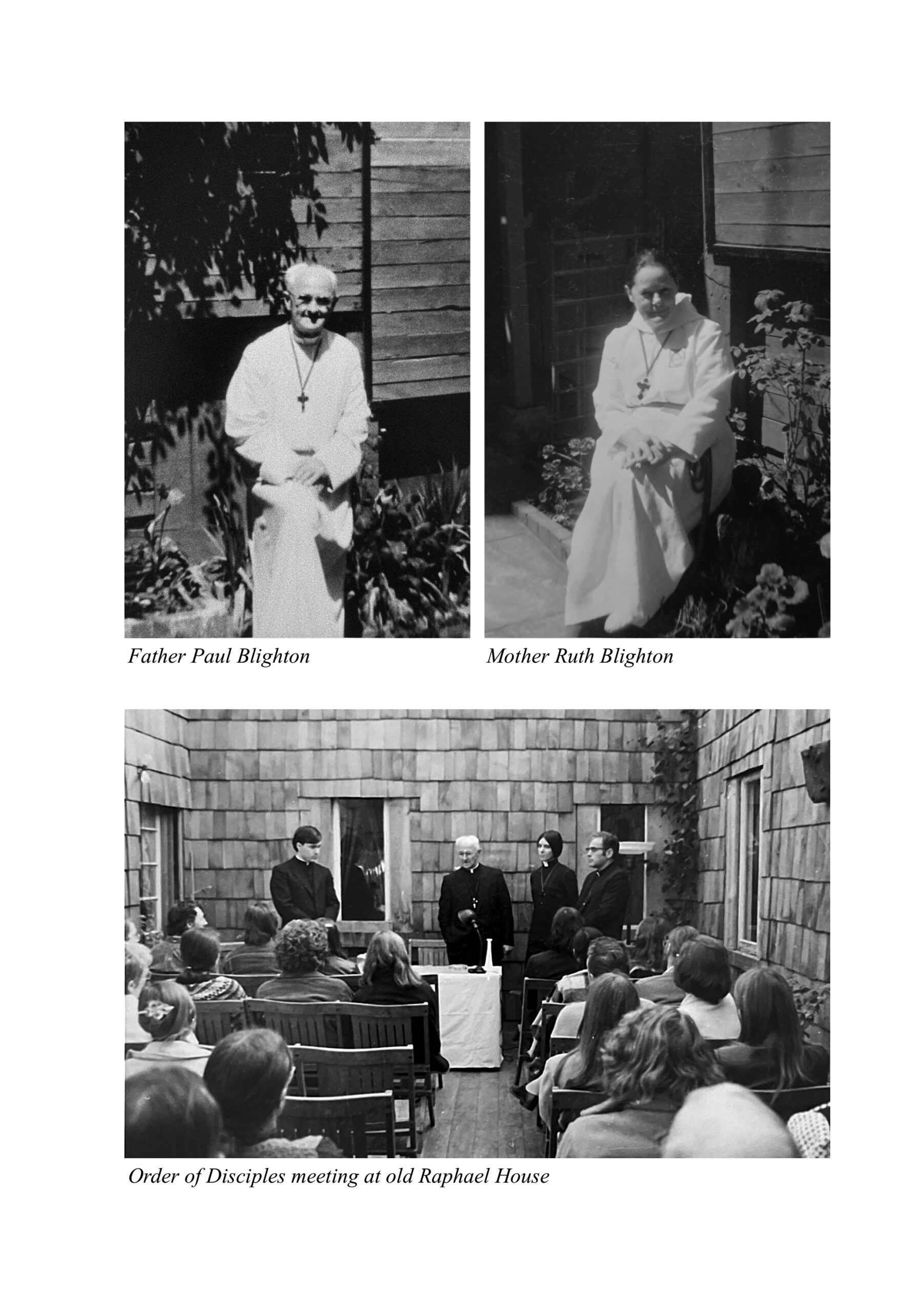
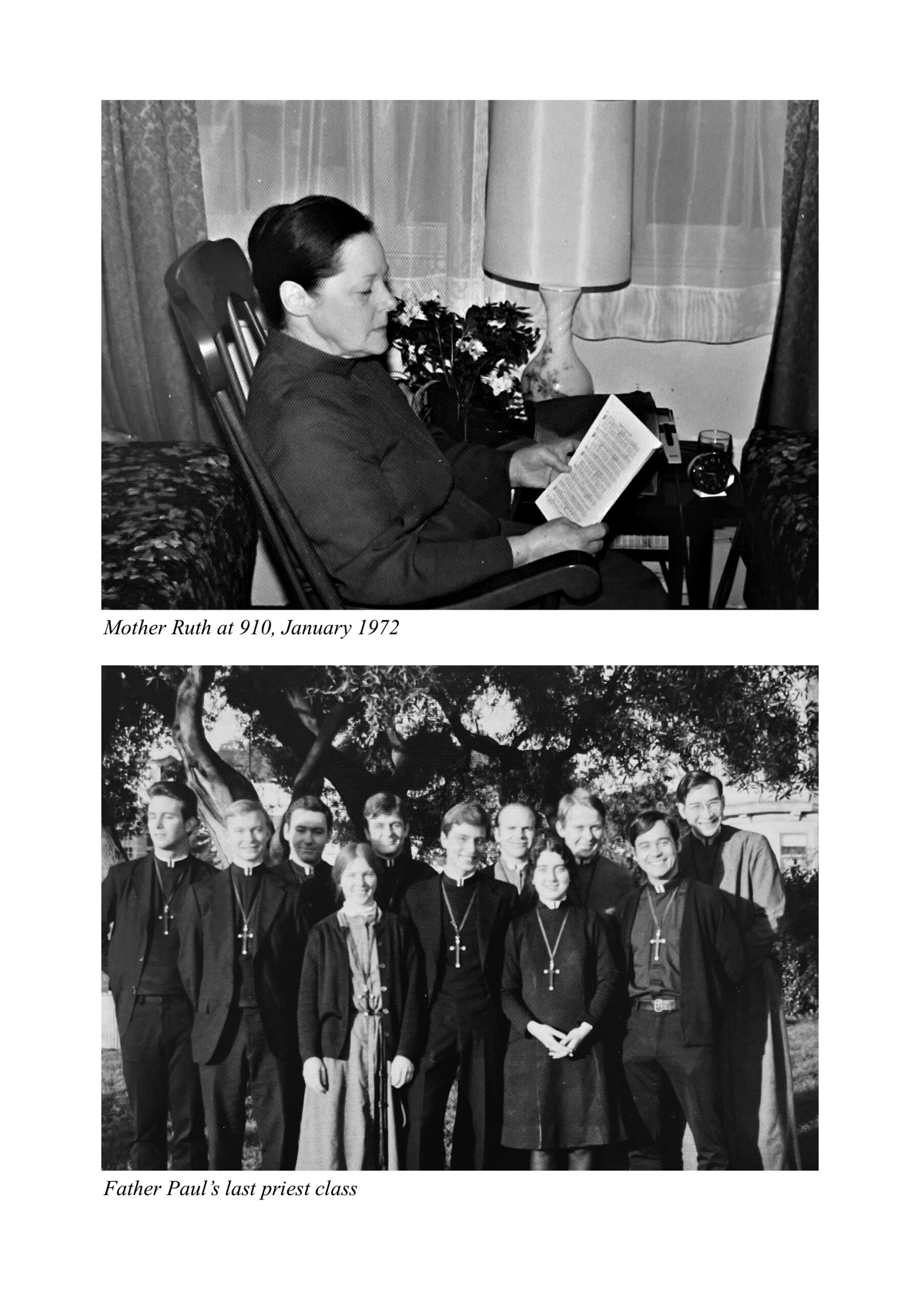
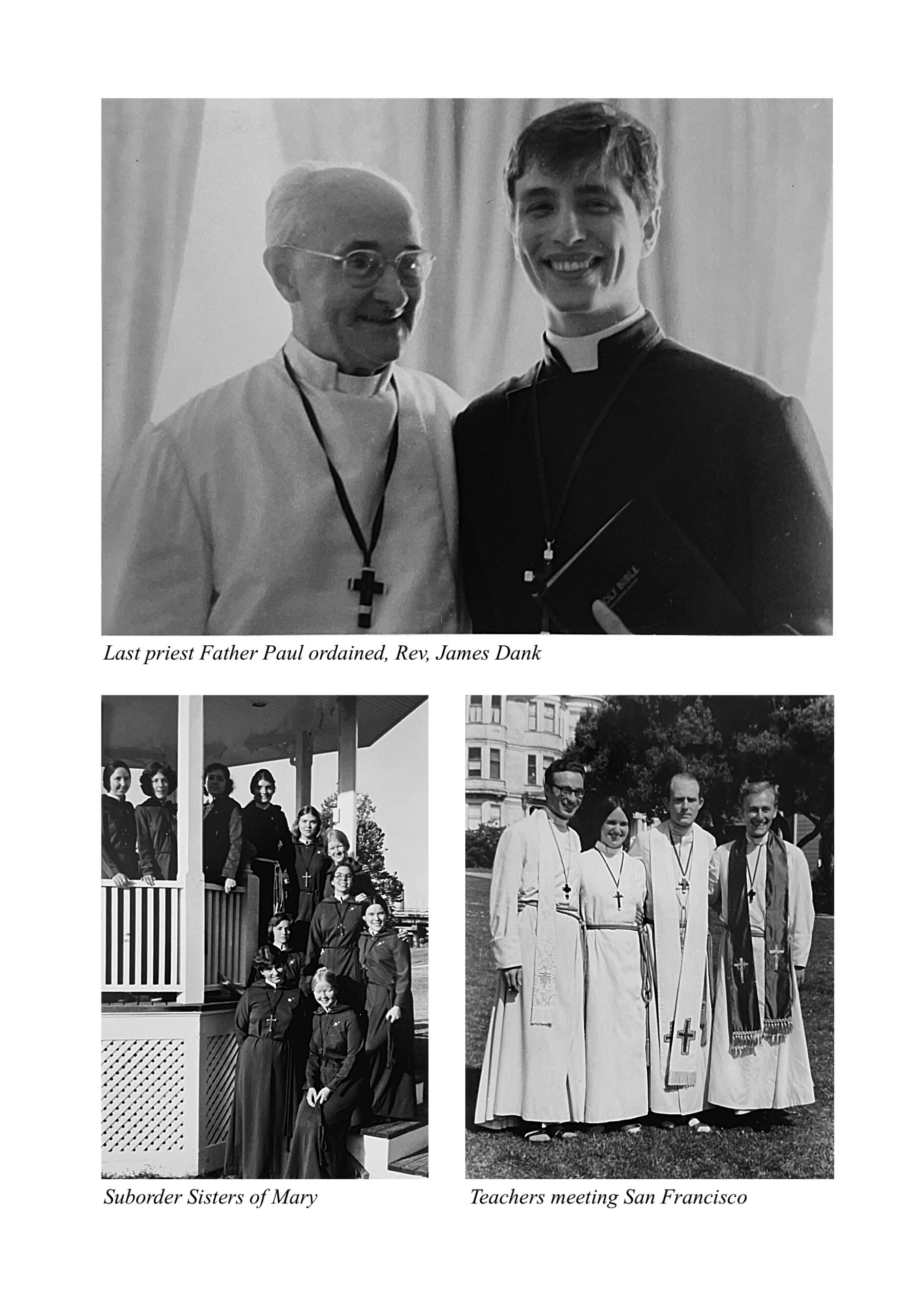
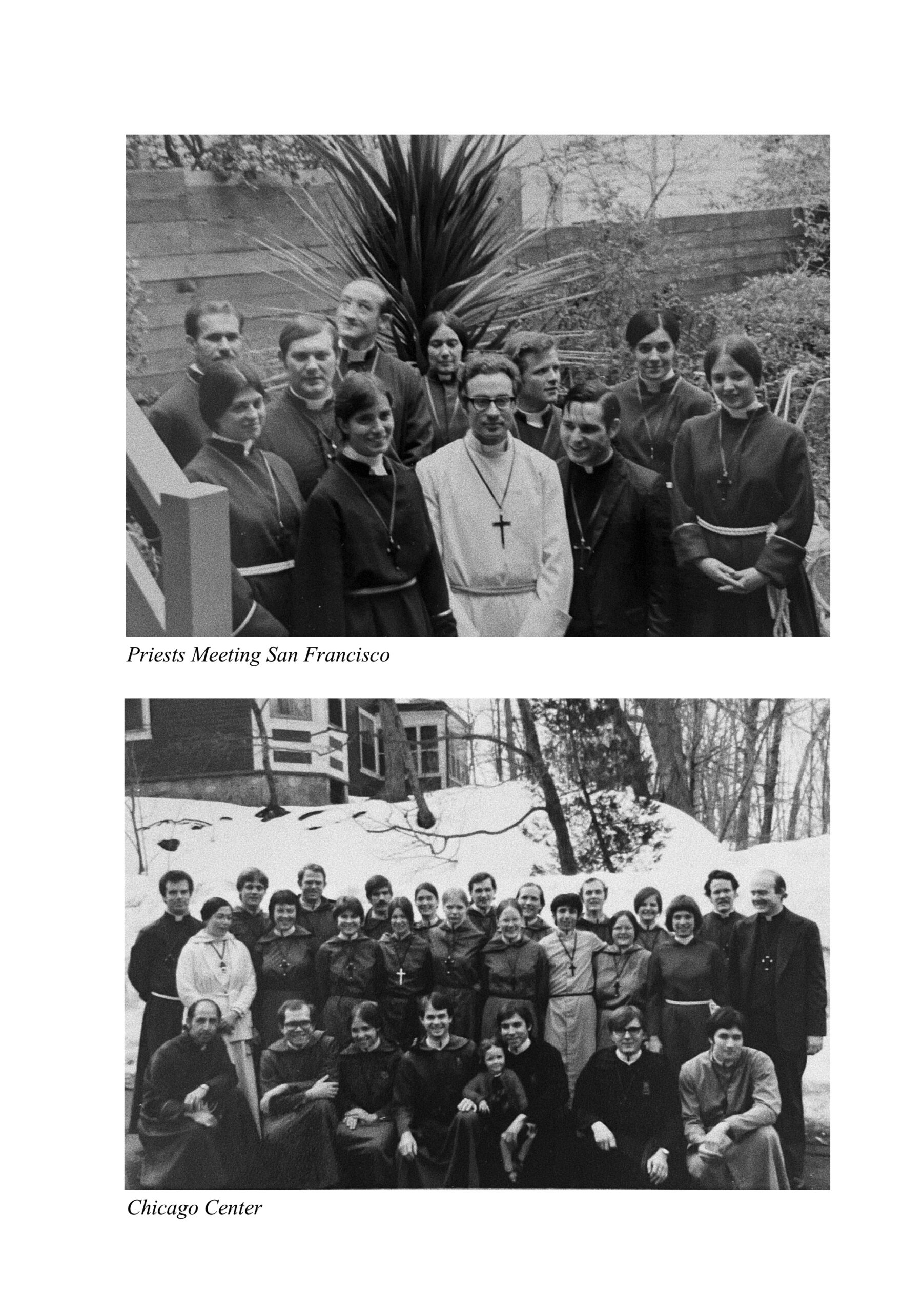
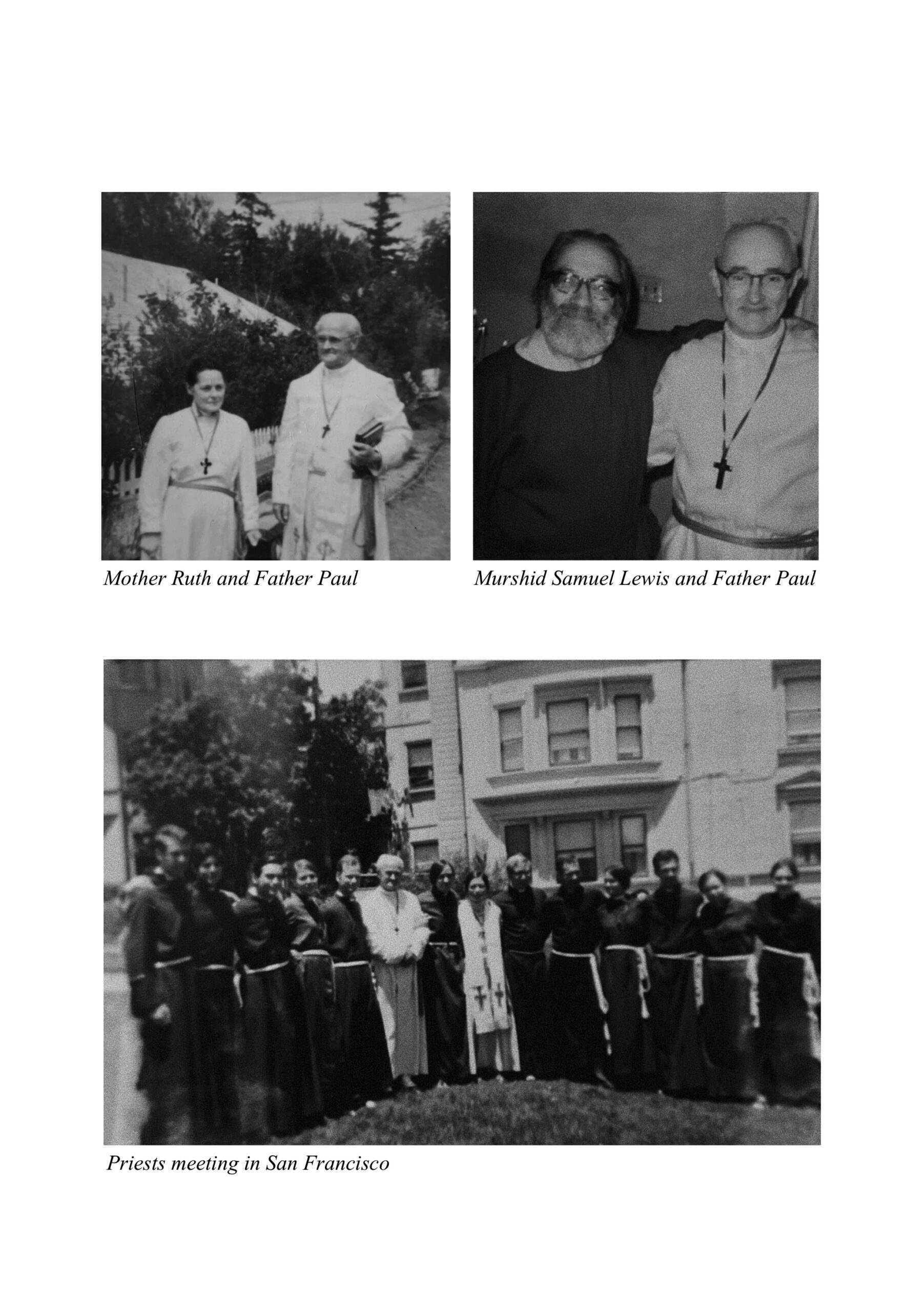
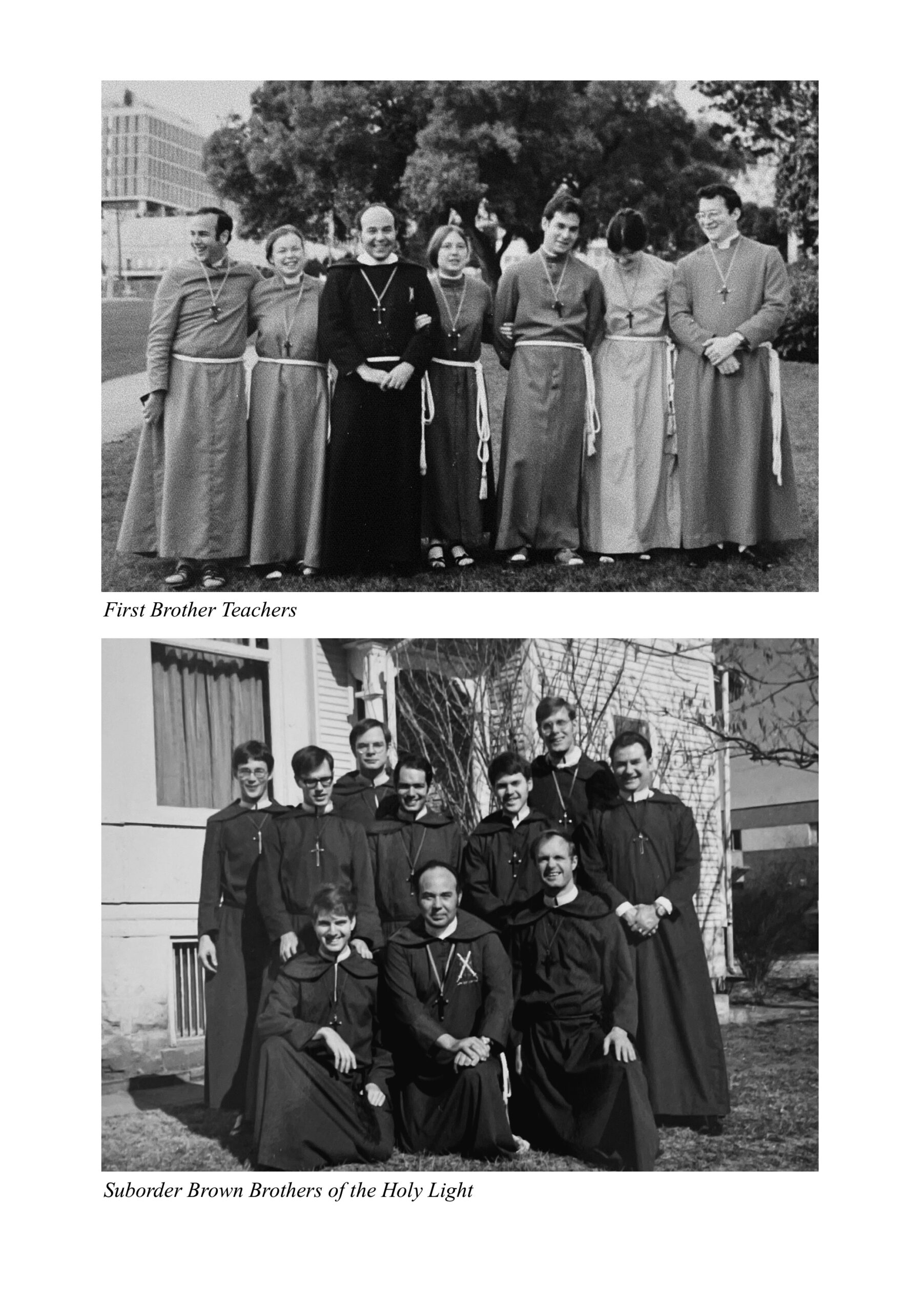
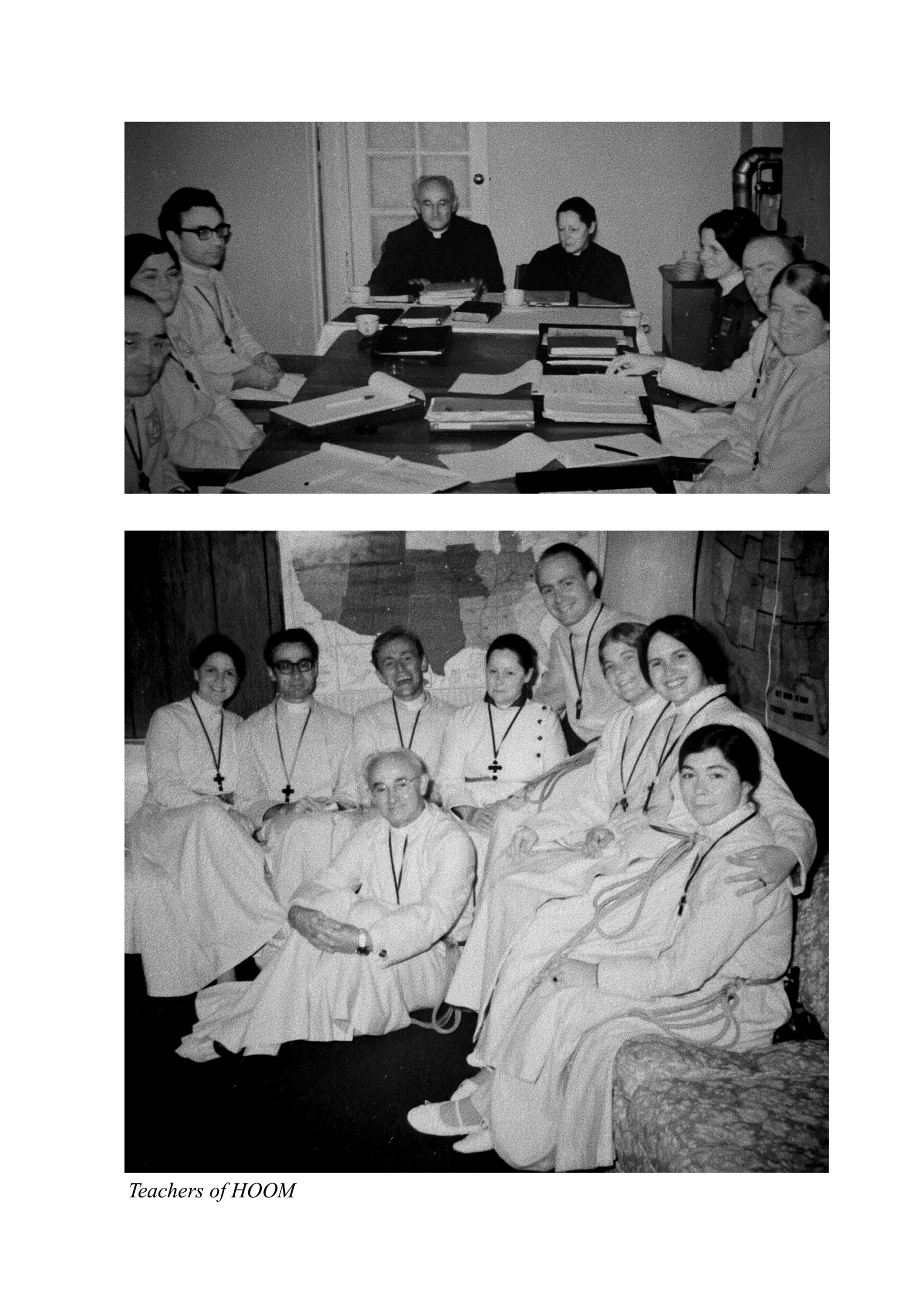
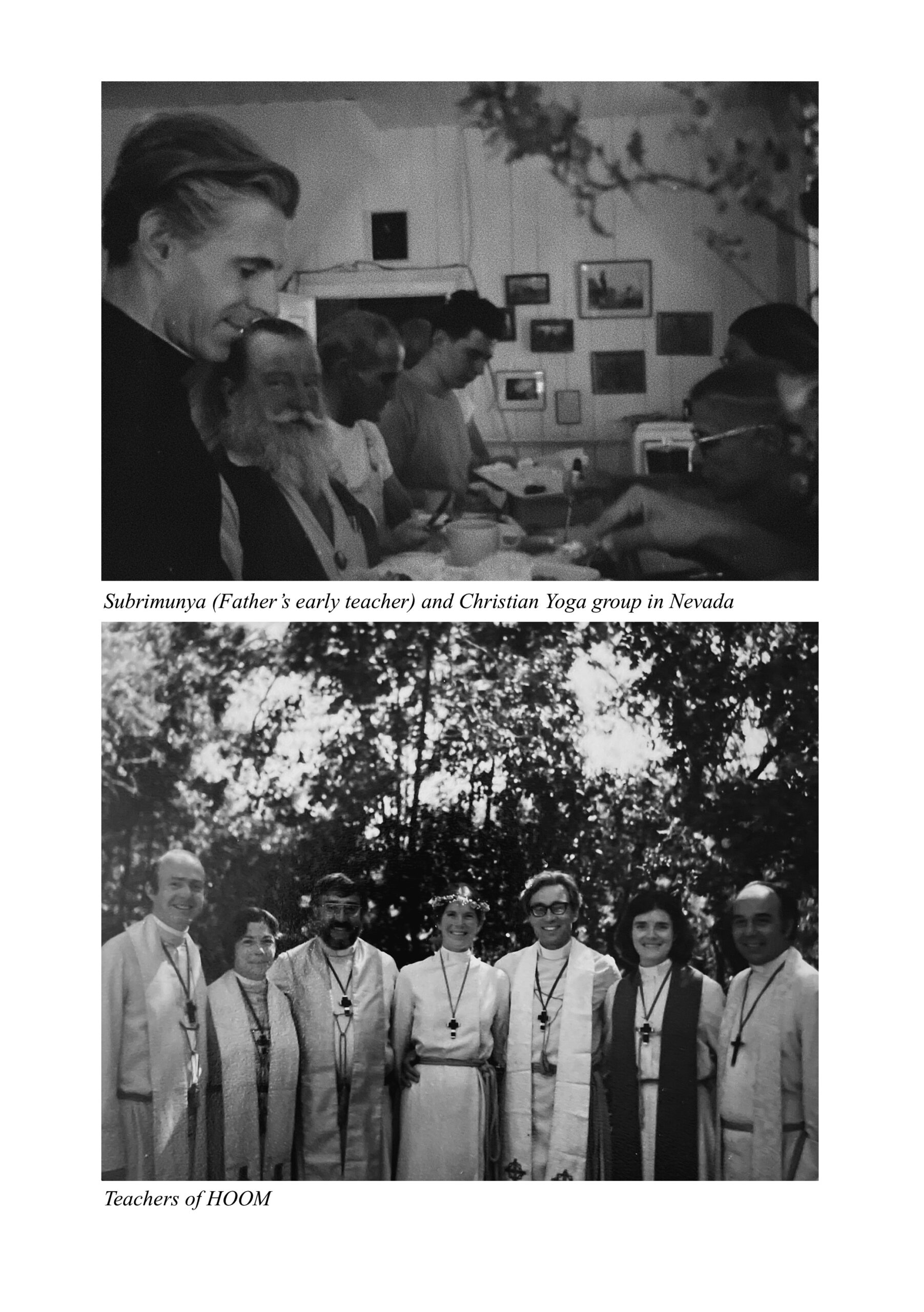
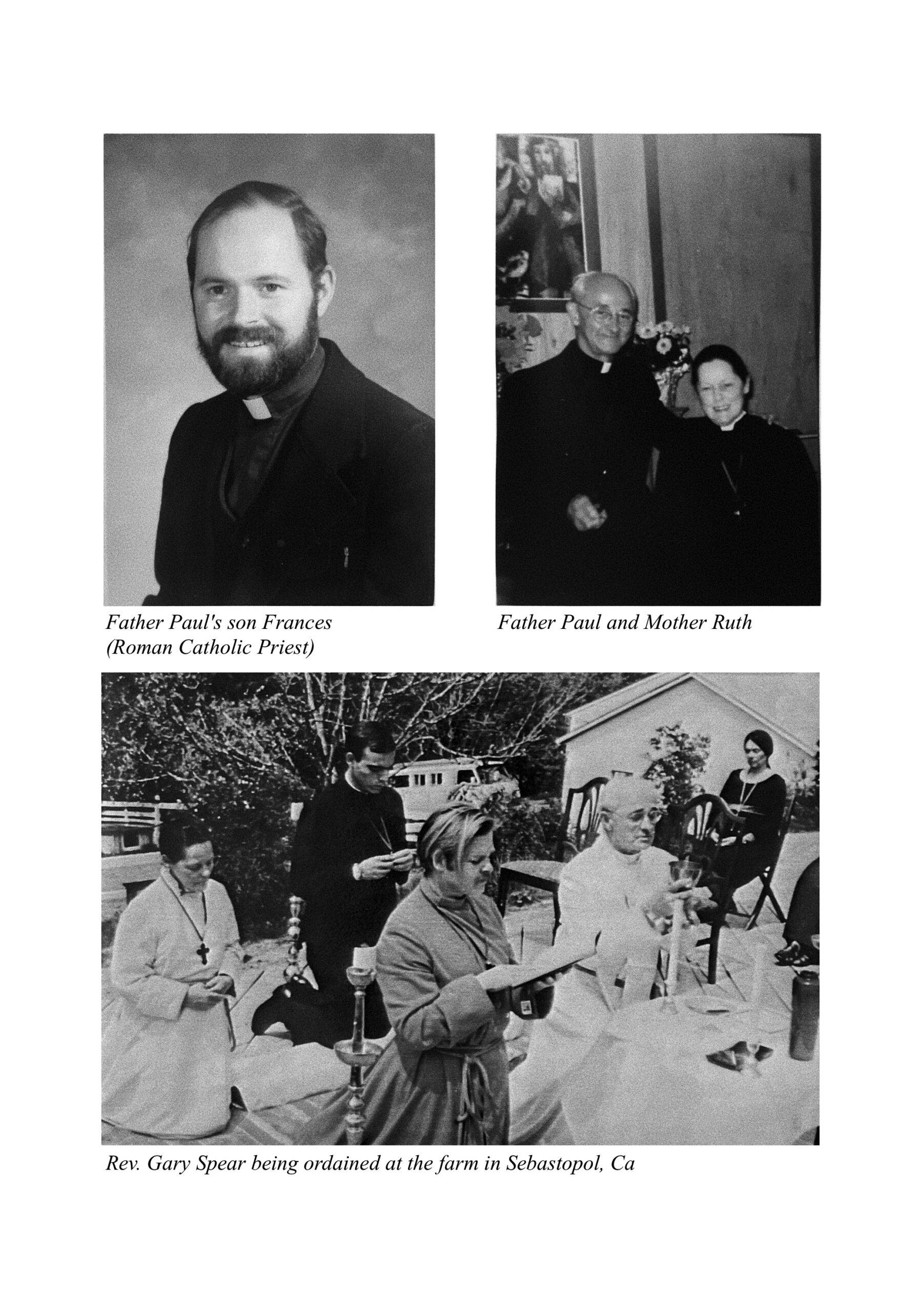
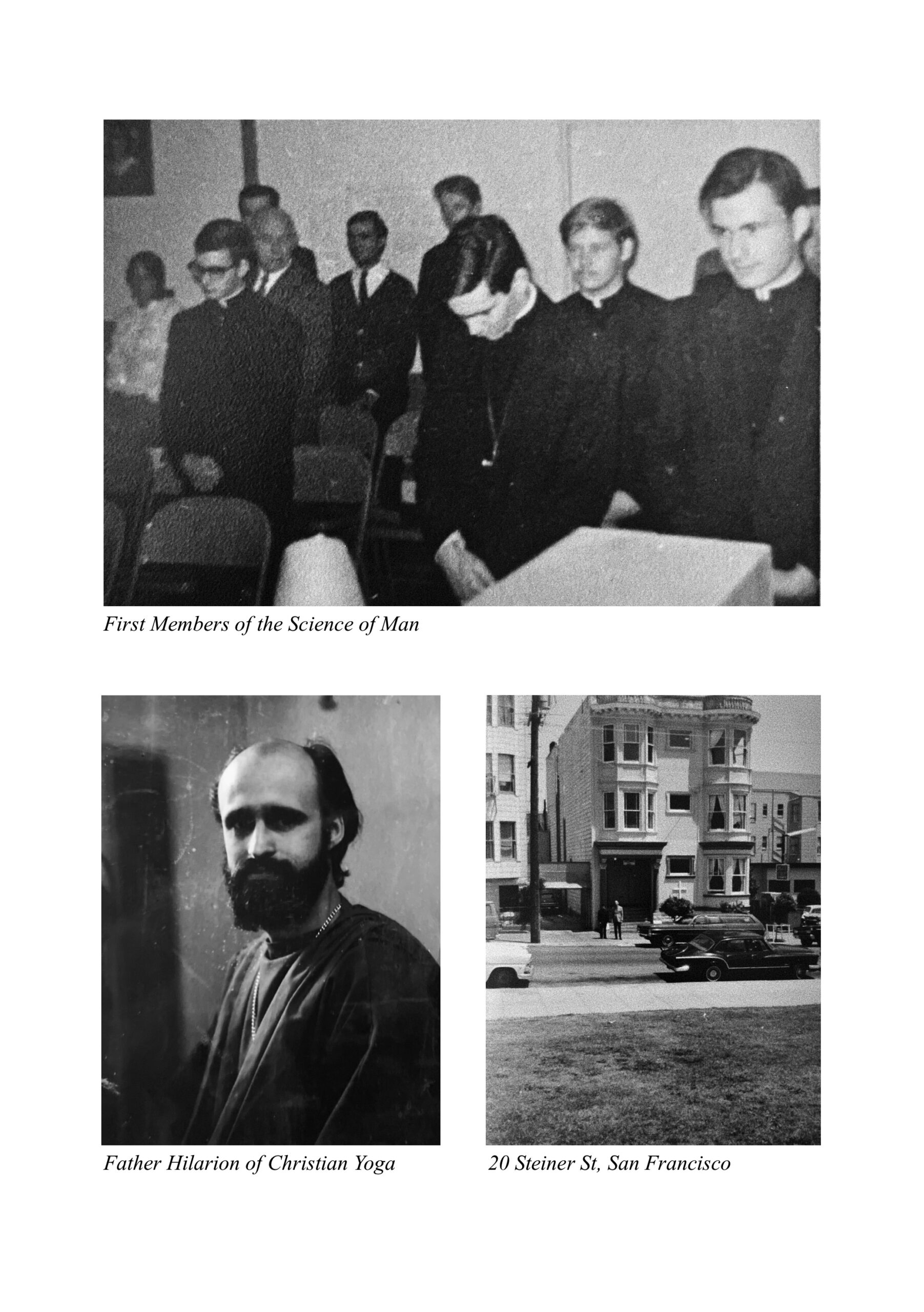
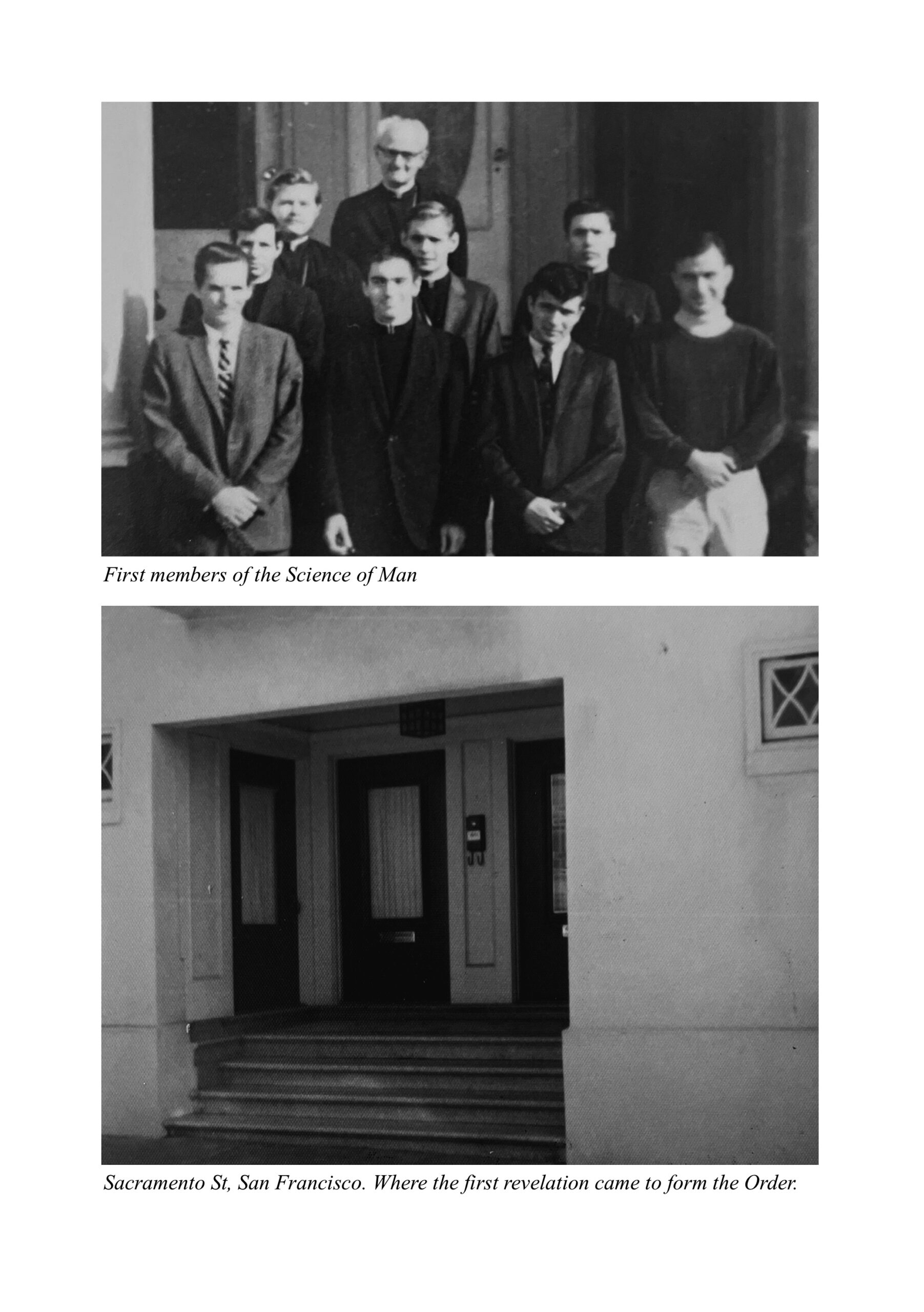
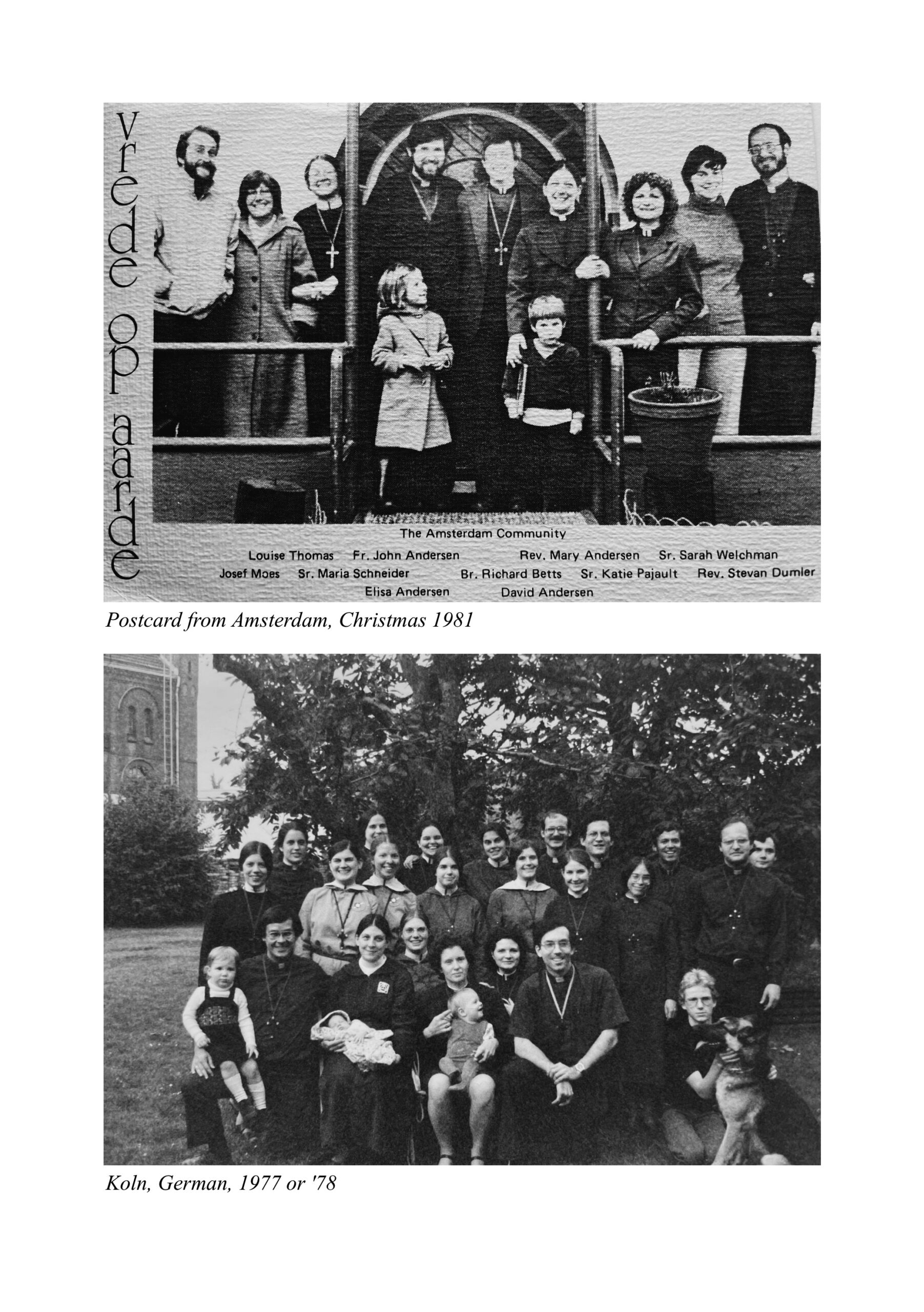
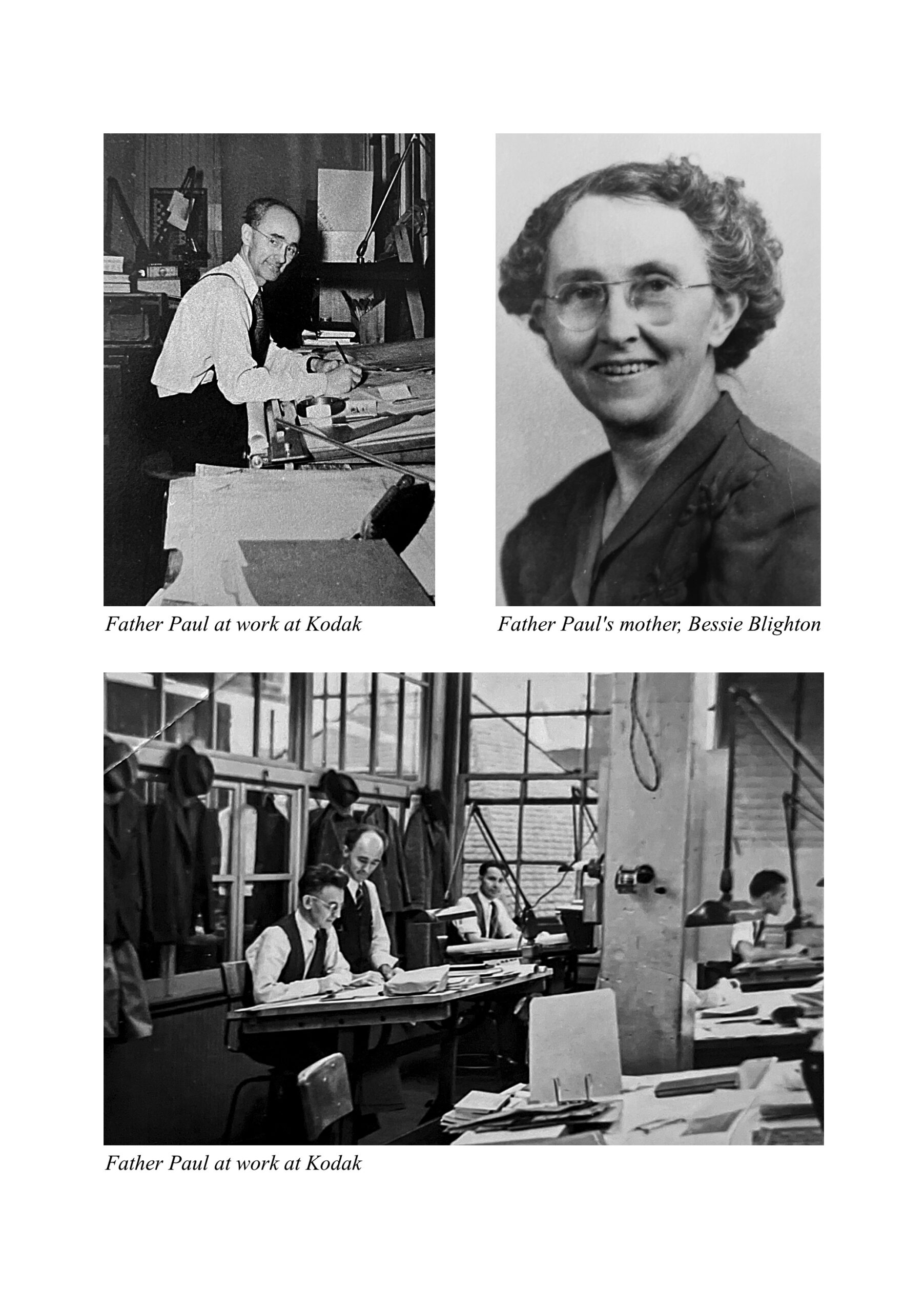
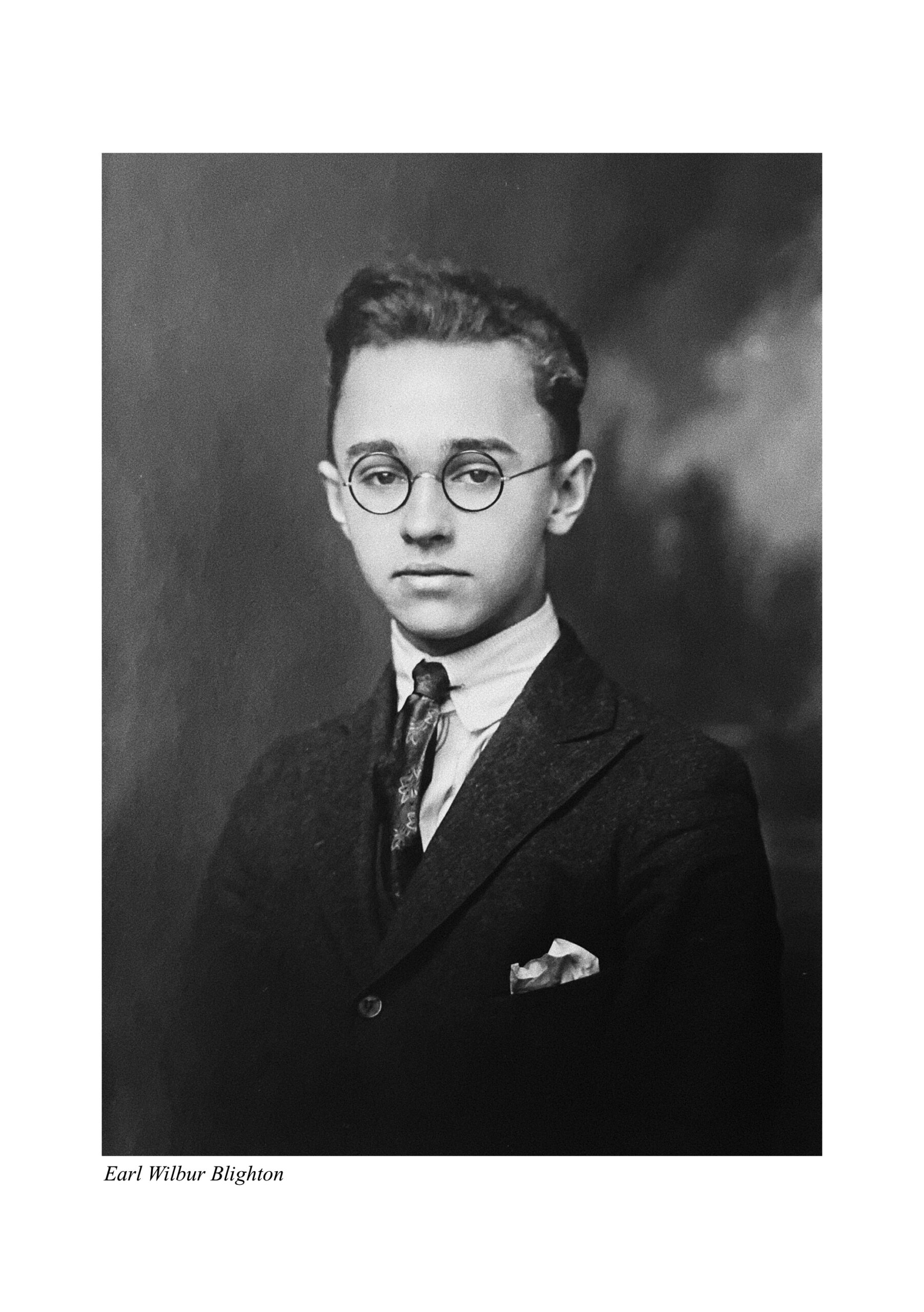
CHAPTER 9
When Denise Baker joined us, that made three long-range Sisters who were seriously committed to the work. While the Brothers were wearing black suits with rabat and collar, the Sisters as yet had no uniform dress, and they decided they would prefer all-black dresses to match the Brothers. On his visits to various thrift stores in the effort to secure black suits for the Brothers, Father came across a place on 16th Street in the Mission District, and there he eventually met Mrs. Ella Rigney, who was leasing the shop on behalf of the Episcopal Church. She did not actually work there, but the lady who did felt she would be interested in meeting Father, so arranged a time for them to meet at the store.
Mrs. Rigney became a staunch friend and supporter from that time on. She arranged to have set aside all the black suits and dresses that came in; and we would periodically receive a box full of them, go through and select whatever we could use and return the rest. Thus the Sisters were also outfitted, and I too began to wear the black. We next had to design a collar for the women. It didn’t then occur to us to use the priests’ collar. Our dresses were given “scoop” tops, not too close around the neck, and this exposed a larger portion of the white linen collar beneath. These were made like the ones used ever since, but it proved difficult to keep them tucked in and they tended to bunch. When the time neared for the first woman priest to be ordained, in September, 1968, Marge was determined to have a collar just like the male priests. And thus our clerics evolved, although they were not being made according to any standard pattern, just using whatever came our way.
A little before that time there was a general desire among Brothers and Sisters to have robes, all alike, to wear in the house. We went to a wholesale fabric store to look at materials and settled on a very nice blue-gray wool. There were two bolts of material available, but we could afford only one. Thus there was not enough to go around for everyone and that created a scramble among Brothers and Sisters to cut out a robe, with varying and sometimes wasteful results. Marge had bought herself a Vogue pattern which was made up in a gracefully-flowing style, but this took more material than was practical. So Bob Colvin created a simple pattern that was suitable for everyone, and I believe it was he who also designed the brown robes for Brother Juniper’s Inn. At some time the Sisters made a gold-colored house robe for Father, who otherwise had only his one sanctuary robe and black cleric suit.
As mentioned before, Father wanted a nice place where young people could come in off the street. A woman came to him in 1968 offering us the lease of her small coffee shop at 1736 Haight Street. They agreed on terms and it was done. Eric suggested the name “Brother Juniper’s Inn”, and to fit the name it was decided that everyone who worked there should wear robes. These were simple, of inexpensive brown material, but monkishly appealing. (The only time the restaurant was ever robbed, one night there was a break-in and the only things taken were the robes.)
Father put a Brother in charge of management. For background atmosphere there was to be only classical music played on tapes. Sandwiches, cookies and coffee were sold at minimum prices just to cover costs, and any local artists could exhibit their paintings for sale on the walls. This made for a very pleasant and peaceful refuge. Whenever Father and I stopped by, we would invariably find one or two of the Brothers or Sisters from 20 spending their free time there, with a cup of coffee. I’m sure it did much good as an oasis from the Haight Street maelstrom. There was no proselytizing, but by their quiet presence and their joyous spiritual dedication the Brothers and Sisters provided an atmosphere which invited the street consciousness to rise higher, and they were available to help or counsel if anyone requested it.
A block or two from there was the Haight Street movie theater. We heard of a young man named Steve Gaskin who was lecturing to packed houses there. He was preaching a philosophy the street people could accept and were hungry to hear. Once he came to see Father at 20, and they carried on a long and interesting conversation. I was much impressed, and afterward asked Father why he had not suggested that Steve join us, as he was such a promising person. But in spite of Father’s tendency to fish for souls, he had made no effort at all to interest him in our group. In answer to my question, he said, “Some people have their own work cut out for them to do.” But Father had made the unusual request for me to put on my sanctuary robe, and together we baptized him in the little alcove off the hallway that was then being used as a chapel. This was done very privately and specially; we did not usually change from clerics to robes for impromptu baptisms. Steve Gaskin later went on to found “The Farm” in Tennessee.
Sam Butenshoen, probably around 60 years of age, was then selling papers on Haight Street. He felt that the 11 p.m. closing time at the coffee shop was too late for the Sisters to be catching a bus home, so he took to bringing them home in his car. We later heard that he would often then return to Haight Street afterward and scour the back alleys during the wee hours, to help people in trouble. He came up to talk to Father one evening. I remember him asking questions about the possibility of joining, and whether he should give up his membership in the Elks Lodge. He did join, but was never under restrictions like the Brothers. He continued to live in his own apartment a few blocks away, but spent most of his time around the Brotherhouses. He did not attend classes, to my knowledge, but enjoyed most other functions. He was a member for the remaining fifteen years or so of his life. On his birthday each July, as time went on, he would give a party at one of the Order houses and provide the refreshments himself.
One incident that occurred at Brother juniper’s was not to anyone’s credit, but it was a vivid demonstration of something that must be seen to be believed. One Brother who had not been with us long (nor did he remain long after) was working at the Inn, and was the last one to close up one night, when a former buddy of his dropped in from the street, and tempted him to take a bit of some drug – although this was strictly forbidden to anyone in our order. Shortly afterward this friend brought the Brother home to 20, and said to Father, “I’ve been in a lot of dangerous situations, but I’ve never been this scared in all my life.” Because this husky Brother was babbling in the treble voice of a tiny child, and was completely unaware of who or where he was. It was the first time I ever witnessed a case of “possession” by a psychic entity – the very thing that Jesus sometimes healed as told in the Bible.
He was laid on the couch in Father’s office, and Father sat by him all night, working to release him. Toward morning, he saw the spirit of a little three-year-old girl sitting on his shoulder, and he was able to send her on her way. The Brother was himself again next morning, but he did not remain with us long. They said he had not taken enough of the mild drug to be seriously affected, but the spiritual conditions under which he had been working caused him to be too highly sensitized to handle it.
Father sometimes advised that if any of us were ever in a situation where it was necessary to accept medication from a doctor, we should ask for just half the usual dose, as our bodies were undergoing delicate transformation through the work of the Spirit, and would react more drastically than would be the case under normal circumstances.
Some spiritually-inclined persons who visited us were critical of the fact that we ate meat. But Father said he had once tried vegetarianism for several years, then had given it up because he became too sensitive. However, he did say that humanity would probably eventually all become vegetarians, but that it would come about more gradually, and less drastically. He felt our Brothers and Sisters were not conditioned to it, and needed all their strength, both for physical reasons and to withstand the spiritual impact they were undergoing. Of course, a few had been vegetarians or had been on macrobiotic diets before coming in, and it was a hardship for them to go back to eating meat.
Our cooks were totally inexperienced during the first few years, and meals were not always palatable, although Father insisted that there always be enough food to be well fed. There came to be jokes about peanut butter. If nothing else tasted good, one could always fall back on that. I think Bill Canright said, “Peanut butter is the ultimate reality.” The lack of cooking expertise was probably harder on Father and me than on the others, who had been living hit-or-miss since leaving home, but we had grown up in a time when all meals were properly cooked. Occasionally in exasperation Father would privately threaten to take his meals in a restaurant, but never did – except when we went out as a small means of recreation. We found a few inexpensive but enjoyable places. His favorite was beefsteak, and there was a low-priced place on Powell Street that served a fixed menu of steak, baked potato and salad. When we went to a Chinese restaurant, he always ordered Egg Fu Yung as one item. He had a favorite restaurant from pre-order times called Pompeii’s Grotto, at Fisherman’s Wharf, but it was more expensive, so we usually settled instead for a fish-and-chips place, or one of the small, ethnic spots on Clement Street.
In order to give the cooks a free weekend along with everyone else, a system was worked out for cooking on Friday a quantity of food that could be left in the refrigerator to be eaten cold for self-service weekend dining. We did have hot breakfasts, the nicest being Sunday brunch after services, since nothing was eaten before communion. So it was on the cold-supper Sunday evenings that we, and some others, often used our allowance for a meal out. When we first moved to 20, one innovative cook named Michael tried to add interest to the breakfast menu by adding food coloring to make the pancakes pink. The next one, Carl, was planning to write new recipes by going within for instructions from the Self (but I think he never got around to that.) One day Father came home from a walk downtown bringing a middle-aged man who had been a restaurant cook, but who was temporarily unemployed due to an alcohol problem. He stayed with us a few months, never fully becoming a Brother but cooking ample meals. However, some Brothers and Sisters complained that his food was too heavy for their tastes.
We all ate in the one dining room at 20 until several priests had been ordained, by the second or third year, and conversation among the priests became more difficult in the general dining room, since some of the talk necessarily concerned the students or their problems, or other confidential business. It was becoming too crowded, as well, with more coming in all the time, so the smaller room next door was turned into the priests’ dining room, and remained so for some years.
We were not an organization given to much silence, a fact I sometimes regretted, because it might have been better for everyone to have certain hours of silence. It seemed that unbridled talk led to some unnecessary problems or undesirable attitudes. If one is placed in a position where conversation is expected, things are sometimes said that would be better left unsaid. We did have a half hour of silence before dinner, between 5:30 and 6 p.m., and again after the ten o’clock prayers – except in Father’s office. He was always accessible for counseling, and the quiet hours were usually no exception. His work did not allow the strict observance of schedules.
He counseled at night after prayers, much of the time, and was usually the last person to bed at night, but always up in the morning with everyone else. If not counseling, he stayed up to do prayer work. He probably slept more soundly than I, because once in the second year there, a burglar broke in through an alley window on the first floor. (I think he took a chalice.) Someone from the outside (was it the police?) saw it happening and shot a gun at him (we never had guns.) The shot rang loudly through the house; but the only person in the whole place who heard it, besides me, was Ray Anderson, then the house father. Everyone else slept blissfully through. I don’t think the person was hurt, but don’t recall whether he was caught.
Ray Anderson later became Master J. But the first person Father trained to be a teacher was Matthew, who was given special lessons and personal work. When he was finally initiated as a Teacher one evening at 199 chapel, it was with the stipulation that it would be for this lifetime only, whereas all later teachers were for eternity. The Teachers’ ordinations were always given at night, in contrast to the priesthood ceremonies which were usually around 11 a.m. Matthew’s ritual was rather picturesque and different from all the others, rather like something enacted in a lodge, with Matthew coming from the back of the room emulating a wanderer searching for something. Father questioned him as to what he sought, and the ceremony continued.
Meanwhile, as this was taking place, Rev. Timothy was inwardly hearing words spoken to him in a strange tongue. After we arrived home, he repeated to Father the sounds received, which made no sense to him. Father recognized the ancient sacred tongue in which he himself sometimes spoke a few words in the sanctuary, and he took it that the White Brothers wanted Timothy to be ordained a Teacher also. That is why he always said he had nothing to do with choosing Timothy, who was later also given the mantle. Then Eric too was ordained into the mastery in February, 1970, and Father passed on to him his own former spiritual name of Raul, while he himself was now known to everyone as Father Paul. After that Ray Anderson became Master J.
The Teachers wore white robes in the sanctuary, but their house robes were gold-colored. It was not until a few years later, where there came to be Brother Teachers, that the gold robes were given to them, and the Teachers assumed white house robes, at first made of unbleached cotton and called “humility robes”. I think it was Marthelia who first brought up the idea of wearing white robes for house wear.
The earliest priests who were ordained had to sew their own robes. A pattern was located which matched Father’s sanctuary robe and the material used for the priests was wool, of a royal blue color, or slightly darker. Most persons had never done any sewing and usually labored for a month making the robe. But it meant a great deal to them and it seemed the discipline of sewing, along with the anticipation and intensive training toward the priesthood, seemed to add to their spiritual awareness. In later years, robe-making was delegated to seamstresses, with nicer results, but minus the spiritual exercise of personal input.
Before leaving the subject of garb altogether, let us mention that eventually a pattern was worked out for women’s clerics which it was felt would be most wearable by all shapes and sizes, a dress without a belt, more in princess lines. By now the dress had a higher neckline with stand-up Roman-type collar like the men, so the white linen portion which we made ourselves was held nicely in place. Capes were another much-desired garment in those days, and a couple of years later they were used for awhile by the Sisters, especially in Chicago. The men’s wear remained standard throughout, until several years later when the color for everyone became dark blue, and a tailoring department was set up to sew both men’s and women’s garb.
Speaking of robes, Father sometimes suggested that he would like to have the cord designed, not to hang as now in the manner of a bathrobe cord, but to have it sewn in the manner of a belt, with a fastener at the side. He didn’t explain it exactly, but the strands wrapped around the waist would be stitched together, (possibly suggesting a cummerbund?)
Another design which may have been meant solely as a test or exercise for Sr. Gail Rest, as I never heard him mention it elsewhere, went thus: he asked Sr. Gail one day to design a chalice cover, which instead of the usual veil would be boxlike. That is, the linen would be sewn so it would come down over the chalice like a box, fitting over it neatly. Sr. Gail couldn’t figure out a way to do it, and when she asked me for ideas, neither could I. Even though it could be sewn thus, one would need to open it out for ironing, and would need stiffening across the top. Nothing more was heard of the matter. Perhaps he was bothered, as many of us were, by the folding of the cloth each time, and sought a simpler way. It could be done using a linen-covered box.
CHAPTER 10
The city’s Urban Planning Commission had set aside a portion of the Fillmore District for redevelopment. 910 Steiner was on the edge of that area, a picturesque part to be saved. But one block over, on Fillmore Street, the buildings were slated to be torn down. In the interim, before this final demolition around February, 1969, Father was able to rent one building, a former hotel at 937 Fillmore. This the order then used as an aid station for men, at a rental fee of just one dollar per year until the wreckers finally came. It was a great help for a few years, and certainly provided a vital service to the community. But for the Brothers it was a difficult and trying job.
The first floor had formerly been used as a bar known as “The Blue Mirror”, which had been vacant for the past two years and left with a heap of filth and rubbish to be cleared away. There were three floors to the building, located in the very heart of the district’s toughest area, where street gangs and drug dealers hung about on the corner. We were later told that there was a shooting range in a tunnel beneath the street, used for practice by some of the gangs. But with time, and the Brothers’ presence, the area began to clear somewhat.
Once cleaned and furnished, The Fillmore aid station for men was opened, with free meals for any who stopped by, and free lodging for up to three consecutive days for those needing a place to sleep. Lodgers were required to go out during the day, while the Brothers cooked simple meals and baked bread, or coped with the various problems, which were plentiful, (including some concerning insect pests, not usually discussed). A couple of rooms were set aside for clothing and other donations that came in, and one Christmas there was a room piled with a jumble of shoes, donated by a downtown store, and these had to be laboriously sorted out into pairs.
A few young people, as strangers coming into town looking for a place to stay, were directed there, and some of them stayed on to become Brothers. One room was set aside as a chapel, and a priest was installed to have charge of the house. Residents could attend morning communion or evening prayers with the Brothers if they chose, but were not pressured to do so.
After we had been there for awhile, our first black priest, charismatic John Clark, was put in charge. There was a sign out in front proclaiming the aid station. Some Black Panthers living two doors down removed the sign, and John put it back. This happened a few times before they finally left it alone. The priest, or someone coming from 910 or 20 Steiner, taught classes to the Brothers on Tuesday and Thursday evenings to free them from having to walk to 20 for classes, except for something special. This procedure was also in effect at 910.
Sr. JoAnn Wheatley acted as Father’s secretary for a time, until Sr. Martha Owens came in from Seattle, when she took over the position. About that same time the Teitelbaum brothers, Larry and Gene, arrived from the East Coast. Father put them to work cooking for awhile. They had always been together, and though not the same age, Father began, for some reason, to call them “the gold dust twins”. (They later became Reverends Benjamin and Gene.)
In the early summer of 1968 many Council meetings were held to work on a new set of by-laws, or rather a new charter for what it was now decided to call the Holy Order of Mans. Using the Science of Man charter as a point of reference, each paragraph was taken up and discussed, point by point. When Sr. JoAnn had typed up a neat copy of the resulting document, Father and I drove to Sacramento on July 24 and had it filed. I asked at what time it could be considered official, and was told it would be when the seal was applied. So that time was noted as 12:15 Pacific Daylight Time at Sacramento. On that day we also visited the State assembly and watched for awhile from the balcony. And thus the Science of Man retired to a dormant state, and the Holy Order of Mans was born. Our rituals had been written into the legal documents accepted by the state, and Father happily announced that now they could never be changed!
CHAPTER 11
The first person to be ordained under the Holy Order of Mans was Bill Canright, in August, 1968. Then there were Marge, John Clark, Franklin Mills, and John Linneman.
The Basement of 20 Steiner was by now being made ready for use as a chapel and classroom, with a couple of additional small rooms for various uses. It was only partially done by the time Bill Canright was ordained, but Father turned over the responsibility for the 199 Duboce church to Rev. Bill, to start out his priestly experience as a pastor, and to use his own ideas in interesting the public. Until then it was just the “Science of Man” church, but Bill decided to call it “The Church of the Children”. This continued for only a few months, as there was not much activity from people outside, although we continued to use it until the first Sunday service was held in our finished basement chapel at 20, in early 1969. Then the place at 199 was given up.
In February, 1969, Rev. Bill with Brother Gary Speer was sent to Hawaii to begin a mission there. They were given three hundred dollars and told to “go to work”. Among their first dedicated students were the Pyne’s and the Noonan’s, with their families. Rev. Bill sent back a coconut in its outer husk, and Father placed it unopened on the bookshelf by his desk, where many will remember seeing it over the years. (A seed, perhaps?) The Hawaii Center continued to grow and became a vital place, attracting many good people from among the seekers there, several of them later to be ordained.
Rev. Matthew married Marge and they were given charge of the 910 brotherhouse. At first they all came as a group on Sundays to the services at 199, but gradually and increasingly they and their house began to detach and withdraw themselves from the headquarters at 20, and eventually the couple was transferred to Hawaii to work along with Rev. Bill for a few months. While still at 910 they were expecting a child, and Marge purchased fine sanctuary linen to use in sewing the layette. Before the child was born they left the order in Hawaii and went out on their own.
Christmas Eve of 1968 brought Jenny Wilday and her small son Todd to visit us for the first time. They had met the Brothers at the coffee shop and had been invited by them to come to 20 for our Christmas Eve celebration. The time is remembered because both came dressed in red, appropriately for the season. Father quite approved of Jenny, and they joined us and moved in almost immediately. Then a few days later John McCafferey came in. (They were later to marry and both to become Teachers as well.) Her life vows were given very suddenly after she had been with us three or four months. A couple of people were in Father’s office at the time, but nothing was said to indicate that vows were to be given. I stepped out of the room for a few minutes and when I returned she was a life-vowed Sister. Then in June of that year (1969) she was ordained into the priesthood. In September John was also ordained as Rev. Philip.
The Spirit moved quickly and Father wasted no time. He sometimes said he did not have much time to spend, so things had to be done quickly. Once, soon after her vows had been given, Father asked me to take Sr. Jenny down to Dr. Riffle’s chiropractic office, within walking distance on Market Street. It was the only time he ever made such a request, although the Brothers went occasionally for chiropractic work there. When I took her in and told Dr. Riffle Father had sent us, he said, “She must be quite a person.”
Mrs. Rigney became increasingly involved with the order as she continued to set aside the black garments for us. In return, sometimes the Brothers would pick up things that had been donated to her by downtown stores, and deliver them to her shop. She also in time invited Father and me to visit her small attractive apartment up the hill from the Mission Highschool. She was Episcopalian, and personally acquainted with both the late Bishop and Mrs. Pike, and the present bishop. She invited Father to attend some business meeting of the church with her.
The Episcopal Church owned a community building on Potrero Street that was being repeatedly vandalized and having its windows broken. Portions of the building were used during the day by two or three groups, and a day nursery was conducted on the first floor, but was vacant at night when the vandalism occurred. There was also a small church beside the main building that was being used by the neighboring Samoan groups for their Sunday services. The property was at the end of the Potrero bus line, near San Francisco General Hospital.
In early 1969 Mrs. Rigney approached Father to see if a couple of our Brothers would be interested in guarding the place by night. So Father sent one Brother over. I believe he took a dog along, or at least he wanted to; but he didn’t stay long. It was actually a dangerous assignment, as sometimes there was gunshot at the windows. Next Brother John McCafferey went. Mrs. Rigney felt that one alone wasn’t enough, but he insisted that he could manage, so he went and stuck it out. The troubles began to diminish, and eventually Mrs. Rigney arranged with her church to allow us the use of part of the middle floor of the building as a secondary brotherhouse. Meanwhile the rest of the building resumed its usual activities. Bro. John McCafferey stayed on, and Rev. Eric Fuchs was sent to be the priest in charge, along with a few other Brothers.
They made quite a nice place of it, and were able to begin doing service work, some of it with the downstairs day nursery, as a start. The place had wonderful potential. We heard that it was to be sold by the church, and began to discuss and to dream about all its many possibilities. (We had not yet purchased 20 Steiner, though still leasing it.) But when our offer was presented to the church they turned it down, and let the Catholic church have it instead, giving to them also a bus which Mrs. Rigney had herself purchased. It seemed that one of their Board didn’t like Father’s religious views. So that dream went. But we were given some ecclesiastical supplies they no longer wanted and that had been stored in the vacant third floor. This consisted mainly of church railings, with two nice wooden chairs suitable for use in the sanctuary. The plainer one went to the sanctuary at 910, the more ornately carved chair went to Fillmore, where it eventually disappeared. Perhaps there was an altar for the Fillmore center as well. Part of the railing was used at 910, and part at Fillmore, as well as some other places.
CHAPTER 12
The first automobile that came in strictly for our use was a used station wagon which Father called Betsy. Around this time someone had introduced the Clarks to our group. Carolyn and husband Duane had a charming seven-acre place five miles past Sebastopol, near the end of a rough private road. In early 1969 Carolyn sometimes drove the 70 miles to an evening class at 20 in San Francisco, when Duane was working at night. Most of the public classes that she attended were taught by Raul (Eric). The Clarks invited us to visit them, and gave written directions for finding their secluded place. The first time Master Timothy accompanied us, and it seemed like a very long drive up through Marin County and into Sonoma County, though in later years the distance did not seem so great.
A long story could be written about the Sebastopol Farm during the time it was associated with the order, at least by those of the Brothers who were stationed there. But to begin with, besides the house, there was a lovely but primitive little creekside cabin which was used for guests, as well as about three other outbuildings, one of which was a little shed which in later years was made over into a one-room cabin for our use, when Father and I were visiting. Another building about the size of a garage was made into the chapel. And in the barn a room was eventually set up for use as a small schoolroom.
Our visits to the place usually lasted two days, during which Father taught classes and counseled, and we sometimes served communion or gave evening prayers. Invariably some (mostly unnecessary) long-distance phone calls would come through for Father, requiring him to go almost running down the pathway to the main house – so there was little actual rest, but it was a change from city to country, in a pleasant setting.
After the Clarks had both joined the order, they turned over the farm, with its mortgage, to the order. (Some years later, after leaving the order, they requested and received it back again.) They had children, and a few other people had either come in with children or, like the Ray Anderson’s and Martin Swanson’s, had been married in the order and had a child since. So the Sebastopol Farm later became the place where children were taken care of while their parents were on mission elsewhere, and there was formed the first order school. Carolyn was ordained in December of 1969, and Duane (Rev. Ronald) in January 1971.
In February, 1969, Timothy’s brother, Richard Harris, was ordained as Rev. Thomas; and in the same month Denise Baker and Martin Swanson were ordained one day apart, and married a week or so later. They had been courting for about a year. They were sent immediately after marriage to Chicago to found a center there. It was Martin’s home town, and though Father had advised them to get their own apartment for starting out in marriage, they decided to be economical and live with his parents while searching for a building which the order could purchase for use as a brother house. When he had lined up several possibilities, it was felt necessary for Father to approve of one before a purchase was made, so Father and I took our only long journey together, on the train to Chicago. We were invited to stay with the elder Swanson’s, and spent a pleasant few days with them, Martin and Denise meanwhile very involved with practicing their priesthood and teaching some people, notably the Beale family (who later joined).
While in Chicago we met Paul and Gail Rest. They came to the Swanson’s to see Father one evening. Paul was attending Seminary to become a minister, having come from a family of Protestant ministers. I expected Father to pay particular attention to him on that account, but he seemed more interested in Gail. Both later joined us, and Paul was ordained in December of 1969, whereas Gail remained in the order longer than he, eventually to become Rev. Sr. Johanna.
We looked at the big brick buildings Martin had seen, but none proved acceptable. Our visiting time was over; it was now Sunday and we were scheduled to return on Monday. Mr. Swanson suggested we go for a Sunday drive, which took us down Berteau Street in a residential area, where we saw a “For Sale” sign on a house which consisted of two family-type flats. We stopped and went in, and decided that with some remodeling it would serve our needs. Then too, Mr. Swanson felt all right about the neighborhood. So we stayed on until Tuesday so papers could be drawn up; and there was born the Berteau Center, and our first property outside San Francisco. Father later designed an altar for them, to fit the particular shape of their basement chapel, and Martin built it, taking charge of the center.
Our return trip by train took a different route, through the Southwest. Father wanted to show me some territory I had never seen before. We went through Death Valley to Los Angeles, where it was necessary to stay overnight to make connections with a train going to San Francisco.
Father suggested seeing a movie about Africa, which didn’t sound appealing to me. I wanted to see the downtown area, to refresh some memories of a long-ago vacation trip, but he refused to do that. So I ended up walking part way down, only to find it no longer held any interest for me, so I soon turned and walked back to the motel. Father was rueful, and said something about having wanted to take me with him into his rest, but he smiled and we went to a restaurant instead. The next day he arranged for us to sit in a glass sightseeing car at the rear of the train. (This was shortly before these were discontinued, and before Amtrak.) It was a lovely trip up the coast. The seats swiveled so one could turn around and look at the view in any direction.
Occasionally we would go out for a couple of days to a motel, sometimes to San Jose, or to the Sebastopol Farm, but increasingly just to a motel in San Francisco (because he said if we drove out of town he would be too tired when we arrived to enjoy it.) He would come in and ask me if I could get packed in ten minutes, both his bag and mine, and caution me not to tell a soul we were going. He would take the house father into his confidence, but usually led them to think we were going out of town. When we actually did go to Sebastopol a couple of times without notice, he was quite upset to find everyone in the yard watching for us to arrive, after he had asked that our coming be kept confidential. But we more often ended up at the very modest Capri Motel on Greenwich Street in San Francisco, and a couple of times at Ocean Beach motel (where we spent our last night, years later). I worked out a streamlined system of packing that didn’t take long, and he probably was testing me also, or training me to be resilient, to pick up and go at a moment’s notice.
He would say that the pressure of his presence and the high level of energy in the house when he was there became too much for people, day after day, and they needed for him to leave occasionally. Then he also needed a break from his tiring schedule, but we both took paper work along to do. The first evening was usually spent unwinding with TV, and eating out inexpensively at some place within walking distance. The next day we might drive somewhere, such as to a parking place near Fishermen’s Wharf, where we could relax in the car by the water. And, after all the secrecy about where we were going, he usually called 20 Steiner on the second evening and invited some of the people with whom he was working toward the priesthood or mastery, to join us for the evening, and there would be some pleasant informal teaching and conversation. He usually set it up that we would be out for three days, then invariably shortened it to two. After the second night, he would get up saying, “I feel there is some reason why I’ve got to get back to the house.” So back we’d go, somewhat to my disappointment, and though I didn’t put it in words, he sensed this and was not pleased at my slight reluctance to leave what had seemed for a small space of time rather like having one’s own home.
A couple of years later we were expected in Chicago (this was probably on the occasion of the second Discipleship convention). He made reservations for the trip, and left the house with everyone, including me, supposing we were en route to Chicago. But we merely drove down to the Capri, except this time we had a nicer room, complete with kitchenette. Here he just sort of hibernated for a couple of days, sitting quietly with his briefcase, and I felt his mind and spirit actually were projected to Chicago the whole time. Probably he felt better able to work with the situation spiritually without so many minds focused on his physical activities. And he was no doubt trying to evade the subtle espionage which dogged his later days and otherwise interfered with the spiritual work, but which I had not as yet observed.
One of our favorite parking places at the Wharf was right beside the Dolphin Club, overlooking the water. But eventually that was closed to automobiles. Then there were drives through Golden Gate Park, usually with Brothers, sometimes showing visiting parents around, sometimes just he and I parking by Stowe Lake with a sheaf of paper work over which he would finally doze for awhile. Or at the ocean beach, relaxing for an hour before driving back to the busy house.
He sometimes took a car load of Brothers and Sisters to the museum at the Palace of the Legion of Honor in Lincoln Park. There was a free organ recital on weekend afternoons, and the lovely paintings – all of which was intended as part of the cultural education. Past the museum, a trail led to a rugged area with a beautiful view overlooking the Golden Gate, where we held a few order picnics, such as on the Fourth of July. Once in awhile he also took a group to the De Young museum in Golden Gate Park to browse through the art exhibits there. Except for our two-day departures, he nearly always took others with us on any little recreational jaunt. Especially with the station wagon – if he didn’t fill it up with other people, he would have felt selfish, not merely in a personal way, but in his consciousness of the Law, which would probably have made him feel he was incurring a debt of some kind. He almost never did anything for himself alone. If he felt the need for recreation, unless he actually needed to be alone, he could only justify it by giving pleasure to as many others as possible. And he enjoyed it better so, along with the opportunity it gave him for a better look at their spiritual needs.
He would tease me about liking ice cream, and always insisted to others in the car that he was never allowed to pass Joe’s ice cream place (on Geary at 16th or 18th?) without stopping. So he’d get everyone a cone, but would himself never try any flavor except chocolate. Another little discovery was Bill’s Hamburger place on Clement Street near 21st. There was a lovely little garden behind the restaurant where he sometimes took the teachers or others for hamburgers, when it wasn’t too cold to sit outside. (The garden has since been enlarged, and seems less magic now, but still pleasant.)
CHAPTER 13
Father once said it would be so much easier if he could work just as a Teacher or just as a Director General, and didn’t have to do both at the same time. Not only was each function a full-time job in itself, but sometimes they were conflicting in nature. Actually, he had many jobs. Besides being Father to everyone, he was also the public relations officer, the bargainor for property and for major purchases, who set up contacts with wholesale dealers, and much more. He had to train others to take these positions as they became ready, while still needing to guide and be available for any problems or questions, of which there were many both major and minor.
He was, above all, the channel for guidance from above and occasional revelations or spiritual directives which came through. He did some writing when there was time, often letting others do the research of materials. He taught continually. At evening prayers he sometimes did healing work, calling up certain persons or passing among them to place his hand on someone’s head for healing or blessing; and, not least, he brought people into the Light and worked on them for the removing of the veil.
After prayers at night he usually counseled with someone in his office at 20 or, after we moved to 910, in his room there. When not actually counseling he stayed up after everyone was asleep and did prayer work for their spiritual unfoldment. He said it was easier to work with them when their minds were quiet and not resisting. Occasionally he would ask me to join him in meditation, directing me to spread Light through the whole house, beginning at the top, and going from room to room and from floor to floor, until all the rooms were filled with Light. He lived on a razor’s edge of spiritual precision, and we all shared in varying degrees the purity of that time which carried its own joy and beauty, its aura of mystery and its blessedness.
One of his stated missions was to raise woman to her rightful spiritual position, something neglected by most churches, and to correct the impression given in Paul’s epistles that woman was to remain quietly in the background. Those letters were written for a different time and society, but now the time had come that she should stand up in equality, even to the point of receiving ordination into the priesthood.
He didn’t relish that mandate, and often would have liked to give it up, at first anyway. It was hard enough to work with men. He often mentioned getting tired of “changing diapers”, figuratively speaking, for both sexes, cleaning up the accumulated mental and spiritual messes which people allow within themselves. Women as a whole, with some exceptions, were even harder to bring to spiritual reality. He once said it was because though men were of the positive polarity on the physical plane, this was reversed on the inner plane, and thus men were more spiritually receptive. Women, on the other hand, being receptive on the physical level, are more positive on the inner level, and therefore it is harder for them to receive in that way. However, the work proceeded and women did begin to prove themselves, being sometimes recognized as priests even in public. It seems too that Paul had to return to unify the many churches he had begun before, and to bring order to the whole picture.
He taught many classes, daytime classes for priests, evening classes for the Brothers and the public; and he preached the most vital Sunday sermons I have ever heard, not too lengthy, and most of them never put on tape. He was always teaching from morning till night in all that he did. A true Teacher (with a capital T) lives his teaching and feels the responsibility of his every action. Persons in the spiritual life take on an added potency, so even their casual activities have some effect on the whole. In answer to someone’s question on this, he once said that the words of the Brothers probably carried ten times the power of the speech of ordinary humanity. And his was so much greater than theirs. He also said that if one could get one hundred pure, spiritual people together, all of one mind in prayer, they could bring about peace in any situation, and protect the city in which they lived. Dr. Sam also said something of similar nature.
Father spent the most time with those who seemed to have greater leadership potential, and these eventually became teachers. He said he did not choose them personally, but that they were pointed out to him. He poured much of himself into those persons and drew them very close so that a transmission could take place, expecting them to carry on the work he had begun.
Yet no one was left out of his attention. Once I requested him to work with some Brother who seemed to have been overlooked and hadn’t managed to get personal attention. He said that it wasn’t always the person he was physically with that was receiving his greatest attention, and that even if he passed someone in the hallway, he would send them something they spiritually needed. I can testify to some of that. Occasionally, such as in a movie theater, his eyes would glaze over in a way that indicated he was not there with me at all, nor asleep either, but intensely concentrated on something elsewhere, with one of his students.
It is surprising that he was able to maintain year after year such sprightly energy and enthusiasm. It took its toll sometimes in weariness, but he never gave in to it nor complained, and was able to combine work with recreation when he needed a break. He did everything so wholeheartedly, and that may have been the secret, nothing partial or half-way. He listened for guidance always from above, and followed it, so he didn’t carry the whole burden of responsibility for his decisions. He was utterly obedient, even when it was painful. But his obedience was not to man, only to God as manifested through his beloved Master Jesus. (The reason for the vow of obedience, other than to maintain order and discipline, was to prepare the aspirant through practice to become totally obedient to God.)
His earlier revelations came from Ananias, and a couple of others. But eventually, as his vehicle became more conditioned, the Master Jesus was able to come through. The first few times, it was physically painful to him because it was so pure. One evening after something had been given in the chapel, he went up to his office and knelt sobbing, both for the pain and the beauty of it. He had such overwhelming love for Jesus at all times. He also communicated with the White Brotherhood on the inner planes, or they communicated with him. He called them “the boys upstairs”, and it was clear he was numbered among them, in a comradely sort of relationship. He said most of them did not choose to return to earth to do the sort of work he did; only an old “roustabout” like himself who liked adventure and action chose to come back when they were not actually required to do so. After having reached a certain place in spiritual evolution one is excused from the necessity of further time in the schoolroom of earth.
As priests were ordained, the Esoteric Council grew into an increasingly capable assembly. At first people pretty much went along with what Father said. But gradually the authority they had taken on with the priesthood began to be felt, and it didn’t always go well for the poor Brother or Sister who was called to account for some minor error. Where Father might have shown mercy and understanding, they often demanded severe reprimands, which seemed surprising since they had themselves just barely left the ranks of those they were judging. It took a few years of living to eventually mellow the treatment. Of course, Father could override anything that went too far, but he preferred to let the priests gain the confidence in themselves that was needed to carry on their other work, so unless it really went beyond bounds he rarely interfered, except in a very roundabout way. He was trying to build the Council as an entity with spiritual authority in its own right, with no one person forming the opinions, so that it might grow into the body it was intended to become in a long-range view.
At the Board of Directors’ meetings too, he was never the President (unless in the earliest years of the Science of Man). He let the appointed President conduct the meeting, and he and I sat at the rear just looking on, unless called upon for some information. Usually the offices were held only for a couple of months, valuable for training in leadership and the workings of the order as an organization, then when the person seemed fit or ready, he was sent out into the field to establish a station or to serve as a missionary.
The houses we bought were not at the outset up to code for the numbers of people living in them. The inspectors came to 20 and made out a long list of things that must be done to satisfy the city ordinances. The Brothers did their best to fulfill them, but when the inspector returned he continued to find fault and put a paper on the door condemning the building for occupancy. Father told him to bring the “paddy wagon” and haul our people away, as we could not pay for all those improvements, and we were doing work that the city would otherwise have to do, helping people. They backed down to some extent. Fifteen years later a Brother visiting City Hall met an employee who still carried Father Paul’s card in his wallet, and remembered him with admiration.
One of his teaching tools was to “yell” at people. It was the use of the Word as a sword to cut through like a surgeon’s knife in order to remove some malignant inner growth. He said one must never do this when he is angry, or it might hurt the other person. He said when you are angry, you’d better not bawl anyone out. It must be done only with love. And everyone knew that Father loved them when he did that, and that it was for their own good, and nothing else. (Or if some did not understand this and took offense, it was their own loss.)
It was harder on him than on them, because it took a great deal out of him, and he sometimes felt exhausted after a particularly obstinate session. He even yelled at me sometimes. Once he said, “I don’t like to do this, but it’s the only way I can draw you out.” I lacked the fiery essence that was in his makeup, and needed firing to rouse to certain kinds of action. I think sometimes too he was indirectly working with someone else when dealing with me; not to say that I didn’t need it. One night at 910 when he yelled about something not at all important, I cautioned him that a Brother was just outside in the garden and would hear. He raised his voice even louder and shouted, “I don’t care who hears me. I have nothing to hide.” That really did embarrass me then. It should be understood, though, that we got on quietly and well, without any real friction; I respected him tremendously, and he respected and assisted the role that had been assigned to me.
He sometimes said he was so simple that people did not understand him. He said he was just what we saw, and nothing else, that he meant just what he said. It was hard for people to understand such pure simplicity. Though he seemed unpredictable, it was because he was guided purely by the Spirit, which is not predictable. There was nothing devious – he was traveling in a clear straight line, intent on serving the Master, and that alone.
However, his statements and instructions to someone else, which he insisted were so simple, could be somehow a bit intricate and difficult to comprehend. I remember him instructing someone how to build a little personal altar for his office, all so clear in his mind and explicitly correct in its symbolism, which had to be just so, but to the person who would do the work it seemed almost incomprehensible. (The altar did come out very nicely when finished.) The same thing would happen when he asked a question in class. It was so hard to come up with the answer he was looking for that most persons hesitated to answer at all. Yet to him, it was pure simplicity and what he had been teaching all the time.
In writing, he saw no reason to write a lot of new things if someone else had already expressed the thing well. He didn’t really want us to get copyrights, although we did. He felt that teachings should be universal and available to all, that the Truth is timeless, and has been told in ancient writings as well as modern. He felt the churches had concealed much from people, and that it should now be brought out and disseminated. He felt that there was some Truth in all religions and that whatever was valid should be brought together and taught, and the Light brought to the whole world. (In cases where there may be doubt about the authorship of some of Father’s lessons, they might be identified by his use of the word “whom” in places where “who” would ordinarily be used.)
Everyone wanted to become a priest, though some found out after ordination that it might have been easier to remain a Brother or Sister, because along with the increase in authority came a higher responsibility than had been expected. However, the priest had a little more freedom from physical restrictions, because Father said one could not practice the priesthood and remain overly bound to minor regulations, such as the house rules governing the Brothers. He must be obedient to God, (though also respecting the laws of the land). If Council met on fast days, the priests could eat if they felt a need in order to be efficient in making necessary decisions. Too much avoidance of rules, though, made it hard on the more restricted Brothers, so Council meetings were moved to non-fast days. Priests were expected to set examples by observing house rules to a reasonable extent, and not to misuse their authority. (In later years it was advised that anyone driving a car should not fast on that day, for safety’s sake.)
Father sometimes took some people out to Stowe Lake or elsewhere on fast day, and bought them a soft drink while there. Sister Karen Hayden reports a typical incident: “It was at the end of a day of fasting that three of us were finishing up a day’s work in the office, seriously attempting to last out the fast until the next morning. Father came in and joyfully offered us some chocolates. He was always teaching us the Spirit of the Law, not the letter.”
Along this line, once on a trip to the Sebastopol farm on a fast day, Father stopped at a store in Sebastopol to buy a ham and other groceries to take to the farm, and he came out with an ice cream cone for me. It put me in a quandary, because I had been observing the fast and wanted to continue, but what could be done with an ice cream cone? It could not be put away until tomorrow, nor could I really question him, so ate it with reluctance. I still do not know what he expected or had in mind, unless to break up a fixation. He didn’t want anything to become crystallized.
Some of the priests didn’t know much about nutrition, and took seriously their autocratic rule of a house, which extended even to the kitchen. Father always declared that everyone should be well fed, but in a couple of instances, out in the field, we learned only after the fact that some meals were not adequate or well-planned; but no one reported this at the time it happened. Some later said they thought that the spiritual training required such austerity, and didn’t want to complain. But Father would have corrected the situation if he had known.
A demonstration of his teaching may be inserted here. Once when a Brother or Sister did something incorrectly, I started to do it over myself, thinking it simpler to say nothing. But Father stopped me, saying no, they must come and correct their own error, for otherwise they would learn nothing.
And another of his mandates was, “If you have got something to say, say it!” He said it was a most damning thing to make little snide remarks, skirting all around an issue rather than coming right out and saying what was really meant.
The altar was meant to have twelve lighted candles, and I think if he could have found candelabra with six lights each, these would have been used. But they were made with odd numbers, so there had to be seven candles on one side and five on the other to equal twelve. I have been asked why some early photos of the altar show the candelabra with the five lights at the left and seven at the right (as one faces the altar). This arrangement was in effect up until around 1970, when somehow this was reversed so that since then the seven are at the left. I never heard it explained and do not know if Father even noticed the change, or if it was of his doing. But I do remember when the five first appeared at the left.
For the early altars, in 1965 and after, as long as they were available, Father used to purchase inexpensive brass candelabra in Chinatown. These had seven holders each, and were attached to the central post on three swiveling “branches” with a candle at each end. My first conscious recollection of them took place at the Geary Street church in 1965. I think Father had all 14 candles lighted, seven on each side, when something happened during the Sunday service to the one on the left. The solder began to melt with some resultant twisting, so he had to break off one whole branch, leaving just five candles on that side. This was clearly impressed on my memory due to the observation that it matched the Tree of Life with its five fruits, at the left of the picture in Key 6 of my BOTA studies, and seemed very symbolic.
From that time on, for a few years throughout the period at Market Street and 199, the five candles continued to be lighted at the left side, with seven at the right. No explanation was ever given, except that the total number was the symbolic 12. There is a photo which shows this form even after we had moved to the chapel at 20. But sometime there it changed. Perhaps some of the altar attendants of that time could remember what happened, whether Father initiated the change, or if it happened accidentally and continued without comment. On Father’s private altar there remained fourteen candles. He once said that only he could use that form, as no one else could handle it.
When candelabra were no longer to be found in Chinatown they were sought, along with chalices and other equipment, at stores which handled used religious goods, at a time when the Catholic clergy were beginning to favor more modernistic designs. The first crosses were found at pawn shops or second-hand stores. These were of black wood, with an attached corpus which was carefully removed before being worn. We all wore those, on a blue grosgrain ribbon, and they continued thereafter to be the cross worn by priests and Brothers. In later years, a source was located in Germany which shipped them to us without the corpus.
Very early in 1966 Father obtained his onyx cross from a pawn shop. One Christmas I received an onyx cross from the Brothers. And after that Father sought onyx for the Teachers, to be worn with a purple ribbon. The onyx was a combination of organic and inorganic material which was supposed to have some spiritual value. At first some were found, but they gradually became unobtainable. One store manager told us that a lady down the Peninsula had a hobby of collecting them and had bought up all they had. A mineralogist on Market Street supplied some onyx which Father had made into crosses, but even he could no longer find pieces that large; so the later crosses were made to order of black jade . There were no ordination rings the first couple of years, so some of us merely were given our rings at the later date when the first of them were made.
Father’s chalice (later the Grail cup) was a Christmas gift from the Brothers (probably in 1969). The McCafferey’s and Rev. Chris Williamson traveled about, to monasteries and stores, seeking a chalice which would be appropriate for him. At length they went to Shreve’s in San Francisco, where there was employed a craftsman who made chalices to order. He had on hand one with a jade collar, that had been ordered custom-made but never claimed, so he sold them the new and beautiful chalice for a somewhat reduced price. When he asked who had referred them to him, Rev. Jenny said that God had sent them.
This was the same Christmas they gave me my cross of plain onyx. I wore it daily for many years, but it proved rather fragile and soon broke. Since glue was not adequate for holding it together, a backing of gold was put on with two little crossbars of gold extending around the front for support. For some reason Father was very much pleased with this arrangement. The gold had some special significance, and he had bands of gold put on the other Teacher’s crosses as well. His own cross had gold tips.
CHAPTER 14
Eric was ordained into mastery in February 1970, and was given the name Master Raul. He was sent to Hawaii to take over the station there. It was probably around March of that year that he invited me to come to Hawaii for a week and teach classes. Father had planned that he and I would go there together in May, and I would have preferred to wait, but he said to go ahead now and we would also take the trip in May (but we didn’t). So I went to Honolulu for the week, while Eric took some time off away from the Center. Though I’ve always loved fragrance in flowers, during that week the fresh bouquet placed daily in my tiny, very warm room seemed almost sickening with fragrance. Their chapel was a sunny room with many windows, where the candles tended to soften and bend over in the moist heat. (The location of the chapel was changed sometime later.) Altogether it was quite nice at the Center and an interesting experience.
I flew to Maui for one night to visit the Pyne’s and teach a class at their small mission station, where they had two Brothers and an outside young lady who would later join. Sr. Lisa drove 25 miles to town evenings to do street missions, while Bro. Tom taught the classes (since he had to drive to work during the day.) They were also helping runaway young people contact parents who came to the island searching for them. Many young people were then living on the beaches, having gone west from San Francisco, with Hawaii as the last outpost.
Everything was so bright and colorful there; then on the return trip the plane came into San Francisco airport during a misty rain, and all was so gray in sudden contrast, with no color at all, not even in people’s clothing – not that I would really have chosen to change places.
On two occasions Father sent me off alone by train to Chicago, the first time to Berteau house where Eric was again in charge; and the second trip was to the larger building at 2328 N. Oakley, when the McCafferey’s were running the house. I recall the altar that M. Philip had put in the Oakley house, because it was so very tall.
One notable revelation from the Master included a mandate to send out missionaries to ten locations in the United States. The first to fulfill this was Rev. David Myers, who was sent to Fort Worth, Texas, in November of 1969. Though Brothers went out alone, it was felt the Sisters should go by two’s. So the first Sisters to go out were Sr. Mary Rule and Sr. Toyoko; and they pioneered in Wichita. It was snowing when they arrived, but that same afternoon their first action was to go out on a street mission.
The Discipleship Movement began at 20, then a house was purchased at Cheyenne, Wyoming, and since the town was not large enough to support many jobs, it was felt the Discipleship could be headquartered there, it being then a railroad stop as well. The Discipleship was designed to bring the teachings to lay persons who were not in a position to join an order, but who could receive lessons by mail to study in their own homes. Though it was not discussed, both Father and I knew the value of being able to study at home by mail. And having lived in remote rural areas, I especially appreciated that the teachings could thus be made available to people who were quite isolated. The Discipleship Movement was designed to be self-sustaining and administered separately from the order proper, by order members who worked under its auspices and were responsible to the order for its actions.
Later the Christian Communities were developed as “churches”, more or less, each to be administered by its own appointed lay officers, with a priest or Brother from the order not directing their worldly affairs, but acting as pastor and spiritual advisor. When the Community became large enough, they were to support the pastor and to provide his living quarters.
There was some discussion between the offices of the Discipleship and Christian Community as to areas where their work overlapped, particularly when Discipleship members who received lessons by mail also joined Christian Communities. The Christian Community head office was set up at Wichita, and it too was to be administered independently by order members, with only major decisions deferred to order headquarters, which received tithes from both organizations.
These structures were set up in a way that could handle growth, so that however large they became, headquarters would not be burdened with every decision of minor nature, nor become involved with the correspondence and other work. Too, it gave scope in providing leadership opportunities for a number of persons, along with valuable training and experience in handling varied situations.
We were fortunate in finding occasional large houses for sale at quite reasonable prices. Some work was always needed to make them useful, but most of them at least tripled in value over the ensuing fifteen years, due to the escalated rise in real estate prices and inflation generally. Before Father passed on, he asked that all mortgages be paid off as soon as possible, foreseeing the possibility of difficult times, when any indebtedness could cause hardship for the order.
It was probably later in 1970 that Father and I moved our living quarters to 910, although I do not exactly recall the time. He first asked me to go and spend a night alone there, where I was put up in the basement room usually occupied by Rev. Karl Rommel, who was then house father. There was no one else on that floor, although the chapel was at the front. The room where I stayed later became my own room after we moved; but that first night was a rather uneasy one (and a couple of years later my last night there would be even more so.) The room was flush with ground level, facing the small enclosed garden at the rear of the house. Past the garden was a huge dark field, between Steiner and Fillmore Streets. Around the corner were several unoccupied condemned houses. It was not a cheerful place to be alone in at night.
However, we presently moved to that tiny basement apartment. What had been a kitchen became a small living room and Father’s room generally. There was a tiny office too, but he retained his office at 20 and traveled back and forth most days. A little hallway led to the chapel, and that was very nice and convenient for us. The garden at the back had a tiny pool, and a couple of small palm trees. Father put me in charge of the flowers and tending it generally. He fully enjoyed the garden, with its small table and chairs at the rear under the bougainvillea, where he could sometimes sit to counsel or teach, or entertain visitors, in good weather. The location was more secluded than 20, and I sometimes missed being in the midst of activities there, but it was more comfortable and an excellent place to work or write.
Father put the HOOM newsletter in my charge. Rev. Josephine had put out the first couple of issues, I think while I was in Hawaii. It became quite a responsibility, especially since what equipment we had (all in the basement office at 20) was rather crude, and I was no artist. Father told me that any selection reprinted from other publications should be preceded by, “They say …”, to distinguish it from what our viewpoint would be. In other words, it would be merely reporting worldly views, not teaching or using them creatively.
After a couple of years of pasting and cutting and soliciting letters from reluctant Brothers, I asked him if I could turn it over to someone else to put together, but he shook his head, and said gently, “They don’t know, Mother.” So I continued with it. He purchased the cheapest paper he could find; for a time this came from a place on Gough Street, and came in various colors.
Diagonally across the street from that store, at 712 Gough Street, was the building we obtained for our first women’s aid station, and the name chosen for it was Raphael House, for St. Raphael, the angel of healing. This was in June of 1971. Father worked with Rev. Ellen (Halt) Robinson on the project to get it planned and started. This was another building slated for demolition by the Redevelopment Agency. There was a carpet store on the ground floor, but we had full use of the upper floor.
There were a number of small rooms around a central court which was open to the sky. It could handle around 21 guests, but we sometimes took more, and there were a few Sisters living there to run the place. Much the same rules prevailed as at the Fillmore aid station for men – free meals to women or families with children, with a three-day limit to residence at any one time, unless circumstances warranted otherwise. This was to discourage those who might misuse the privilege. It was a much smaller and homier place than the one on Fillmore, but it also did some fine work. Because of its convenient location, not too far to walk from Civic Center, we offered to buy it from the City, but they would agree to sell only if we would tear it down and rebuild, which was financially out of the question. We were still using that place when Father passed on. As an added note, he felt we should not accept government money in our endeavors, as then they would want to partially run it.
My best memories of 910 are of the chapel. Many good meditations were held there, the most memorable being those for which Father set up guidelines; I think he probably helped influence their effectiveness too. Some ordinations took place there, although never as many as at 20. And when the first Discipleship convention was held, services and counseling and some baptisms were given the visitors at 910, while the classes were taught in the open courtyard atop the women’s aid station.
910 had become a Sister House when we moved there, and remained so. This made Father’s presence all the more vital. It seemed the place would snap to life when he came in the front door. For the first time, after moving there we began taking most meals privately in our quarters, on TV tables, as we had no other table nor room for one, except for Father’s small coffee table. The food was brought down from the kitchen which was just overhead, and also at the head of the stairs leading to the chapel. Sometimes the kitchen sounds overhead bothered Father when he was trying to meditate. When Rev. Gene Teitelbaum began cooking there, he partially solved the problem by wearing tennis shoes, which he called “whisper shoes”.
Our three-day Easter feasts moved from house to house, with 20 hosting one day, Fillmore another, and 910 another, each attended by all of the houses. Usually Thanksgiving and Christmas feasts were held at Fillmore because they had the largest dining space. Father and I during the first years shared those feasts, but toward the last, except at Easter, we usually went in just long enough for Father to bless the food, then left, because he said they could relax better without us. One Thanksgiving we left behind a particularly lavish spread at Fillmore and went out in search of a restaurant. Place after place was closed for the holiday, so we eventually wound up at Foster’s cafeteria at 12th and Market, for a very mediocre serving of turkey and pie.
It was while we lived at 910 that a few persons came into the order who were more or less middle-aged. Most of these had followed their children into the order. For these and a few who were just above the youth-level Father began what he facetiously called an “over-the-hill” class, slanted more to their age group.
Rev. Patrician McLean was to be ordained into mastery. (Father later gave her the name Isjesian, which was a contraction of the names “Isis” and “Jesus”, whom he described as the two successive lords of earth.) Father asked me to help make her white teacher’s robe. Since he never assigned anything lightly, I felt that this request was significant and must be given all I had. It meant more than a robe; spinning the vesture of a new garment symbolized in esoteric terminology the building of a physical body. It was as though he wanted something transmitted to her. I got her measurements then started to work on the pattern we always used for robes, adjusting it to her size and taking much more care than I would have in a garment for myself. It was a sacred assignment, from Father; but I guess she didn’t know that.
When I asked her to come down to where the work was spread out on the bed, she brought with her Sr. Marie (Rev. Marian) Carter, who was then acting as seamstress at 910, making robes for the priests when they were ordained. She did good work, making close-fitting robes. I felt a bit let-down at the lack of trust in my abilities, but worried more about the symbolism involved in the gesture. Presently I went from my tiny bedroom where they were eagerly discussing the robe, to the equally small living room where Father was sitting in silent perplexity. Then as though bothered by their girlish chatter (both were then 19) he asked them to leave, and went into meditation. I think this may have been the deciding factor which led to his working with Marian, and to her eventual ordination into the mastery. It may have seemed like a sign to him; the person currently in training as a teacher had chosen, and he always paid special heed to the new teachers. Perhaps he felt it a mandate from the Host.
Sometime that year I’d had a dream in which a Sister was hurrying along, carrying a portable sewing machine. Because of her great haste, she dropped the machine and it broke into fragments. Then a voice somewhere twice repeated these words: “When they did that the whole pattern was broken.” It did seem there came a partial change in direction after that time.
In the autumn of 1971 an architect named Lou Conklin came in for a few weeks. He was congenial with Father; they could speak the same language. Being a widower past middle age, he was not put in the same category as a young novice. He said he had loved his wife very much and would never remarry, but wanted to use what savings he had to build a chapel in her memory at the farm in Sebastopol, because he knew it would have pleased her. He asked if there was anything in particular that I would request for the chapel, and I thought a church bell that would peal out over the valley on Sunday mornings would sound lovely in the quiet countryside. He also helped Father draw plans for living quarters for us both adjoining the projected chapel. From Father’s room the plan showed a door opening directly into the sanctuary. My room was to be on the opposite side of the sanctuary, but with no direct entrance into it; and both our rooms opened into a large living room. It appeared like a semi-retirement plan for Father and me.
After the plans had been drawn up, Lou and another Brother were staying in the Sebastopol cabin which Father and I occupied when there. It was a shed fixed up for our use, and had a cheap, wood-burning heater of very thin metal, which used to worry me because it often became cherry-red and the stove pipe went out through the wall behind the stove, so insecure that it often jarred loose from the wall and had to be pushed back in. It was very poorly set up and dangerous, to the eye of one who had grown up using wood stoves.
We were not in Sebastopol when the inevitable happened, one night during evening prayers. When they came out of the chapel after the prayer service the cabin was all ablaze, and there was nothing they could do to stop it, although it did not reach the other buildings. Some felt the cabin burned for spiritual reasons. It almost seemed symbolic, since it was considered Father’s and mine (though we seldom were there to make use of it). In San Francisco, a few nights before the fire, I had a dream in which was clearly shown the path which led up to the cabin door, and with it came some words spoken in rhyme, about “the lion’s door”. I couldn’t recall it all or decipher the meaning, but part of it was: “Remember, thy foot is…. …thy house is at the lion’s door.” (I’m not sure if there was something said about “a thousand footsteps on the floor”.)
Plans were later drawn up for a children’s house on the hillside just above where the cabin had been, and those plans were carried out, a charming little house built to scale just for the children of order persons, who were being cared for at the farm. The projected chapel was not built.
One day Father asked the architect to drive Rev. Marian to the farm and to see what he thought of her. I don’t recall if she had yet been ordained as a teacher, but it was during the time he was working with her to that end. After they were back at 910, Lou was closed with Marian in Father’s little office, while Father paced the floor in his room. When I started to say something, he silenced me, saying, “Shh, this is very important.” Then he told me Lou was offering Marian two thousand dollars for her very own bank account, as a test to see if she would accept it. As it happened, she refused, asking why she would need any money of her own, since the order supplied all her needs. So she passed the test in that.
I later wondered if all Lou’s talk about his money may have been nothing more than a test for everyone. Anyway, he now said he had changed his mind and probably would remarry after all; and hus ended all talk of building the new chapel. Shortly after Christmas he left, leaving no trace of his whereabouts. Father held him in high respect and hinted that he thought the man may have been an angel. Apparently they shared some spiritual secrets and instructions, particularly in regard to Marian.
That Christmas while Lou was still there (he spent Christmas Day in the chapel) Father was given the new green station wagon as a Christmas gift from the order, since the old one called “Betsy” was done for. He had mentioned to me that he hoped next time to get a smaller automobile than the old station wagon, but the new one was even bigger than before. Rev. Woody was then president of the Board and had something to do with its purchase. Father felt obliged to use it to fullest capacity, so we rarely drove anywhere alone.
Father called his tiny office at 910 the “healing room”, having moved in a tall table for occasional massage. He was also testing a little electric hand-massage gadget, and in a few cases used the light machine in there. Otherwise, the room was rarely used by him, but he sometimes let others use it, such as the architect, and Rev. Gerald Daily when he was working on some technical drawings for Father, such as designing a more streamlined version of the light machine.
Once during those days, Father and Marian bought a Mary statue for the garden. They set it under a pyracantha bush, and all the following summer, if one sat within a few feet of it, a very fine mist could be felt, even in bright sunlight. It was hardly noticeable, but one could both see and feel it on an outstretched hand, and looking up toward the sky, there it was, very fine, but nowhere else visible.
The Immaculate Heart Sisters, of which Marian eventually became Mother Superior, was aptly called, in a way. When she was a new Teacher at 910, she always had the Sisters wash her white robe by hand; it was never allowed to go into a washing machine. The spiritual symbolism was lovely, but I felt it was rather too much to ask of the Sisters. When she was finally given the vows of the Sisters of Mary, it was first named the Immaculate Sisters of Mary, but she wanted the word “heart” added, so it became the Immaculate Heart Sisters of Mary.
When it came time to install her as Mother Superior of the IHSM in a formal ceremony, the vow of celibacy was to be taken for life. Father said it was necessary for me to take part in the ceremony, but I told him I couldn’t participate in giving that vow for life, only for a shorter term; but that he should go ahead, if it must be that way, without my taking part. He was upset with me, and did not have the ceremony at that time, but later, when the wording was changed to a five-year-vow. As always, I was sorry afterward for not having “gone along” with him on that, as I think in actual practice it would have been modified anyway, and probably the words “for life” were meant more in the way of giving life to the whole thing. He did not say that, but I assumed it might be so.
At the time of the ceremony, on July 29, 1973, when the Immaculate Heart Sisters of Mary and the Brown Brothers of the Holy Light both came into being as sub-orders, Father Joseph Brown also had been through difficult personal experiences that separated him from his family, so that he remained in the order, while his wife and children left. He was made the Abbot of the masculine sub-order. (At some time later Father said he felt that after perhaps five hundred years, the Holy Order of Mans would go underground, and reemerge later through the sub-orders.)
The night that Father Joseph first came to a class and stayed afterward to talk with Father, requesting permission to join the order, Father held back on account of his family. But as they talked Joseph saw Father hold a match in his hand in a certain way he had when lighting a pipe, and this pointed out to him the fact that Father was the teacher he had seen in a dream, who was identified by the lighted match; and he urged so persistently that Father agreed he could move with his family into an apartment across the street from 910 and attend classes.
Father had a way of lighting lots of matches to start his pipe or cigarette, and there was usually a stack of burnt matches in his ash tray. When he was talking to someone, he would light a match and hold it poised just above his pipe while he talked, and I would stare in fascination as it burned closer and closer to his fingers, until the flame almost touched his hand before he would finally put it to the tobacco and begin to puff. Or he would shake it out and light another, and begin all over again. He had a way of breaking pipes, too. When we were out somewhere overnight, he would nearly always have to stop somewhere for a new pipe, having snapped the stem of the old, it almost seemed on purpose – as perhaps it was.
CHAPTER 15
It was while we lived at 910 that Father bought the small wooden rocker, and he seemed so pleased to have found something for my size. He said he didn’t know they made chairs that small. Needless to say, I have treasured it ever since. In his room during this period he used a footstool while relaxing in his armchair. That brings up another subject: what did he mean by calling himself the footstool of the Master? It did not infer that he was somebody for Jesus to put his feet on, but that he was to act as the Master’s hands and mouthpiece so that Jesus (in Father’s words) “could rest from form” while his order was being founded on earth. Father’s work enabled him to avoid the necessity of reincarnating in a physical vehicle to do the job personally.
Father sometimes mentioned that he had made a series of seven charcoal sketches depicting the seven days of Creation, and that these had been sent out to be exhibited somewhere, but that they would be returned someday. Does this mean that his work will not be lost, but that it will be found again and carried forward?
When we were at 910 Father asked me to get together material on Jesus’ life, arranged chronologically. I rather enjoyed the work, roughly writing up the material so that he could take and rephrase it in his own words. I wouldn’t have dared to tackle it in the sense of writing a book, and did the chapters in lesson form so they could be taught one at a time if needed for class work. Parts of it were taken from Father’s writing, notably the chapter on Ascension; but most was from other sources, using the different Bible translations at hand, whichever stated things most clearly.
Instead of rewriting it, as I had expected, he took the chapters and handed them to his secretary as they came in, and had her type them up. Then he proofread them and made a few corrections, but not as much as hoped for. There was so much material that they became the three Books of Jesus.
When the first printing was exhausted and it was time for the second, feeling embarrassed by some of the flaws, I wanted to make corrections, but Father strongly objected, saying, “Those are lives!” I still do not fully understand what he was saying, but they obviously were more to his mind than mere books. We did make a few minor corrections, and he very reluctantly went over the copy a second time, approving or modifying in places. But when the Jesus books were finished, Father said, “You have done a good work, if you never do another thing!”
Another work that took place during this period was the drawing of our own set of tarot cards, instead of using those of the BOTA, as had been the case for teaching. Since the tarot work was my province, I asked Sr. Cynthia Dietch to draw the first set for us. She did a good job, and Br. Gary from Canada, who had studied commercial art, added a few details. This became our first version, and over the years, as new ideas occurred, the pictures were refined and slightly modified before each reprinting. Though Father did not like the idea of copyrights, I sent in copyrights for the cards so that some other group would not appropriate them and shut us out – to my subsequent regret, (when in after years the order refused me or anyone else the use of them, or of the copyrights, and all were destroyed along with the books).
When Father dedicated the order’s first real library at 20 Steiner, by having his picture taken with librarian Sr. Margaret Schick, he told me, “I’m doing this for you.” Again I do not know what was intended, unless it is that he wants me to maintain a library of the order’s works, or to work with books generally. His mysterious remarks certainly made life interesting.
I tend to describe things as they appear or are seen to be evident. Once when I was speaking of some order matter from that viewpoint, Father Paul said, “You know, Mother Ruth is right! But I can’t work that way.” And another time, in the same context, he said: “I work with cause rather than effect.” – which would explain some of his statements which might seem at odds with appearances. He was basically a creator, an instigator who made things happen from the inside out, whereas I am more of an observer and recorder, though an experiencer too.
The first few years I was never absent from a class or service, not wanting to miss a single wonderful word of the teachings. Everything I have read or heard since pales by comparison. But when he began to draw persons close for special training as teachers, I began to withdraw a little. Sometimes when he called a special class for priests or teachers at 910, I would ask, “Do you think I should come?” and he might say, “There is nothing in this order closed to you.” Or, “You’ve heard all this before.” So in his last two or three years, I did not attend as many classes, but when they happened to be in the next room I could hear them. My time at 910 was spent mostly in paper work.
Occasionally Father would ask me to look at a new lesson that was being prepared, and ask my opinion. I might catch some mechanical error or get a feeling that was worth passing on, but mostly I felt his work was so inspired that there was little one could say. He did respect the intuitive feelings I might get, but he didn’t approve of anyone being bothered by misspelling or typographical errors, and would say that if one’s mind was on what was being said, one would not notice such things. (I think a person who works with the written word might be excused, because it is such a daily necessity to closely watch every word.)
At the Sunday services on December 30, 1972, the Grail descended to Father’s chalice. I have no exact memory of the occasion, only of the wonderment and conjecture that followed. One evening Father called in a few priests and teachers to meditate on the Grail and its meaning. Not a great deal was clearly seen at the time, but there was a sense of upliftment for the order, and it was worked with from that time on. Father’s chalice was set aside as the “Grail chalice”, although the Grail itself is not limited to the chalice. One of its functions apparently relates to healing. (As an afterthought, I wonder if the Knighthood of the order proved itself spiritually worthy to attain the object of its quest?)
CHAPTER 16
Occupancy of the Fillmore aid station was maintained as long as possible, but the time came when it had to be closed in preparation for demolition. All the mattresses were brought to 910 and piled in the alley outside my bedroom, and that brought into the house an invasion of a variety of bugs, which became quite intense, at least in the basement.
This must have been just a few weeks before the fire, which occurred on August 15, 1973. For a week previous to that fateful day, out in the back there was growing a feeling so sinister that the atmosphere was thick with it. I felt it, and heard afterward that some of the Sisters had also. But it was something not to be spoken of, not to be given life.
On August 14 a Sister was visiting me in the garden, and while we were out there we saw in the large vacant area behind our yard a few dark-haired young men who might have been Asiatic, but were actually of rather indeterminate age and nationality. From the other side of the fence they began hacking away at the large bougainvillea vines which sheltered the patio at the rear of our garden and provided an attractive screen of privacy. Whereas I had thought the bougainvillea was part of our garden, it appeared the major roots were just outside the fence, and they were cutting them all down. When I went to ask them who told them to do that, they said, “That man up there,” and pointed toward the upstairs window of a house around the corner from us, on McAllister Street. I couldn’t see anyone; but it was the precise direction from which I had heard someone speak about five weeks earlier on the Fourth of July.
That Fourth of July everyone at 910, except Father and me and a couple of Sisters, had gone out for a holiday picnic which involved all the order houses. It was an unusually nice day, sunny and warm, with no breeze. Somehow the whole neighborhood was very still, as though everyone on the street had gone out for the day. I sat beside my window, opened to the back yard, when a man’s voice floated down crisp and clear from the direction of McAllister Street,, saying, “I want them out of there. I don’t care if you have to burn the house down.” It was an authoritative, middle-aged business-like sort of voice. At the time I didn’t imagine it as applying to us. There were so many vacant condemned buildings around theblock, and there had just recently been a fire in one on the corner. We frequently heard gun shots coming from those buildings, and often the Sisters would call the police. Some dogs were kept in some, being trained (as we were told) by gang members as attack dogs, and they barked a great deal. So I assumed he was referring to one of those buildings, and dismissed it. We usually kept someone on guard at night in the garden, due to the nature of the neighborhood.
The loss of the large bougainvillea vine would expose our garden to full view from the vacant lot. I spoke to our elder Bro. Sam about it, and he reluctantly went to have a word with the young men, then came back and said, “It’s all right.” But after they had cut down a considerable amount, they went out into the large open field and did a frightening sort of war dance, yelling and making cawing sounds like crows.
That night I couldn’t even think of sleeping, it felt so dreadful out in the back, the head of my bed being right by the window. I finally went to the next room where Father was counseling with novice master Rev. Elizabeth Loring, and said casually, “You’d better put on a second guard tonight.” Father went outside and asked the Brother who was on night guard duty how it looked out there, but all was quiet so he came back inside and did not pursue the matter. Perhaps another guard would not have helped anyway, unless he had watched the front.
The next morning shortly after five o’clock I heard the sound of feet running rapidly down the outside stairway, but not a word was spoken, and I assumed Rev. Elizabeth was taking her novices out for an early morning walk. But presently someone upstairs loudly screamed, “Jesus!” Father said, “Someone is after one of the Sisters!” and he ran to the inside stairway which led up from the chapel. There he saw flames, closed the door quickly and ran back, saying, “The house is on fire. Get out as fast as you can and don’t take a thing.” I put on a robe and grabbed just one item to carry out, the proof copy of a book that had just come back from the printer, mistakenly thinking the whole book would otherwise be lost. Father took only his briefcase.
I assumed everyone else was out by then; but a few were still trapped inside. We had not been called because the Sisters had assumed we were already out. The firemen were already at work when we got outside, and they did a wonderful job. It is not necessary to go into further details, except to say that that a fire bomb had been thrown through the glass of the front door at the foot of the stairway leading to the second floor, and the flames spread rapidly upstairs. It was said that someone passing by on a motorcycle called the fire department, and they quickly responded. Everyone was miraculously saved, although a few had inhaled smoke, and had to remain in the hospital for awhile. Among these was Rev. Elizabeth, whose birthday it was. The house was gutted, except for the basement, where the only damage was from water which had leaked down from the firemen’s hoses above. I never went back to look at it.
A few months earlier we had purchased a building at 101 Steiner Street, diagonally across the street from 20; so Father and I moved there and everyone else was variously relocated. It was a hard blow for Father, and for everyone. I suppose we had felt exempt from such things, and it came as a shock that our dedication did not render us totally invulnerable. Father never complained, but I knew he missed the little patio at 910 which had allowed him to get some fresh air without taking time off.
There appeared to be some sort of campaign against us, for shortly after moving to 101 Father received death threats from two separate individuals. One had never seen Father, but had spent just two weeks at the order house in Hawaii. He would come and sit on the steps at 20. (Someone pointed him out to us.) The other threat came from someone who pretended to have been a Trappist monk, and who stayed with us for a couple of months earlier in the year. Father treated him with special kindness, due to his religious calling. But he left without notice and moved to the Tenderloin district, then began making threats, not only to Father, but demanded that no Brothers should enter the area of town where he was living, or they would meet with trouble. He also sometimes lounged on the grass in Duboce Park, along with others, watching our house. When it was necessary to cross the street between 20 and 101 during that time, one never knew what would happen. Father didn’t talk about it, but it was hard on him. The previous year he and the order had been slandered by a treacherous newspaper reporter to whom he had given every kindly consideration. And there were other negative goings-on such as tapped telephone lines.
A Grail chapel was now set up at 101, in the small room next to Father’s, (which had been the Revs. Sweeney’s bedroom). That Christmas Father was presented with an altar for the Grail chapel, which Rev. Tom Pyne and Rev. Gerald Daily had built in the basement of Rev. Tom’s parents. It was a nice enough room, with its blue rug. Its one window facing the street was covered over with heavy purple velvet to screen out the outside world and its noise; and an amber light was centered in the ceiling, according to specifications. But in the adjoining building next door there was rock music thumping much of the time, and this was not conducive to a peaceful “vibration” in the chapel.
There was a larger chapel put in the basement of 101, and every Saturday morning at 8 o’clock Father taught Book of Activity classes there, to a large assembly of Brothers and Sisters and a couple of disciples from outside. Everyone would be waiting for him, when he would walk briskly up to the podium with some cheery remark and begin to teach. Those were the Book of Activity classes that are now on cassette tapes. There was also another series of tapes made that winter at evening sessions, of “Corporation Classes”. But the most memorable tape was the one which he called his Christmas present at Easter, and which he made at least a month before Easter, stating that it should not be played until a certain later date (by which time he was no longer here). Though he almost always insisted that someone else be in the room with him when he made tapes, perhaps because it helped him to speak more naturally, this one was made while he was quite alone. I could hear him from the next room, and was puzzled at the wording.
Once when Father was serving communion in the 101 basement chapel, (I think it was a Sunday service), he was holding his chalice when it tipped and spilled wine onto the carpet. It seemed an accident, but I was aghast at the implication, because my instinctive impression was that it was blood. I always felt that when Father was in the sanctuary anything unusual had a special connotation. After the service, upstairs, he pointedly asked me, “What did that mean to you?” My only answer was, “I’d rather not say”, not wanting to give life to the thought that had sprung to mind.
That autumn of 1973, he asked me to take the materials he and his secretary had collected on the subject of the Grail and to write them up. I postponed the job with dread, because it seemed to be linked with the blood and crucifixion of Jesus, and I was a bit afraid to work with it. I had felt something similar the previous year when he had me type up the sacrament for last rites.
The McCafferey’s had been recalled from Chicago and were given the room next to mine, overlooking Duboce Park; they also had an office on the first floor below. Father taught Marthelia and a couple of other teachers how to do healing work using the Grail cup. He had a wooden box made for it, and gave me one of its two keys, keeping the other for himself.
That December there was a Privy Council meeting (his last one) of all the Teachers and Brother Teachers, of whom there were now several. There were two candidates for ordination into mastery during that week, but Father could concentrate on only one at a time, so he asked the Council to decide which should be taken first. Rev. Josephine had already been picked and a tentative date set, but it was decided to ordain Rev. Barbara Franz first. She was the twelfth to be enmantled by Father, and the last. She was named Master Elonia, the name sounding a little like “alone”; and Father had said a short time earlier he guessed he’d now have to work alone.
I think I understand some of the sense of adventure Father felt in working with his more advanced protegees. As he covered them with Light and extended his mantle, the spirit acted on them and in them to bring out surprising gifts and results from their inner beings. These Father fully enjoyed witnessing and sharing, on behalf of his Lord and Master.
It was obvious that teaching (especially of the young teachers) was exciting to him, because one couldn’t know exactly how the Spirit would work to bring the person through. It was part of the spiritual adventure, the knighthood.
It seemed he had to stop when twelve had been ordained as teachers, with this completing the symbolism of twelve apostles. I had thought all twelve signs of the zodiac might be represented, but they weren’t. There were three of Scorpio, two of Sagittarius, and two of Pisces, for example. I had also originally thought there might be twelve each of male and female teachers, twenty-four altogether.
Among the significant events during our months at 101 was a very symbolic wedding between Rev. Grace Jew and Rev. Dan Christus, their last names seeming to signify a marriage between Hebrew and Christian. It could also be called a marriage of East and West, as one family was Chinese-American and the other Greek-American. The last ordination which Father Paul performed was that of James Dank, on March 27, 1974, in the 101 chapel. Afterward Father came upstairs saying, “That was the real James.”
It was that Christmas that he gave me a Bulova watch, because he said I had “never had anything”. By now he was receiving social security, so it was not charged to the order. I am convinced he knew it would be his last Christmas and wanted me to have something nice. It may have had another meaning as well. He also bought a TV that December, though not for Christmas. Our old black-and-white hand-me-down set was not working well, and he asked me if I’d like a color TV. I thought we were not supposed to want anything, and evaded the question by saying that whatever he would like would be fine with me. He finally grew impatient and said, “If only you’d want something!” Though I couldn’t quite understand that viewpoint, I agreed that a color TV would be very nice. The down payment was from his own resources, but I had to finish paying it off after he passed on, as the treasurer’s office felt it would not look well on the books to list a television set as an order expenditure. But it proved a godsend during the lonely evenings afterward, as he probably foresaw.
One gift to him on his last Christmas caused me concern, and I wonder if it was also a prognostication to him that he was soon to leave. It was with chagrin that I saw the small “Pieta” statue that someone gave to him. It had always seemed important to me to give him things that were symbolic and upbuilding even if not always useful, such as the book, “The Cosmic Christ”, which I had chosen for the title. The lifeless body of Jesus in his mother’s arms, though beautiful as a work of art, was appalling to me in the light of a gift to someone with his creative power. Did this send a message to him, among other things, of his coming departure?
The statue surfaced again at 20 Steiner around the time of my own son’s demise, and I asked someone who was formerly Catholic to take it away out of my sight. He said these things mean something different to a Roman Catholic, which is quite understandable.
Of course, these things of themselves do not cause anything to happen, but they act upon the mind and place impressions on the subconscious. After all, everything springs from within, but sometimes outer things can subtly influence that which is just below the surface. I can guess why the commandment was given, “Thou shalt make no graven images.” There are things which move between the worlds, between the inner and outer. I’m sure the intent of the giver was loving and innocent, but its effect upon the recipient may have been different.
The Sebastopol farm was limited as to the number of people it could accommodate, due to a sewage problem, so we needed to look for a place that could house more people. The result was that a small farm of seven acres was purchased near Petaluma, and the children were moved there. Marian Carter, or Master M, now the head of the Immaculate Heart Sisters of Mary, was moved to the new farm to run it with the help of a couple of newly-vowed IHSM Sisters. The place wasn’t actually being farmed, as the concentration was on a country place for the children. Master M was presently transferred to Chicago with the Sisters, to occupy the Berteau house there, but the children remained at the farm. At one time Father felt that there might be a spot at the rear of the Petaluma property to build a house for him and me, probably with semi-retirement in view; but Rev. Tom Pyne thought there would again be sewage problems. In any case, it was not pursued further.
Sr. Anna Kowalchik (later Rev. Anna Klauber) was Father’s last secretary, along with Sr. Cecilia Black, who had been with him for a longer time. On the lighter side, Sr. Anna said that once when she was at 20, Father came over from 101. It was raining and he was all wet on one side and all dry on the other. When she asked him why, he answered, “You know it never rains on the other side.”
Rev. Margaret Wisshack had been one of his secretaries while we lived at 910. She could speak German, and when a native German woman joined us by way of Hawaii, and was ordained as Rev. Gerlinda, Father sent them together to start our first foreign mission station in Germany. Eventually Gerlinda left from the center which was stripped of funds, and Father called Rev. Margaret back. During the winter we were at 101, she was staying at Raphael House while training a small “team” to return to Germany, and was translating the Golden Force into German. Another German Sister had recently come in. Sr. Christiana Voigt was on a bus tour before returning home to Munich, having finished her time as an exchange student in the Midwest, and stopped overnight at our Raphael House on Gough Street. She stayed on, and with a couple of others formed the nucleus of our first long-range center overseas. Father encouraged Rev. Margaret and Rev. Stevan Bauman to consider marriage, and they were married a few months later, and together headed the team which eventually went to Cologne, Germany, and became the central station of our European community.
Master Raeson Ruiz was with us part of that spring, and he translated our communion service into Spanish. Rev. Mark Anderson, having returned from the Hawaii center, was house father at 101 during part of that period; and Bro. Joseph Teagarden was the cook.
A couple of months before Father’s passing, I had a strange vision which was not really a dream, because I was not quite asleep. It was more like watching something that was actually happening. In it I saw an old jalopy drive up in front of 20 across the street. It was night but only semi-dark, like twilight. A hippy-type of girl remained in the car, while a man got out. I immediately knew he was a black Kahuna, although I had no knowledge about them or how they should look. He was dressed in a bulky cloak made of black crow’s feathers, and he walked out into Duboce Park and made some gestures that I somehow knew were meant to harm the order. Then he got back into the car and drove off. It was so real that I got up and looked out the window. When I told Father about it next morning, he took the matter seriously enough to walk all around the block.
That last winter he bought us each a set of golf clubs (at his own expense) and had Rev. James Harris teach him how to play golf. I didn’t always accompany them. They would go out to Lake Merced and get a bucket of balls to practice with. He was becoming quite good at this, but had not yet got out onto the green. He practiced only about an hour each time, and I think he took up the project mainly to get some sun and a little exercise, and to limber up a stiffness in his legs. There was also rather a nice normal atmosphere, quite a change from the street where we lived. The exercise was rather belated, as he had sat for so many years behind a desk or in his room counseling, or working at other things, but almost always sitting down. He never grew overweight, but his dynamic nature must often have felt a wish to be more physically active – though his profession as an engineer had also kept him behind a desk. I have seen him sit in Esoteric Council for many hours at a stretch without once leaving his chair.
During that winter he sometimes complained of gas pains. He also had a slight cough, and would take peppermint tea, and we put some eucalyptus leaves in water on his gas heater, so he could benefit somewhat from the fumes. But he never showed signs of actual illness.
One night, about two months before his passing, Father came into my room at three o’clock in the morning and asked me to go into the Grail chapel and pray for him. He said, “You don’t know what I’m going through.” Then he went into the next room and woke Master Marthelia and asked her also to come and pray for him. At the time I thought he was suffering from the stomach pains, but since then it seems more as though he was facing the foreknowledge of having to leave us, and his suffering was not necessarily physical. Instead it was his Gethsemane.
About a month before he left, I felt that I should heed his request to write up the Grail material, and asked for the folder of notes. This I left in the Grail chapel beside the altar over the weekend, (hopefully to absorb some higher inspiration), and planned to start working on it Monday morning. But on Monday he brought in his materials on “Light and Color” instead and asked me to write those up and to slant them for use in the healing course. Along with this he gave me an outline of the whole projected healing course, as it had been planned. So I began to organize the notes. He said some of the material was old, and not to trust all of it. He was also looking for another notebook of his more personal notes on the subject, but couldn’t locate them then. (Some months later the steward at 20 found them in a box high on a shelf in the hallway outside his office). So the Grail work didn’t get started, and some years later it still has not been done, nor has there been any guidance to do it. The material on color was done up in just 50 copies, handed out to the teachers and a few others.
At 101 I was just doing whatever work came to hand, improving the tarot pictures for the 1974 printing, proofreading and overseeing some work being done on the composer (word processor). I typed out some abridged material about Mary from an old work. Father said he himself would write the Mary book which the order was intended to do, because he had “more feeling” for the subject. But of my interim copywork he said, “Maybe we can use it.” I thought perhaps he preferred to have the Mary work done by a man, and since he never got around to it, beyond collecting a quantity of material with the help of his secretaries, after his passing I gave the packet of material to Raeson or one of the other Teachers, and lost track of it.
For some curious reason, twice during that spring of 1974 he stopped by my open door and said, “You can have my desk if you want it.” His desk was the ponderously large one in his office at 20, and since I already had a desk, though smaller, why would I want to take his? I only said it would be impossible to get it up the stairs at 101, and he said, “No problem.” The fact that he repeated the same words again another day impressed it on my memory, so after his passing when we moved to the Ranch his desk was brought along for my use there.
A week or two before he left, he showed me a bunch of photos just received from the St. Petersburg center, one each of the Brothers and Sisters stationed there. He handed them to me and asked me to pick out which four seemed the strongest in potential, as though testing my judgment, so I looked them over and picked out the four who appeared most likely. He said, “That’s interesting. Those are the same ones I picked, with one exception.”
Around this time he got together a collection of revelations received over a period of time and, selecting certain ones, he asked for my green felt-tipped pen with which to check them off. Then he had Marthelia mark some of them, and me also some; all had to be done with green ink. These were then printed up and distributed.
He now for the first time, in accordance with the by-laws, chose an assistant instead of an aide, having long since reached a point where he needed someone to take over part of the work load. Before this he occasionally had a part-time aide, but decided that now he needed someone firmly grounded in the order, who had the understanding of it from way back, one of the “old timers”, as he said. He called St. Petersburg and asked Rev. Benjamin Teitelbaum to come at once, and expected him by plane within a day or two. But Rev. Ben frugally took a bus, and made stops at one or two order stations along the way, so when he finally arrived Father asked what had taken so long. They then tried to set up some sort of intricate communication system between his room on the second floor at 101, and Rev. Benjamin’s room on the first floor. (In a sense speaking to him from above?)
After many years of trying to find a good lawyer who would be willing to fight for the order and take an interest in its welfare, Father finally settled on Kevin Ryan; and I remember him saying, “I think Ryan is going to be all right.” He also said of Rev. Tom Pyne, then president of the board: “Tom is a good boy. I think he can handle it.” (As it turned out, after Father passed, Rev. Tom did take care of all the practical details of the funeral, and such.) And Father cautioned me by saying, “The teachers have sight, but they don’t always see correctly.”
Once he said to me, “You and I are going back across the bridge.” I thought then he meant the small bridge that crossed a little stream just before one reached the farm in Sebastopol (which we no longer had nor visited). But he may have referred to going through transition. I had always expected we would go out together, due to some impression gained from the very early days. In fact, a day or so before he left, in reference to his search for a motel where we could stay for a couple of days, he asked: “How would you like to go with me to Los Altos, where we were before?” I took him literally, and said that the place where we had once stayed was not Los Altos but Los Gatos; and he said, “Oh, you make the whole thing impossible.” I can see now he was not referring to a geographical place, but what? The name Los Altos could be translated as The Heights. Actually once around 1966 we did drop in briefly to see a married friend of his down the Peninsula, but I don’t know who it was or if it could have been in Los Altos.
Something he said suggested the life of Jesus when, a few days before he left, he asked, “Isn’t it a good thing for a person to give his life for the sake of others?” Such statements worried me because he never spoke idly, and although I didn’t know in what context it was meant, I said no, people aren’t supposed to be sacrificed any more, .
When Jesus was betrayed and arrested there was a young man present whose garment fell from him as he fled. Strangely, about a month before Father’s passing, it briefly became a fad for persons to appear in public, running swiftly with no clothes on. They were called “streakers”, and it recalled to mind the young man in the Bible, (Mark 14:51-52).
Jesus had said, “If they do these things in a green tree, what shall be done in the dry?” (Luke 23:31). Christianity was a green young sapling then; now it is old wood, and dry. Of Jesus it was said, “They sought to kill him.” This is not to compare Father with Jesus, but the Biblical drama of those times was continually outpictured and reflected through the Science of Man and its order.
Perhaps it seemed to the Host above that it was better not to have history repeat itself now, but to help Father leave before that happened. No good could have been accomplished by permitting the threats to materialize. Also, by going, perhaps it was felt he could draw some of the fire away from the flock.
I think that as a Master he wouldn’t have wanted to grow old or feeble before their eyes. He was nearing his 70th birthday, and he knew the younger teachers were champing at the bit to do things their way. Some of the teachers’ meetings took a great deal out of him, having to keep things on an even keel; though he enjoyed their company socially. A couple of years previously he had accompanied me on a visit to an old friend in a rest home, where the elderly people were sitting about as though numb and almost lifeless. He said, “I hope I never get like that.” Then he added, “But I know they wouldn’t let that happen.”
About a week before he left, he had two of the Brothers or priests come up and move his bed. It had been against the wall between his room and mine, and he now had it placed against the wall that separated his room from the Grail chapel.
He also asked me to bring in the little wooden rocker that he had given me, from my room to his, and had me take one of the yellow arm chairs to my room instead, saying that the little rocker would be more comfortable for him. So I switched the chairs, and the rocker was placed just inside his door, but he continued to sit in the yellow arm chair, which was the twin to mine, and never sat in the rocker so far as I knew, but only sat facing it from across the room.
During his last three days, he announced that his door was closed to all visitors, and when Master Marthelia knocked once during that time, seeking to enter, he stopped even her – and I had never seen him refuse admittance to a teacher before, under any circumstances. He stood in the door and only said to her, “I’ll see you when this is over.”
The last day at home he seemed unlike his usual crackling self, to the point of being actually dreamy, saying little. When I asked a question about some mundane matter, he said in that strangely dreamy way, “Oh, why did you have to bring that up now?”
It was Wednesday, a fast day, and I was observing the fast. He was having a guest for lunch in his room next door – a man from the ecumenical council of churches. Father came to my door and said, “You’d better eat something.” He was not inviting me to join him, and it was an unusual bit of advice; anyway I sent down to the kitchen for a bowl of soup, or whatever they had. He must have known that strength would be needed later on.
He had planned for us to go away for a couple of days, accompanied by Rev. Benjamin. As it happened there was a doctor’s convention in town at the time, and it seemed that all available rooms had been taken. He made a few calls with no apparent results, then the next day I gave it a try and called several. He insisted that we must have one with a kitchen. I finally came up with a reservation at “The Plantation”, near the Capri motel where we had usually gone. (By coincidence, these pages are being first-drafted in another place called the Capri Apartments, in Eureka – a town to which, through meditation. I had some years earlier felt guided to go.)
Before we left the house, he appointed Master Raeson to remain in the Grail chapel while we were away, and for Rev. Karen Sakizawa to take him meals. No one else was to enter either the Grail chapel or Father’s room while he was away. Going downstairs cheerily before we left the house that afternoon, he spoke to Bro. Al Igarta who was sitting in the dining room as he passed through, said to him something like, “Well, son, I’m leaving.” Bro. Al immediately sensed that it was a final good-bye, and sat silently grieving while Father went to the kitchen and spoke similar words to Bro. Joseph Teagarden, who also understood them in the same way, though they were spoken lightly as usual when one is going off for a couple of days. Coming back through the dining room, where Bro. Al sat with bent head, he said comfortingly, “It’s all right, son.” making him feel a little better.
We set out with Rev. Benjamin and drove to The Plantation motel, and I remained in the car while the other two went in to check it out. They soon returned saying it would not be suitable, and had told the clerk we would come another time. Then we drove out toward the beach.
En route the gas was low, so we stopped at a gas station, and when Father and the attendant took off the radiator cap, a stream of boiling water shot up into the air like a geyser. Fortunately no one was hurt. On the way, we passed a few hitchhikers, and Father considered each, but decided not to stop. He often used to pick up someone when we went out, but he was selective and sought to choose persons who seemed most needful or likely to be benefited.
We drove to the beach, and he stopped at the office of the Pacifica Motel, where we had stayed a couple of years earlier. They were on the list of those I had called seeking reservations, and had been told there was no vacancy. But Father went in and got just the room he wanted, with a kitchen. It was number 1, at the southern end; and Rev. Benjamin got a room a couple of doors away. There was a parking space underneath at the back. It seemed quite isolated until later in the evening when someone moved in next door. The location was near the end of the N Judah streetcar line which passed our place at 20 Steiner Street on its way downtown.
We immediately went out to a nearby grocery store to buy provisions for the two days planned for staying there. As we browsed through the store, selecting things that looked appealing, such as some strawberries for supper, Father kept piling in more groceries than we could ever have used – for example, two dozen eggs. We ended up with two big bags of groceries. As we left the store, a young man and woman were standing uncertainly on the corner, and Father stopped to talk with them. He pointed in the general direction of 20 Steiner Street and told them if they needed help of any kind to be sure and go there. He was filling every moment with spiritual service, as he always had; but this would be his last contact with the public. I think that in speaking to them, he was speaking to the many like them who would come after.
We three went back to the motel, a nice roomy apartment, and I cooked dinner for us in the little kitchen. At the table, Father kept saying how nice it was to have dinner with one’s friends. He had never called us friends before. (Jesus in the Bible called his disciples “friends” shortly before he left.) He also said how much he was looking forward to this rest, and I knew how much it was needed so tried not to disturb him in any way. Looking back upon that evening, one of the most touching remembrances is of his gallantry and cheerfulness, in the face of what he must have known.
After dinner we watched a little television with Rev. Benjamin. I grew so sleepy as to hardly be able to keep my eyes open, and was looking forward to going to bed. They turned off the television around eleven o’clock, and Father said he felt a communication coming through. Rev. Benjamin took out a notebook, but I said I had a tape recorder and ran to get, turning it on to “record”. But due to my inexperience with the mechanics, it did not record the message, and neither did it get written down beyond the first couple of sentences. But we later each wrote out what we could remember of what was said. We were told it was not intended to be given out, so perhaps it did not matter that it was not recorded exactly.
The source was identified as Ananias, and unlike the usual slowly-spoken revelations, this was delivered more rapidly than I had ever heard him speak, at least at such times. He started out saying, “It has been a long way and a long road, but this thing is blossoming into a fruitful thing of our Lord.” He went on to say, “You came from far away where people are more powerful. Your steps are too long for these people, your way too fast, and they cannot follow you. They haven’t yet the comprehension to handle it.” He spoke of other order matters, then: “Enjoy your days of rest. … receive these blessings, and go in peace.” There were some words in a foreign language, then he looked at Rev. Benjamin, who was seated beside him, and said, “This one is marked, and will be called.”
Rev. Benjamin then went outside to his room, and I went to the bedroom to prepare for bed. It seemed rather “spooky” outside, so I checked the window, then sat up in bed and did a little prayer work. Meanwhile Father was going about to all the doors and windows, carefully “battening down the hatches”, something I had not seen him do before. He put a chair in front of the door leading outside, and said, “Don’t open this door tonight, no matter who comes.”
My hand lotion was in a small travel bottle on the dresser, and Father asked if it contained oil. I said no, it was lotion, and he could use some if he wished. He asked me if I would put oil on my hands instead, and set out a small plastic bottle which contained olive oil. He also asked me to burn a little incense, so I burned some frankincense.
He presently came to undress, and put on his white robe, then asked, “Are you meditating?” I said, “No, I’m praying.”, and he said, “That’s good too.”
He got into bed and was also sitting up when suddenly he rose and very swiftly dressed in his black clerics, even to putting on his shoes, but leaving them untied. I mentioned how strange it was that while I had been so sleepy before going to bed, I was now just as completely wide awake. Feeling restless, I also presently got up, slipped into my white robe, and went out to the living room where he was.
He had fixed himself a cup of peppermint tea (which he always made with hot water and a drop of peppermint oil) and was pacing up and down and scolding (or at least so I thought) the pain in his stomach. Suddenly he said in a very loud voice, “This has got to stop!” I worried about the people trying to sleep next door, but didn’t say anything. He held out his cup of tea for me to taste, and said, “Is this too strong for you?” I said, “No, it’s not as strong as usual.” He drank some of it and set down the cup. Those were our last words together. Again it seemed to reiterate the scripture where Jesus asked his disciples if they could drink from his cup.
He had arranged a bedspread over the arm chair beside which he was standing as though he had prepared to sit there, and then perhaps wrap it around himself. Might he have intended to sit there and quietly “pull the drawstring”, in the way he had sometimes told us the old Masters did when leaving the body? I think he would have liked to do that when his time came, if possible, although he once said it would not be an easy matter to explain away in modern times.
But standing there, before he could sit down, his body became limp, as though it were melting, and all the stiffness went out of it. In falling he hit his head slightly on the edge of the dresser, and drew a little blood. Whether this made him unconscious, or whether, as it appeared, he was already unconscious when he fell, he breathed for an hour or so longer, but did not regain consciousness. This may have been a merciful act of God and the Host, to ease his way out.
I followed my first impulse to run and call Rev. Benjamin, even though it meant opening the door. It worried me afterward that I had not obeyed his injunction to leave the door closed. But looking at it from the standpoint of his care in checking all the windows, he may have been foretold of leaving that night but without knowing how; and wanted to make sure it would not be the result of violence from the outside.
Rev. Benjamin then called the McCafferey’s, Elonia and Bro. Doc to come quickly; but his breath had stopped when they arrived. I meanwhile had been massaging his feet and could see why he had wanted the oil on my hands. But none of us believed he was really gone. This could not happen to Father Paul, the indomitable teacher. We waited numbly all night for him to sit up and speak to us.
Strangely, that evening, both before and after he left, I heard seals barking out in the ocean. I had never known them to be in that particular area before. Do they bark in the night? Or were they sea lions – for the lion of God? It was also a reminder of the seals in Revelations, and of the seal on his work. As I sat before the window during the night, someone shot an air rifle from the ground below, outside the window, making holes in the glass just above my head. We were at the second level, but not very high up, in a rather isolated area with no buildings on that side.
Even on this last night Father proved his mastery, slipping quietly out without public notice. None of the hoodlums who had threatened his life was given power over him. He did not take his own life, nor did anyone take it from him. It is obvious that he had been told by the Host above that the time had come, and he left quietly, gallantly, cheerfully all the way. I can believe that he was indeed, in his time, (as I had once heard in meditation), “the greatest man on earth”.
Next morning hope had worn thin. There had been no tears, just a growing feeling of desolation. We called Rev. Joe Miller to ask if he knew of a doctor, since Bro. Doc had not quite graduated. When Rev. Joe came, all cheery and vigorous, the tears finally did begin to flow, but he stopped them by saying Father would want us to rejoice. We could not do that, but in the dismal atmosphere his presence was very helpful. By then Rev. Tom Pyne had also arrived and set about cooking breakfast for everyone, at Rev. Miller’s insistence that we must eat something. Until then we couldn’t have thought of such a thing. But now it became evident why Father had purchased such a quantity of groceries the night before.
Later on, someone walked with me on the beach. The vacant room next door was rented for me to sit apart, and the teachers kept vigil with Father. We had not yet really given up hope of his recovery. Master Andrew flew in from Chicago. We waited all through Holy Thursday, but on Friday M. Andrew said there was no use in waiting longer, so they called the coroner, and we went home.
That Good Friday was the most sorrowful and difficult time imaginable, because we had to return to let the Brotherhood know that they would not again see Father in the flesh. Phone calls had to be made all around the country, and I had to speak to the gathered Brotherhood in the chapel at 101, one of the hardest things I’ve ever faced.
On Easter Sunday, and for some time thereafter, reports came in of people having seen or felt or dreamed about Father. It seemed as though he touched-in everywhere for awhile. The Thursday after Easter would have been his 70th birthday, and that evening the teachers held a memorial service for him at the Christian Community. Master Raeson stayed a few more days before going back to Boston. He was warm and comforting, just letting me talk, and not saying much. Rev. Tom regaled the group with funny stories, from his viewpoint, about the early order. And I called in Rev. Mary Eyer from Atlanta, thinking she would be a good person to have as an assistant – which she more than adequately proved to be, along with her devoted loyalty to Father Paul.
I always felt Father went from the order house to go through transition in order not to inflict upon the Brothers the spectacle of his passing, or not to leave the “ghost” of that memory in its rooms. Perhaps that was part of it.
But, while listening to a sermon which emphasized “you can’t take it with you,” I just had another thought. It is likely that he didn’t want to go through while retaining any attachment to the physical world. He didn’t want familiar objects or habitual settings to cling to him in passing. In an impersonal motel room the surroundings held no claim upon him, and he could leave without encumbrance.
Once I had asked Father why, instead of going to a motel, we could not stay overnight in my son’s temporarily vacant apartment; but he said it was because an apartment carries the vibrations of the person who habitually occupies it, whereas a motel has but brief and temporary occupants who do not remain long enough to leave their influence behind.
I wished he might have forewarned us in some way, yet can see that opposition to his going would almost surely have blocked his free passage so he could not have slipped out so easily. I still wish he had left behind some sort of word as to his wishes concerning a successor, who should take charge. But it seems in fact there was no one ready for that position. He did spend some time during his last week talking to Raeson and Rev. Denise, and one or two others, about moving the corporation out of town, with certain exceptions, but nothing about a successor to his office. As for that, he had always said he would be around for another twenty years, so his departure was not expected. Perhaps he meant he’d stay around for twenty years after leaving?
[But by the order’s twentieth birthday, in 1988, they had put him out of the order by selling it out from under him. The Holy Order of Mans, as such, lasted less than twenty years though he probably remained with us individually for that length of time, and even beyond.]
~~~~~~~~~~
Reading from “The Path of the Masters”: …“then only will he discover the Master coming out of the East to give him light.” And I remembered that Father Paul came not only from the east (coast) to the west, as many of us did, but he had worked at Eastman Kodak in New York. Just one more of many “coincidences”.
CHAPTER 17
Any account of Father’s life could contain more questions than answers; yet when viewed as a whole most of the questions fade into nothingness before what he was. And it was because of what he essentially was that one could follow him, even when unable to fathom certain things, knowing that his vision was greater and his mission of higher scope than human eyes could see. There was something larger than mere events taking place, and it was that spiritual overlay which held the life-bearing seed of what was to come.
He was not just the first of a line of Director-Generals, nor even just the founder. He was the progenitor of the Science of Man, and of the later order – or at least the channel through which this work came from the Master Jesus; and this goes beyond any organizational office, coming as it did from on High.
Many funny stories are told about him, and that is all right too. He enjoyed wholesome laughter, and he did many things which inspired humor. But a few tales have made the rounds, repeated with variations from person to person until they have become merely ridiculous. Even so, he did not want to be made a demi-god, nor to be an object of adulation. He told me during the last week or so: “I did many things I did not want to do.” And once when I asked about something, he said, “You won’t understand this until you are on the other side.”
“Every scribe instructed in the kingdom of heaven is like a householder who brings forth from his storeroom things new and old.” (Matthew 13). Father taught in this way, using the ancient with the new. The teachings cannot be forced. He would hold out bait and if they nibbled, wanting more, he would feed out some more, but only just enough at first to confirm their interest. Then if they wanted the work, (or the works), they were required to put themselves on the line. He said no one ever appreciated getting something for nothing. They had to pay the price, not in money but in the giving of themselves. They had to give up old bad habits or improper behavior and fully dedicate themselves; only then would he give without stint to each according to his needs, or his merits or potential, and bring him into the Light, Life and Love of Christ.
Bless Father Paul for the treasured spiritual gifts he gave to us, always with such pleasure. Truly he outpictured the words Jesus spoke: “It is your Father’s good pleasure to give you the kingdom.” He enjoyed giving the spiritual gifts, and did so unstintingly. He also enjoyed giving material gifts, just to bring joy to someone, as well as when they had spiritual significance.
Whether or not he came from Venus is beyond our human ken at this time, but he did come of the spirit of Venus, because Venus represents Love, and he came in the spirit of Love. It also seemed that the latter part of his life was a blooming time, when he came into his own after a lifetime of preparation.
The Apostles knew and accepted the divinity of Jesus. Why then could not all the Jews see it? We accepted the spiritual reality of Father Paul; but why could not everyone recognize him as a master? Perhaps because those who are guided (or, for whatever reason, are prepared in advance) have been given different glasses to enhance their vision and to see nuances and realities behind the outer shell.
Why did he not leave his mantle with one of the teachers, nor even appoint a successor to the office of Director General? He had often said a teacher passes on his mantle to a chela before leaving the earth plane, (which might have made it easier for us afterward.) But a part of the answer can be found on tape 302 where he says, in regard to passing on his mantle, “I can’t do it now, in this life now, because I’m under different regulations at the moment, in this life.”
In a personal notebook was found written in his own hand, dated March 3, 1974:
“There must never be a day when this order is dependent on three or four men or women to run it, for that spells tragedy. You are all potential leaders of some kind and should prepare yourselves to take your place in the perpetuation of this order and the work of Jesus Christ.
“Father Paul”
A question once arose as to why Father should have changed his garb at the last moment, from his white robe to black clerics. One Brother gave this possible explanation: he said that Father took off his white robe so that he could pick it up on the other side. I wonder if he considered the black suit as being a symbol of physical matter, and thus the part of him which he would dispose of.
While he was here we basked in his spirituality and soaked up as much of it as we could, seeking to absorb and retain it for our own. Recently, thinking how I missed the feeling of solidity and security which had been experienced in life and affairs during his presence, it suddenly seemed rather odd, because in outer things he was the most “unsolid” person imaginable. He owned nothing beyond his clothing and a few accessories. He was not settled in one place, and in fact resisted both possessions and permanence. He would at a moment’s notice move in whatever way that he felt directed by the Lord or the Host. And he would be held by no one.
Why did I feel so secure with him? It must have been because he possessed the only solidity that has reality, that of the Spirit, through the purity and power of his centeredness in God. And although you couldn’t guess what he would do or where he would go one minute from now, you knew there was nothing capricious about it. He would be traveling with his beloved Jesus, on a straight line with God’s will as best he knew how, and never deviating, never falling short. He would be all there. So you would have to strive to be a little more to be all there too, to be with him, or to follow him; and what can be safer than to be with God?
It must have been this strength of his, serving without deviation, that manifested as a feeling of stability; and his authority, sharpened by wisdom and tempered with love, that made his presence feel so right. Then, of course, that upon which he based his life and actions in the realm of Spirit provide the only solid foundation anyone can have.
We are filled with gratitude for the privilege of having known him. Once during the early days he called me to witness some ballet dancers on television, and he said, “You can’t do this, but you can watch.” He meant more than just those particular dancers on the physical level – perhaps the kind of mastery shown by the Cosmic Dancer. It was a wonderful privilege for those few years to witness a spiritual Master at work.